
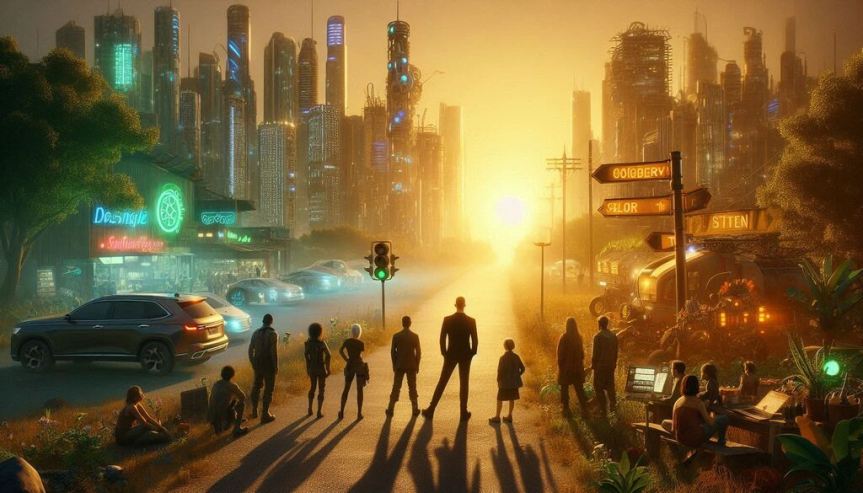
Will it be heaven or will it be a further insight into hell, the choice might still be ours to make and the only vote is for how it happens and not if?
I have so many friends now that want to work, can work and would love to work. Many of the jobs left are in care work such as nursing and not everyone is built to be a nurse, or delivery services to peoples doors and not everyone is fit enough to cycle quickly or productively enough to peoples homes. It’s not just about the jobs left but all of the jobs being lost or no longer hired for that we can’t all be doctors, nurses and delivery drivers so what does the future hold for everyone else. I don’t have any solutions but am certainly aware of the fact that right now there is a clear and present danger and problem for humanity.
Our politicians talk about the need to work our ethics teaches us that work sets you free as does our morality. But what about those left that are unable to due to circumstance out of their control what will happen for them. If we can not afford to run the machines that produce goods and services that no one can afford to buy what happens in a consumption focused society then. Our model of production, services and supply is not as resilient as we might think it is and neither are the people that purchase and consume the goods either.
There is so much chatter by economic experts of productivity, but if people are not working who or what is measured as being productive and none productive. Without an income we struggle to purchase and without our ability to purchase an economy will struggle to produce. This is a global issue and not just a local issue, we can neither run or hide from this situation. It will effect all and our only weapon or strength we have is to vote to mitigate from the impact of these changes and that will take time that many might not have.
In a future where machines handle most or all traditional jobs, society would likely undergo a fundamental shift in how we value time, income, and purpose.
1. Economic Restructuring
Universal Basic Income (UBI): Governments may implement unconditional cash payments to all citizens to maintain consumer spending and prevent poverty as wages disappear.
Automation Taxes: To fund UBI, some propose taxing the “robot labor” or the massive profits generated by AI-driven corporations.
Decoupling Income from Labor: We may move toward a “post-scarcity” economy where the cost of goods drops drastically, and survival no longer depends on holding a job.
2. Shifting Human Roles
Focus on “Human Touch”: Roles requiring deep empathy, complex ethics, and interpersonal care (like nursing, therapy, or early childhood education) are expected to remain human-centric.
Creative and Philosophical Pursuits: Freed from survival-based labor, humans could dedicate themselves to the arts, scientific exploration and personal development- though who ultimately picks up the tab for this I do not know.
Moral Custodians: Humans will still be needed to oversee AI ethics, take legal responsibility for machine decisions, and provide “human-in-the-loop” governance.
3. Immediate Practical Steps
Continuous Upskilling: Focus on “soft skills” like critical thinking, systems understanding, and adaptability, which are harder for AI to replicate.
AI Literacy: Programs like the UK’s AI Skills Hub are already emerging to help workers transition into roles that manage or implement technology.
Reducing Work Hours: Automation could naturally lead to a two- or three-day workweek as productivity gains are shared.
The future is potentially quite bleak for humanity if we don’t look to address these issues sooner rather than later. We might get a chance to know our value and see what worth we finally have to others whether we are black or white straight or gay, all are humans and have a right to life, that life has value and although there are always rules to live by and for we have the right to live that life for sure.

 Welcome to Huwspace