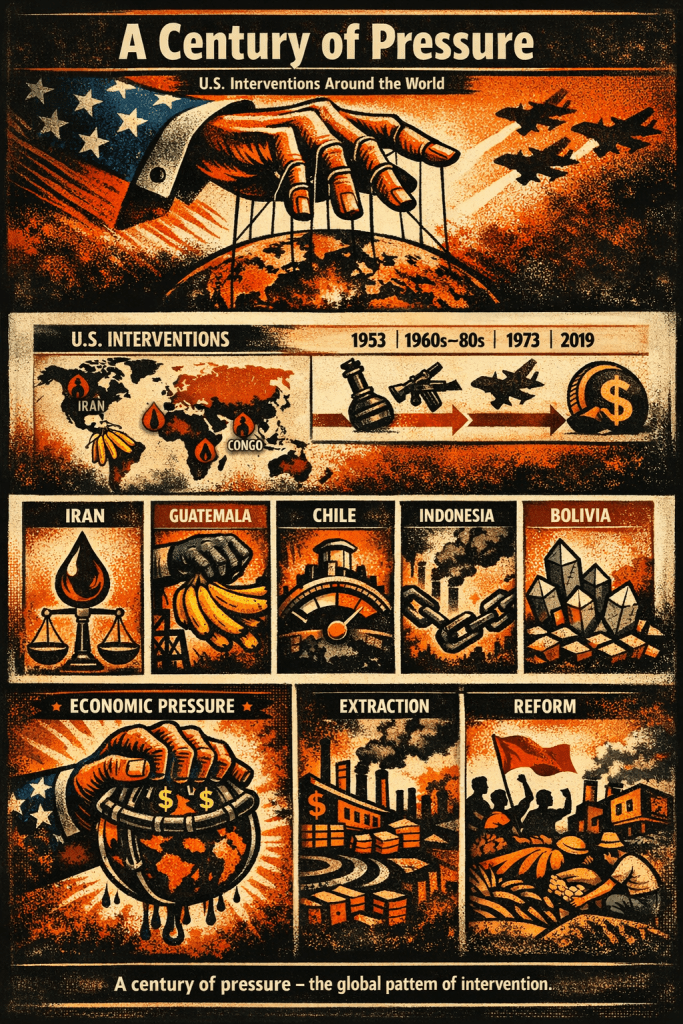

Darkside Of A Super Power: How U.S. Undermined Left‑Leaning Governments Worldwide

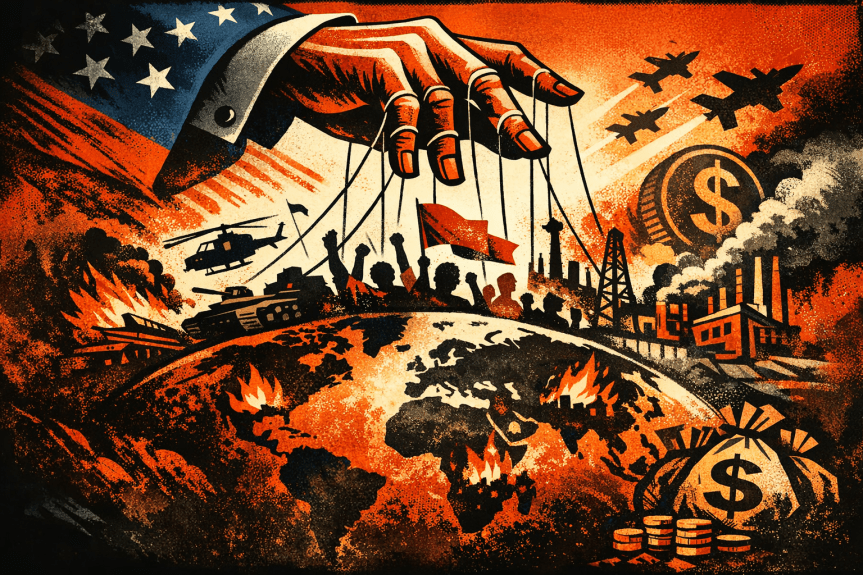
For the last hundred years, the United States has repeatedly intervened—covertly, economically, and sometimes militarily—against governments that tried to redistribute wealth, nationalise resources, or break from Western corporate and strategic influence. Historians argue that these actions were driven by Cold War ideology, corporate lobbying, and the desire to maintain a U.S.-led global order.

What was good for a country, its people and it’s ability to stand taller on it’s own two feet would not necessarily match with what would be in the interests of the US. When an agenda of profit over people would and continues to override the agenda, then something was going to have to give and yes people are going to suffer at the expense of profit. This is not a question of simply destroying possible authoritarian undemocratic non US influenced countries across the globe that worked against the interests of the US. But often a case of destroying left leaning democracies of countries that no longer saw the US as having their democracies interests at heart and looked to stand on their own two feet rather than in someone else’s corporate shadow. Israel’s belief to wipe out infrastructure and opposition across the middle east at this present time with the support and backing of Donald Trumps government appears to come across as regime destruction on steroids.

Below is tour of ten countries where left‑leaning governments attempted major reforms—and what happened next.

Iran (1953) — Oil Nationalisation Meets Cold War Anxiety

Mossadegh nationalised Iran’s oil to fund national development. The U.S. and UK removed him, restoring Western control of oil and installing the Shah. Impact: dictatorship, repression, and decades of instability.

Guatemala (1954) — Land Reform vs. United Fruit

Árbenz redistributed unused land, including United Fruit’s vast holdings. A CIA-backed coup followed. Impact: a 36‑year civil war and mass atrocities.

Congo (1960–61) — Lumumba’s Independence Project

Lumumba wanted Congo’s mineral wealth to benefit its citizens. He was removed and later killed during Cold War manoeuvring. Impact: Mobutu’s long dictatorship and entrenched poverty.

Brazil (1964) — Social Reform Meets U.S. Alarm

Goulart pushed land and tax reform and expanded voting rights. Washington supported a military coup. Impact: 21 years of authoritarian rule.

Indonesia (1965) — The Anti‑Communist Purge

Sukarno balanced nationalist and communist factions. The U.S. supported forces that eliminated the PKI. Impact: mass killings and Suharto’s authoritarian regime.

Chile (1973) — Allende’s Democratic Socialism

Allende nationalised copper and expanded social programmes. The U.S. backed efforts to destabilise his government. Impact: Pinochet’s dictatorship and widespread human rights abuses.

Nicaragua (1980s) — The Sandinista Revolution

The Sandinistas expanded healthcare, literacy, and land reform. The U.S. funded Contra forces to undermine them. Impact: civil conflict and economic collapse.

Grenada (1983) — Maurice Bishop’s Vision

Bishop promoted workers’ rights and social programmes. The U.S. invaded after internal political turmoil. Impact: end of an independent development model.

Burkina Faso (1987) — Sankara’s Anti‑Imperialism

Sankara pursued vaccination, women’s rights, and debt rejection. He was killed in a coup widely viewed as externally influenced. Impact: reversal of reforms and renewed dependency.

Bolivia (2019) — Lithium, Gas, and Indigenous Power

Morales nationalised resources and reduced poverty. He was forced out amid disputed election claims. Impact: political instability and policy reversals.

The Pattern

Across these cases, historians highlight recurring themes:

  • Resource control: oil, copper, bananas, lithium, minerals.
  • Corporate lobbying: United Fruit, ITT, major oil firms.
  • Cold War containment: fear of Soviet influence.
  • Prevention of alternative models: successful left‑leaning democracies risked inspiring others.

The result was often the same: authoritarian regimes, economic dependency, and long-term instability, while the U.S. secured strategic allies, resource access, and corporate protection.

Trump as Continuity, Not Exception

Trump’s foreign policy sits in the same long arc of U.S. interventionism—but with a different style and toolkit rather than a different underlying logic.

Continuities with past interventions

  • Same core objectives: Regime alignment, not democracy per se. Like earlier coups and covert ops, Trump’s moves aimed to weaken governments seen as hostile to U.S. interests—especially left‑leaning or anti‑U.S. ones (Venezuela, Iran, Cuba, Nicaragua)—and to favour regimes or oppositions more open to U.S. strategic and corporate priorities.
  • Economic warfare instead of classic coups: Where the 1950s–70s used CIA coups and military backing, Trump leaned heavily on sanctions, financial strangulation, and diplomatic isolation—“maximum pressure” on Iran, crushing sanctions on Venezuela, tightening the embargo on Cuba. The mechanism changed, but the goal—forcing political change by making the economy scream—echoes Chile under Allende.
  • Targeting left or left‑populist governments:
    • Venezuela: Recognition of Juan Guaidó, sanctions on oil, and open talk of regime change mirror older U.S. hostility to resource‑nationalising, left‑populist governments in Latin America.
    • Cuba & Nicaragua: Expanded sanctions and rhetorical framing of these states as part of an “authoritarian socialist” axis continues the Cold War pattern of isolating left governments in the hemisphere.
    • Iran: “Maximum pressure” and talk of regime change fit the long line from the 1953 coup through to contemporary attempts to weaken the Islamic Republic.
  • Protection of strategic and corporate interests: Just as United Fruit, copper companies, and oil majors shaped earlier interventions, Trump’s policies aligned with energy, defence, and financial interests: backing Gulf monarchies, supporting fossil‑fuel exporters, and pushing for favourable investment conditions in Latin America while punishing governments that nationalised or tightly controlled key sectors.

What’s different about the Trump era

  • More overt, less covert: Earlier interventions were often deniable; Trump frequently said the quiet part out loud—talking openly about “taking the oil,” “dominance in the western hemisphere,” or regime change in Venezuela and Iran. The underlying logic wasn’t new; the candour was.
  • Transactional framing instead of grand ideology: Cold War presidents wrapped interventions in anti‑communist rhetoric and “freedom” language. Trump framed many moves as deals, leverage, and dominance—America First rather than a universal mission—though the effect on targeted states (economic collapse, political destabilisation) often resembled earlier anti‑left operations.
  • Less state‑building, more pressure and exit: Compared with Bush’s Iraq or earlier occupations, Trump was less interested in long‑term reconstruction and more in short, sharp pressure: sanctions, recognition of rival leaders, targeted strikes (e.g. killing Soleimani) and then stepping back, leaving fractured political landscapes behind.

How to read Trump in the longer history

If you zoom out, Trump looks less like a rupture and more like a loud, stripped‑down version of an old pattern:

  • Left‑leaning or anti‑U.S. governments that control strategic resources are pressured, isolated, or targeted.
  • Economic tools (sanctions, financial blockades) now do much of the work that coups and covert ops once did.
  • The language has shifted—from anti‑communism to “terrorism,” “dictatorship,” or “socialism”—but the structural aim is similar: prevent alternative economic and political models that might weaken U.S. strategic and corporate advantage.

Huw UK Job Market review 2026

Though I have successfully managed to navigate many a storm in my employment history and keep my head above water maintaining a position in the job market for most of the last 30 years or so. Surviving the closure of companies, redundancies and also businesses no longer having enough money to hire me or restructuring me out of a roles on the odd occasion. I am more blessed with some of the areas that I have worked than cursed and have met some great people along the way and had a lot of fun at times spending some of the money that I have hard earned. I have at no time found getting a job or trying to get promoted or change jobs easy, in anyway shape or form and there are several patterns of behaviour by employers across the post industrial service sector that have developed across the service sector and government employers that are a concern for me and do not look to change in the medium to short term if any thing things are getting worse and accelerating into a darker place quicker now than ever before.

My present employer no longer employees any administration staff (by way of having admin in any job titles) to undertake work even though a considerable amount of what I would call administrative work still needs to take place in order for the organisation to function effectively and efficiently and get things done. You are either an apprentice an employment officer, employment support officer or manager, senior manager or director. More often than not you also need to have direct experience of doing a job already before they will hire you to do a job so internal recruitment opportunities are very few and far between unless, you have probably guessed it, you are already doing the job you are applying for.

I get this (I don’t like it though) and understand this how they operate and so to gain experience and improve my employability I go out of my comfort zone and so have expanded my employment experiences by in the last 10 months working part time on top of my full time job role for a housing association on a residents board that explores areas of change and improvement to be recommended to the housing association by residents and staff. I have enjoyed this role its been an unpaid post and has really helped me expand my knowledge base and experience whilst also helped me learn new skills and hopefully prove that I am employable to other potential employers in the long run.

So with my new found set of skills and employment experiences I started to try and look for other areas of work both with my own employer and also with other organisations that I would hope to work for and with. In a relatively short space of time I managed to get invited to two interviews out of three adverts that i had applied for, so not too bad success rate so far. One of the roles was an administration role which would have resulted in a pay cut and leaving the organisation I work for now and the other role was a potential promotion into an almost corporate executive role.

Well I had both interviews on the same day and the role that really stood out as a better opportunity was the one with my present employer, although in hindsight that interview went terribly right from the start and the project lead had no interest in hiring me and I think she did not even want to interview me either and I was possibly sifted out as a potentially suitable recruit by HR not her.

Just before I left the interview I spoke up saying thank you for this interview opportunity it really does feel like exciting times to work here, to which the HR person on the panel agreed and the project manager of the role quibbled in to say that the whole thing was a nightmare, leaving me with an impression that she was either overwhelmed and out of her depth or just disinterested in the whole concept of the project that she faced trying to hire a team of people to do her job for her with which was not me. Suffice to say I was told that I did not have the job and did not have the correct employment experience. So why they bothered to interview me in the first place god only knows. I also was not offered the other role due to a better candidate on the day too.

Not just viewing this from my personal experience of employment and employability over the last 30 years but the service sector or office and government based employment roles that have sustained an employment for the last 30 years no longer exist and are likely to not return under current trends and predictions.

My first job that I got that opened my world to being a productive employee in an organisation that I loved to work for and appreciated my working for them in my early 20’s I just cant see me being able to obtain the role again if I were trying to enter a role in the job market in todays environment compared with pack in the 1990’s.

My employment experience consisted of a failed degree which then led me to move in with parents and work at a local Castle on the edge of Dartmoor for a charity called the National Trust doing gardening for them, that opportunity led me to go and work for a local Estate Agents as an office junior, which then led to me then getting an awesome varied and rewarding job with the Devon Wildlife Trust as a low and behold Administrative Assistant, where I earned enough money to move out of my parents house and in with some friends, I though my career truly had begun and I felt I could work hard and be rewarded for my hard work at the same time.

The whole concept of no more admin anymore in a lot of employers across the developed world and the computerisation and automation of roles for efficiency purposes is both logical and a race to the jobless market. If we get rid of all employees or a large proportion of employees through ever innovative forms of computerisation and automation, just what are said employees or unemployees supposed to do with themselves and how will they afford to buy products and services within an economy and how will a developed economy sustain itself with an ever increasing populace that are either unable or due to the barriers they face unwilling to work and contribute income taxes into a system that has sustained people throughout my lifetime.

Better to have lived, worked and lost than to have never lived, worked and lost at all.

This is about not just living a rewarding life and navigating personal or global storms, but having enough money to live a rewarding life keeping your head above water and being done in a way that is sustainable for all not just a lucky few.

James – Sometimes

Britain Isn’t Working

Chained To A Past That Locks Away Its Future!

I’ve lived in the UK long enough to know its contradictions intimately. This is a country that can produce Oxford mathematicians, Glastonbury headliners, and Nobel‑winning scientists — yet can’t run a functioning train network on a rainy Tuesday. A country that invented the industrial revolution but now struggles to build a railway line without it becoming a national scandal.

The UK isn’t a failed state. It’s a stalled one. And the data backs that up.

This isn’t a doom‑scrolling exercise. It’s an attempt to understand why a country with so much potential consistently underperforms — and what it would take to turn it around.

Britain’s Economy Has Been Flatlining for 15 Years

Let’s start with the numbers, because they’re brutal.

  • GDP per capita in the UK has grown only 6% since 2007. The US grew 21% in the same period. Germany: 15%.
  • Productivity — the engine of living standards — has grown at 0.3% per year since 2008. Before the financial crisis, it was 2%.
  • Real wages are still below their 2008 level. That’s not normal. It’s unprecedented in modern British history.

This is the longest period of wage stagnation since the Napoleonic Wars. Think about that. Two centuries of progress — and then a flatline.

Why it matters

When productivity stalls, everything else stalls: wages, public services, investment, optimism. You can feel it in the national mood — the sense that the country is working harder but getting nowhere.

Why it’s happening

Because the UK rewards rent‑seeking (property, financial extraction) more than value creation (innovation, skills, manufacturing). Because we underinvest in infrastructure, R&D, and people. Because our planning system is a productivity‑killing machine.

What would make it better

  • A national investment strategy focused on green energy, AI, biotech, and advanced manufacturing.
  • Planning reform so we can actually build things again.
  • Tax incentives that reward innovation, not speculation.
  • A skills system that treats vocational excellence as a national asset.

Britain doesn’t lack talent. It lacks a system that knows what to do with it.

Public Services Are Failing Because They’re Designed for a Different Century

You don’t need statistics to know the NHS is struggling — but the statistics are still shocking.

  • NHS waiting lists: 7.6 million people.
  • Average time to charge an offender in England: over 400 days.
  • Local councils: 1 in 5 at risk of effective bankruptcy.
  • Train cancellations: highest on record.

This isn’t because people aren’t working hard. It’s because the system is structurally broken.

The deeper issue

Britain runs 21st‑century problems on 19th‑century institutional architecture. Westminster is hyper‑centralised, overloaded, and allergic to long‑term planning.

What would make it better

  • Multi‑year funding settlements so services can plan instead of firefight.
  • A national digital transformation programme across health, justice, and local government.
  • Workforce strategies that treat staff as humans, not line items.
  • Radical simplification: fewer agencies, clearer accountability.

We don’t need to spend like Scandinavia to get Scandinavian outcomes. We need to design like Scandinavia.

The UK Has a Confidence Problem — and It Shows Up in the Data

This is the part that feels personal.

Britain has slipped into a cultural posture of low expectations. We’ve normalised decline. We’ve become experts at explaining why things can’t be done.

And the data reflects that psychology:

  • The UK invests less than 1% of GDP in public R&D. South Korea invests 4.9%.
  • Business investment is 30% below the OECD average.
  • The UK builds half as many homes per capita as France.
  • We take longer to build infrastructure than almost any developed country.

This isn’t just economics. It’s culture. A country that doesn’t believe in its future won’t invest in it.

What would make it better

  • A national narrative of renewal, not nostalgia.
  • Civic education that builds agency and critical thinking.
  • A media ecosystem that rewards depth, not outrage.
  • A political class that talks about the future instead of the past.

Britain needs to rediscover ambition. Not arrogance — ambition.

Our Democracy Doesn’t Feel Democratic

Trust in politics is at historic lows. And again, the numbers tell the story:

  • The UK has one of the least proportional electoral systems in the developed world.
  • Millions of votes effectively don’t count in safe seats.
  • Turnout among young people is collapsing.

People aren’t apathetic. They’re alienated.

What would make it better

  • Proportional representation or a hybrid system.
  • Citizens’ assemblies for long‑term issues like climate, AI, and constitutional reform.
  • Radical transparency in political funding.
  • Digital participation tools that bring people into policymaking.

Democracy isn’t just voting. It’s agency. And Britain has been quietly stripping agency away.

The Real Problem: Britain Has No National Project

This is the heart of it.

Countries that thrive have a mission. A story about what they’re building and why it matters.

Japan: robotics and advanced manufacturing. South Korea: technology and innovation. Denmark: green energy. The US: AI, biotech, and frontier science.

The UK? We don’t know. We haven’t known for a long time.

What would make it better

Britain needs a national project big enough to unite people and concrete enough to guide policy. For example:

  • Becoming the world leader in green energy.
  • Building the most advanced digital public services on the planet.
  • Creating Europe’s innovation supercluster.
  • Designing a new social contract for the 21st century.

A country without a project becomes a museum. A country with a project becomes a magnet.

Britain Isn’t Broken — It’s Under‑Designed

This is the part where I get frustrated, because the UK’s problems are not mysterious. They’re structural, cultural, and entirely fixable.

Britain has the talent. Britain has the resources. Britain has the institutional memory.

What it lacks is the decision to reinvent itself.

A better Britain isn’t a fantasy. It’s a design challenge. And like all design challenges, it begins with imagination, clarity, and the courage to build something new.

Britain must learn from its past but not live within its past – reform the monarchy, tax those that profit from others at no expense to themselves. Free people to work and be creative. Do not punish those that can’t work because of those that won’t work. Create a state that does not promise all to everyone and consistently delivers nothing to no one.

Amy Macdonald – The Human Demands

Live, Work, Die Repeat

The UK economy consists of workers, unemployed and those that profit from the status quo.  

The UK economy in 2026 is characterized by a high-inequality structure where the richest 1% own roughly 21% of wealth, while over 14 million people live in poverty. A weakening labor market has seen unemployment rise to 5.2% with over 9 million economically inactive, often due to long-term sickness, while corporate profits have contributed significantly to cost-of-living pressures.

Those that Work (75.0% employment rate): As of Oct-Dec 2025, approximately 34.24 million people are in work, though the labor market has loosened, with payrolled employees falling in early 2026.

Those that Don’t (20.8% inactivity rate): Economic inactivity remains high, driven primarily by long-term sickness, and an aging population, with youth unemployment (18-24) hitting high levels in early 2026.

Those that Profited: Wealth concentration is high; the richest 56 billionaires hold more wealth than 27 million other people combined. This group’s wealth has grown significantly faster than earnings, benefiting from capital growth, while many households face stagnant incomes and high costs. 

The UK economy in 2026 is defined by a widening gap between earned income and accumulated wealth, with persistent “economic inactivity” and high levels of wealth concentration among a small minority. 

1. Those Who Work (The Employed)

The workforce remains the primary driver of the economy, though it faces significant pressure from “fiscal drag” and rising costs. 

Employment Rate: As of late 2025/early 2026, the UK employment rate stands at approximately 75.0%.

Tax Burden: Many workers are paying more in direct taxes due to frozen income tax thresholds (Personal Allowance remains at £12,570), a phenomenon known as “fiscal drag” that brings more people into higher tax brackets as nominal wages rise.

Income Inequality: The top 1% of income taxpayers account for 12.9% of all pre-tax income, while the bottom 10% account for just 0.3%. 

2. Those Who Don’t (The Unemployed and Inactive)

This group includes both those looking for work and a historically large number of people who are “economically inactive.” 

Unemployment: The unemployment rate has risen to 5.2% (approx. 1.88 million people), with youth unemployment (ages 16–24) being particularly high at 16%–17%.

Economic Inactivity: Roughly 20.8% of the working-age population (over 9 million people) is economically inactive.

Health Drivers: A major driver of this inactivity since 2020 has been long-term health conditions, which remain at historically high levels. 

3. Those Who Have Profited (The Wealthy)

Wealth in the UK is increasingly decoupled from active work, favoring those with existing assets like property and pensions. 

Wealth Concentration: The top 10% of households own more than one-third of the national wealth, with an average of roughly £2.3 million per person. The bottom 10% have almost no net wealth.

Asset Divide: Total household wealth is over 15 times higher for those who own their homes outright compared to those who rent.

Difficulty of Advancement: In 2008, it took 10 years of typical earnings to move from the middle to the top of the wealth distribution; by 2018, this had increased to 16 years, making it harder for working families to “climb” through labor alone.

Corporate Profiteering: Some analysis suggests a “profiteering crisis,” where corporate profits have outpaced wage growth, further concentrating gains among shareholders and asset owners. 

Survive, vote and demand change for the better for you and all.

Those of us blessed to live in democracies should vote for and advocate for positive political and economic change. With the rise of the green party as a potential political and economic force for good in the UK this can only be positive for all. Old invested interests will fight hard for the states quo to continue but what even if there reaches a threshold when even the statues quo of profiting at the expense of everything else also ultimately becomes unsustainable then change must and will come. We should vote and advocate for what shape that change must and will be in the form of.

With rising pressures on human employment stability and continued worsening growths in gaps in wealth between those that exploit others and those that are exploited, political change needs to take place to readdress a balance between the humans that have a right to live and exist over those that wish to dominate for their own self interests at the expense of others.

Have people forgotten about Gaza due to the invasion of Iran

From the murder of many thousands of civilians in Gaza not even perceived to be human by some of their killers to a change in pace and pursuit of an illegal invasion of an unlawful nation state. As of late February 2026, the estimated number of Palestinians killed in the ongoing war has reached significant levels, with official and independent sources reporting varying figures based on direct and indirect causes.

Reported Death Toll (Gaza)

  • Official Recorded Deaths: At least 73,188 Palestinians have been reported killed in the Gaza Strip since the conflict began on 7 October 2023.
  • Total Reported Deaths (Including West Bank): Some sources indicate the total number of Palestinians killed across both Gaza and the West Bank exceeds 80,692.
  • Indirect Deaths: Independent studies, including those published in The Lancet, suggest the total death toll could be significantly higher—possibly surpassing 186,000 to 335,500—when accounting for indirect causes such as starvation, disease, and the collapse of the healthcare system.
  • Demographics: Women and children are estimated to make up approximately 70% of the total fatalities

The vast majority of the West see Israel as a beacon of democracy in the middle east with a right to exist sadly leading to inherent will and right to enter ongoing wars to fight for its survival against its enemies that it sees if it does not destroy will destroy her.

While the Israel-Palestine conflict remains a critical, ongoing situation, the new, high-intensity conflict with Iran—which has included strikes on Tehran and retaliation from Iranian forces—has created a “Tale of Two Wars,” where the latter dominates international headlines and diplomatic focus.

Here is a breakdown of the situation as of March 2026:

  • Shifting Focus & “Forgotten” Fears: Palestinians in Gaza have expressed deep concern that their ongoing, dire situation is being overlooked as the world focuses on the rapidly escalating conflict between Israel, the US, and Iran.
  • Impact on Humanitarian Aid: The outbreak of the Iran conflict has had direct, immediate consequences for Gaza. Israel blocked border crossings to Gaza following air strikes on Iran, causing fear of renewed famine and causing supply lines for humanitarian aid to be severely disrupted.
  • Ongoing Catastrophe in Gaza: Despite the shift in attention, the situation in Gaza remains critical, with reports of continued, intense, and, in some cases, widening, military actions, following a two-year period of severe destruction.
  • The “Two Wars” Context: The 2026 conflict is being characterized by the simultaneous, yet competing, catastrophes of a new war with Iran and the continuing humanitarian crisis in Gaza, with the former often acting as a “shadow” that masks the ongoing devastation in the latter. 
  • While international awareness of the situation in Gaza remains, the intensity and potential for a massive, regional war with Iran have altered the primary focus of international media and political leaders, creating a perception that Palestine is being forgotten.

The main justification for war with Iran is the fear that Iran will develop a nuclear bomb capacity if not stopped. This would be an existential threat to Israel, given Tehran’s frequent rhetoric calling for the destruction of the Israeli state. So although the war with Iran might be seen as one that must be fort, must it be thought unlawfully and does it excuse or explain Israel’s actions in Palestine.

Gaza by David Rovics


The Case Against Monarchy in Modern Democracies

Many a revolution and civil war has played out across the world in many a country including the UK to sever the head of a monarch from the political control of a country. It seems bizarre in this day and age that Britain has a monarch as the head of it’s state, political and religious institutions. But what is even more bizarre is the strength of will at the heart of the establishment to maintain the status quo and make no change to this set of institutions, state of affairs or even review or to ensure transparency concerning where money goes to the monarch and how or why it is then spent.

For me this is not an argument about whether a King or Queen are good people or not but whether they have the right to be born into the role they play and I strongly believe that there should be no birth right to any position in our state let alone that of the head of state.

Arguments against supporting monarchies in democratic societies generally center on principles of equality, accountability, and the desire for a modern, meritocratic state. Critics argue that inherited power is fundamentally incompatible with the democratic ideal that all citizens are equal and that leaders should be chosen by the people.

  1. Lack of Democratic Accountability 

A core tenet of democracy is that leaders must be answerable to the people they serve. 

No Choice or Removal: Unlike elected officials, monarchs cannot be held to account or removed at the ballot box by the public.

Hereditary Risk: Relying on inheritance means there is no selection process to ensure the leader is capable; a nation risks being stuck with an incompetent, “petty,” or “vindictive” individual for decades. 

2. Incompatibility with Popular Sovereignty

Democracy is rooted in the idea that power belongs to the people, not a specific family. 

Anachronism: Critics view monarchy as a vestige of a feudal past that has no place in a modern world where legitimacy should derive from the consent of the governed.

Secrecy and Lobbying: In some systems, monarchies are exempt from transparency laws (like Freedom of Information requests), allowing for “lobbying by stealth” for private business interests. 

3. Economic and Social Costs

Opponents often point to the tangible burdens of maintaining a royal institution. 

Taxpayer Expense: Critics argue that the significant funds spent on the “extravagant lifestyle” of a royal family—including security, travel, and palace maintenance—could be better used for public services.

Colonial Legacy: For former colonies, retaining a distant monarch as a head of state can be seen as an obstacle to fully reconciling with their history and achieving true national independence. 

4. Institutional Resilience vs. Democratic Values

While some argue that constitutional monarchies provide stability, critics contend: 

Borrowed Time: Monarchies in democratic countries are often described as “operating on borrowed time,” requiring manufactured goodwill to survive.

Fragile Neutrality: A monarch’s perceived neutrality is easily shattered if they attempt to intervene in political matters, leading to constitutional crises.

Will the UK always have a monarchy?

Whether the UK will always have a monarchy is uncertain, as it is not guaranteed by law and relies on public support, which has shown a long-term decline. While it remains popular as a symbol of unity and tradition, support dropped to a record low of 54% in 2023, with around 25% favoring abolition. 

Key Factors Regarding the Future of the Monarchy:

Public Opinion & Trends: While a majority still support the institution, backing has fallen from 76% in 2012 to 54% in 2023. A growing minority, now around 25%, supports a republic, marking a 10% increase in just five years.

Constitutional Pathway: There is no legal barrier to abolition; it could be achieved through a parliamentary act and a referendum, creating a new, elected head of state.

Arguments for Removal: Critics argue the institution is incompatible with modern democratic values, lacks transparency, and that its wealth (e.g., the Duchy estates) should belong to the public.

Arguments for Retention: Proponents highlight the monarch’s role in providing political stability, acting as a non-partisan head of state, and contributing to tourism and international soft power.

Future Adaptability: The monarchy’s survival has relied on its ability to adapt to changing times, a strategy that future monarchs like Prince William will likely need to continue to maintain support.

The monarchy’s future depends on the “oxygen of public support” and its ability to remain relevant to future generations, making its permanence not guaranteed. 

Removing the power base of a born and bred King or Queen from the head of the UK will not be easy or happen overnight but it does feel like a form of constitutional madness to still have a monarch today as the head of a democratic society and is very much one that has been in place for so long it is sadly perceived to be a normal state of affairs.

Donald drill baby drill Trump

Well it’s either a coincidence that this so called “Narco-Terrorism” state of a nation has tonnes of oil or the state of Venezuela has been targeted for it’s oil reserves on the pretence of it being an illegitimate government that simply no one would care about. Such reckless statesmanship by Trump could present a green light to both China and Russia to do as they choose in their own spheres of influence tearing up all agreed post world war two international rules of law and understandings on statehood. The day is truly a dark one indeed and the world is a more dangerous place thanks to Trump.

When you begin to accept the simple truth that Donald Trump lies in his presentations and statements in order to get his own way, this whole mess that is the invasion and kidnapping of the president of Venezuela really is a shit sandwich.

News media stations over in the UK are reading out the Trumps administrations statements as newsworthy factual documents whilst many of the citizens here have or are waking up to the fact that Donald Trump is a bad man that lies a lot and a con artist – but none of that is yet coming across in the mainstream media or our political representatives.

 On January 3, 2026, the Trump administration launched Operation Absolute Resolve, a large-scale military strike and Special Forces raid in Caracas that resulted in the capture of Venezuelan President Nicolás Maduro and his wife, Cilia Flores. They were subsequently transported to New York to face federal charges. 

The Trump administration has provided several primary reasons for this intervention: 

1. Law Enforcement and “Narco-Terrorism” 

The central legal justification used by the administration is the enforcement of a 2020 U.S. Department of Justice indictment. 

Criminal Charges: Maduro and Flores were charged with narco-terrorism conspiracy, cocaine importation, and weapons offenses.

Drug Influx: Trump accused the Maduro government of leading the “Cartel de los Soles” and flooding the U.S. with illegal drugs, including fentanyl and cocaine. 

2. National Security and Migration

Border Control: Trump explicitly blamed Maduro for the surge of Venezuelan migrants to the U.S., claiming Maduro “emptied his prisons” to force inmates to migrate.

Foreign Influence: U.S. officials highlighted Maduro’s close ties to Iran, Cuba, and Russia, accusing him of providing a foothold for hostile actors (including Hezbollah) in the Western Hemisphere. 

3. Economic and Oil Interests

In public remarks following the raid, Trump stated that the U.S. would now “run” Venezuela until a “safe, proper, and judicious transition” could be made. 

Oil Reserves: Trump announced plans for U.S. oil companies to move into Venezuela—which holds the world’s largest proven crude oil reserves—to rebuild infrastructure and “take back” oil wealth.

Reimbursement: He suggested that oil proceeds would be used to reimburse the U.S. for its efforts and for American interests previously pushed out of the country. 

Current Status (as of January 6, 2026)

Court Proceedings: Maduro and Flores have pleaded not guilty in a Manhattan federal court. Maduro has characterized his capture as a “kidnapping” and himself as a “prisoner of war”.

Interim Government: Following the raid, Vice President Delcy Rodríguez was sworn in as interim president in Caracas. The Trump administration has warned her she must comply with U.S. demands—including cracking down on drug flows and removing Iranian and Cuban operatives—to avoid a similar fate.

International Legality: The operation has been widely condemned by the UN Secretary-General and various world leaders as a violation of international law and the UN Charter. 

Coldplay – Spies

Tony Benn (1925–2014)

Don’t judge someone just because they believing in social justice,

judge them if they do not.

We live in a time very much alive to billionaires finding items that we choose to consume and purchase in order to extract wealth from the rest of us.

War is often seen as a necessary expense to be endured whilst sickness and poverty a necessary evil to be politically ignored.

On War and Peace

  • Benn stated that all war represents a failure of diplomatic efforts.
  • He believed there was no moral distinction between different types of bombers that kill innocent people for political ends.
  • He differentiated between faith, which one might die for, and doctrine, for which one might kill. 
Birdy – People Help The People

Understanding U.S. Tariffs: Costs and Consequences

In 2025, U.S. tariffs are taxes levied by the federal government on imported goods at the border. While intended to protect domestic industries and reduce trade deficits, these duties directly impact American citizens through higher prices and broader economic shifts.

What are the 2025 U.S. Tariffs?

As of late 2025, the U.S. has implemented an aggressive trade regime characterized by widespread “reciprocal” and sectoral tariffs: 

  • Baseline Tariff: A minimum 10% baseline tariff applies to imports from nearly all trading partners.
  • Sectoral Tariffs: High specific duties apply to key industries, including:
    • Automobiles and Parts: 25% on most foreign-made cars and light trucks.
    • Metals: 50% on steel and aluminum (up from 25% earlier in the year).
    • Pharmaceuticals: 100% on branded or patented drugs, unless the company builds manufacturing plants in the U.S..
    • Lumber and Furniture: 10% on timber and up to 50% on kitchen cabinets and some furniture.
    • De Minimis Change: On August 29, 2025, the $800 exemption for low-value imports was removed, making small packages from retailers like Shein or Temu subject to duties.

How They Affect American Citizens

The primary impact on citizens is financial, as tariffs act as a “consumption tax” passed from businesses to individuals. 

1. Increased Costs of Living

  • Direct Price Hikes: Importers often pass the cost of the tariff directly to consumers. In 2025, households face an average estimated loss of $1,100 to $2,700 annually.
  • Specific Good Impacts: By late 2025, shoppers have seen significant price jumps in staples:
    • Groceries: Up 2.7%, with beef and coffee surging by 14% and 19%, respectively.
    • Cars: New car prices have risen by an average of $4,000 to $6,500 due to auto and metal tariffs.
    • Apparel: Clothing and leather goods prices have increased by up to 28%.

2. Regressive Tax Burden

Tariffs disproportionately affect lower-income families because they spend a larger share of their income on essential goods that are now more expensive. The poorest 20% of households face a tax increase equivalent to roughly 6% of their income, compared to only 1.7% for the top 1% of earners.

3. Labor Market and Job Security

  • Sector Gains vs. Losses: While tariffs aim to boost manufacturing jobs, research indicates that job losses in “downstream” industries (which use imported materials) often outweigh gains in protected industries.
  • Unemployment: Projections suggest the current tariff policy could lead to an increase in the unemployment rate by 0.6 percentage points by the end of 2026. 

4. Retaliation Impacts

Trading partners like China and Canada have imposed their own “tit-for-tat” tariffs on U.S. exports. This hurts American farmers and manufacturers who sell products abroad, further straining local economies. 

5. Reduced Consumer Choice 

Higher costs and trade uncertainty often lead retailers to carry fewer imported brands, resulting in fewer options and lower product variety for American shoppers. 

In essence, tariffs act as a regressive tax, raising the cost of living and operating for Americans while often failing to deliver promised economic benefits, shifting costs from foreign producers to domestic consumers and businesses. 

Taxman (Remastered 2009)

Political Strategy or Mental Illness? Analyzing Trump’s Statements

President Trump is described as “delusional” by mental health professionals, political commentators, and world leaders due to his persistent assertion of claims that directly contradict documented facts. These descriptions often center on several key behaviors:

Clinical and Psychological Perspectives

  • Fixed False Beliefs: Psychiatrists define a delusion as a “fixed false belief” that is resistant to reason or confrontation with fact. Experts have cited his insistence on “stolen” elections and exaggerated crowd sizes as fulfilling this criteria.
  • Narcissistic Personality: Many specialists argue his perceived delusions are rooted in Malignant Narcissism or Narcissistic Personality Disorder, which can lead to a “delusional detachment from reality” to protect an inflated self-image or “personal myth of greatness”.
  • The Gospel of Positive Thinking: Some analysts link his behavior to his lifelong adherence to Norman Vincent Peale’s “Power of Positive Thinking,” where reality is shaped by one’s own mental attitude, leading to a refusal to acknowledge negative outcomes. 

Recent Examples and Actions (2024-2025)

  • Economic Claims: Critics describe his 2025 assertions that tariffs “magically” bring in billions from foreign countries—rather than taxing domestic consumers—as economically “nuts” and detached from reality.
  • Polling Discrepancies: In late 2025, Trump was described as delusional for claiming he had the “highest poll numbers” of his career on Truth Social, despite concurrent data from the Associated Press and Fox News showing some of his worst approval ratings.
  • Foreign Policy Assertions: Observers pointed to “delusional fantasies” in his 2025 claims regarding foreign leaders, such as incorrectly stating he ended a war between Azerbaijan and Albania (two countries not at war) and suggesting he could “own” or “take over” the Gaza Strip for real estate development.
  • Annexation of Canada: His public discussion in 2025 about Canada potentially becoming the “51st state” was cited as an example of a belief system that ignores the reality of sovereign nations and public opinion.

Debates and Counterpoints

  • Political Strategy vs. Mental Illness: Some observers argue he is “crazy like a fox,” using conspiracy theories and falsehoods as calculated tools for political success rather than out of a true clinical delusion.
  • The Goldwater Rule: The American Psychiatric Association’s “Goldwater Rule” prohibits members from diagnosing public figures without a personal examination, causing some professionals to push back against colleagues who label the president “delusional” publicly.
  • “Trump Derangement Syndrome”: Supporters often use this term to argue that it is actually his critics who are delusional, reacting irrationally to his unconventional but effective political style. 
Buffalo Springfield – For What It’s Worth (Official Audio)