Understanding the Surge of Global Conflicts Amidst Climate Crises

The 2020s have unfolded as a decade of overlapping crises — pandemics, political instability, economic shocks, and a sharp resurgence of war. But beneath the headlines lies a deeper question: are wars genuinely more common today, and if so, are climate pressures and diminishing resources part of the cause?

Conflict research suggests the answer to the first question is yes. The second is more complicated.

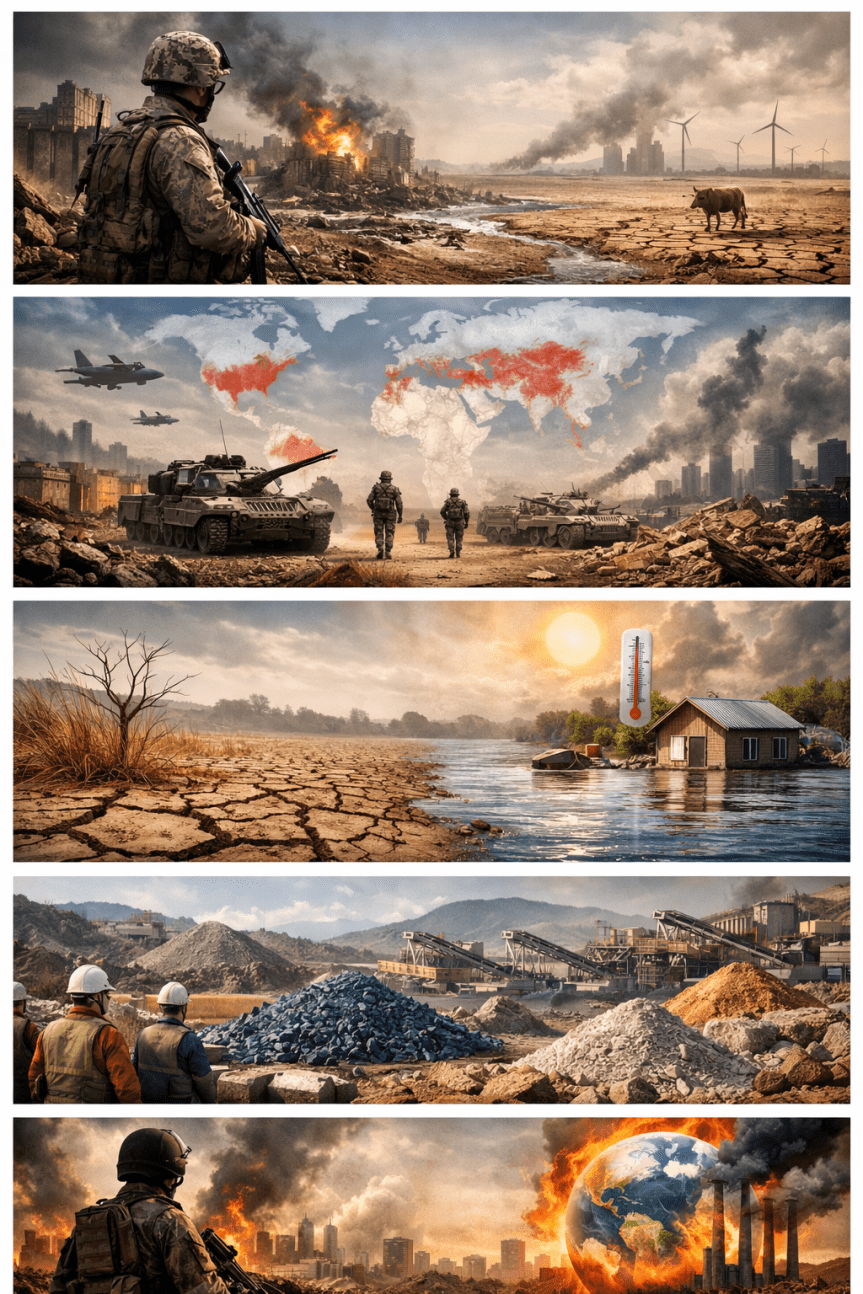
Recent data from global conflict monitors shows that state‑based wars have reached their highest levels since World War II, driven by major conflicts in Ukraine, Gaza, Sudan, Ethiopia, and Myanmar. Wars and armed conflicts have become significantly more common and deadly since 2020, reaching their highest levels since World War II. This marks a clear break from the relative stability of the early 2000s and 2010s.

The New Landscape of War

The post‑2020 conflict environment is defined by several striking shifts:

  • Record-high active state conflicts
  • Annual battle deaths exceeding 240,000
  • Foreign interventions doubling since 2008
  • Global military spending rising to $2.9 trillion

These trends point to a world where diplomacy is weakening, geopolitical rivalry is intensifying, and international norms are eroding.

One particularly alarming metric is that peace agreements are failing, with only 4% of conflicts ending via treaties compared to 23% in the 1970s.

The machinery of peace is breaking down. There seems to be less will for peace and greater investment in sustained conflict.

Climate Change: Not the Spark, but the Fuel

Climate change and resource scarcity are often cited as causes of modern conflict. Yet the evidence shows they are not primary drivers — they are risk multipliers.

Climate as a Threat Multiplier

Climate change rarely ignites wars directly. Instead, it destabilises societies already under strain:

  • Droughts destroy crops and livelihoods
  • Floods displace communities
  • Desertification pushes pastoralists into farming regions
  • Extreme weather undermines fragile governments

Climate change does not typically cause direct inter-state warfare. Instead, it worsens underlying social and economic vulnerabilities.

When livelihoods collapse, recruitment by armed groups becomes easier. When governments fail to respond, grievances deepen. When desperation rises, violence follows.

Scarcity — and Abundance — of Resources

Resource scarcity fuels localised conflicts, especially in fragile regions:

  • Water shortages
  • Loss of arable land
  • Competition between herders and farmers

But abundance can be even more dangerous.

The global race for lithium, cobalt, nickel, and rare minerals — essential for green technology — has intensified geopolitical competition. In places like the DRC, resource wealth funds armed groups and prolongs war.

The War–Climate Feedback Loop

The relationship between war and climate is not one‑directional. It is a destructive cycle.

Global militaries account for roughly 5.5% of all global greenhouse gas emissions… war heavily accelerates climate change.

Conflict destroys infrastructure, burns cities, and releases massive emissions. Rebuilding after war produces even more.

Climate change increases conflict risk. Conflict accelerates climate change. A vicious loop.

Some might argue that the real drivers of Post‑2020 conflict are as follows – but these assumptions lead to more questions than answers

Despite environmental pressures, the perceived influential drivers of modern war remain political:

  • Weak governance and corruption
  • Breakdown of diplomacy
  • Major powers ignoring international norms
  • Foreign interventions escalating local conflicts
  • Rising authoritarianism and geopolitical rivalry

Climate change amplifies these forces, but for me increasing wars and fights for resources were very much predicted to be on the cards years ago as an output due to climate crisis, global warming and a hunt for resources.

Conclusion: A Hotter World, A Colder Politics

Wars are more common in the 2020s — not because the planet is simply running out of resources, but because political systems are failing to manage the pressures of a warming, crowded, unequal world.

Climate change doesn’t start wars. But it makes them easier to start, harder to stop, and far more devastating.

The 2020s show us a world where environmental stress and geopolitical instability now move in tandem. Understanding this relationship is essential if we hope to break the cycle.

Darkside Of A Super Power: How U.S. Undermined Left‑Leaning Governments Worldwide

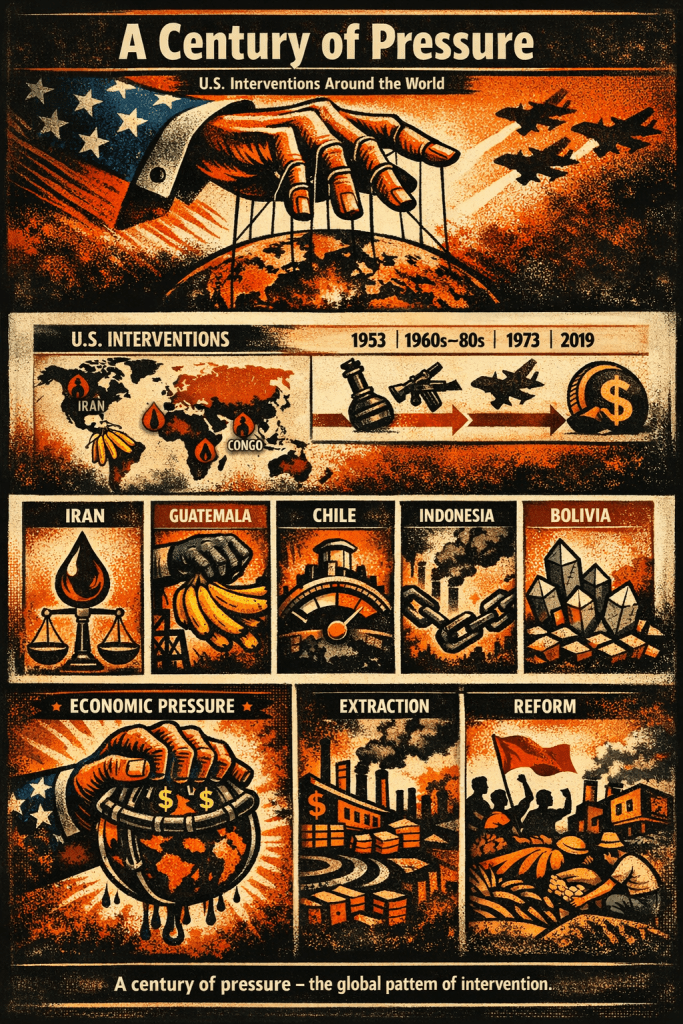
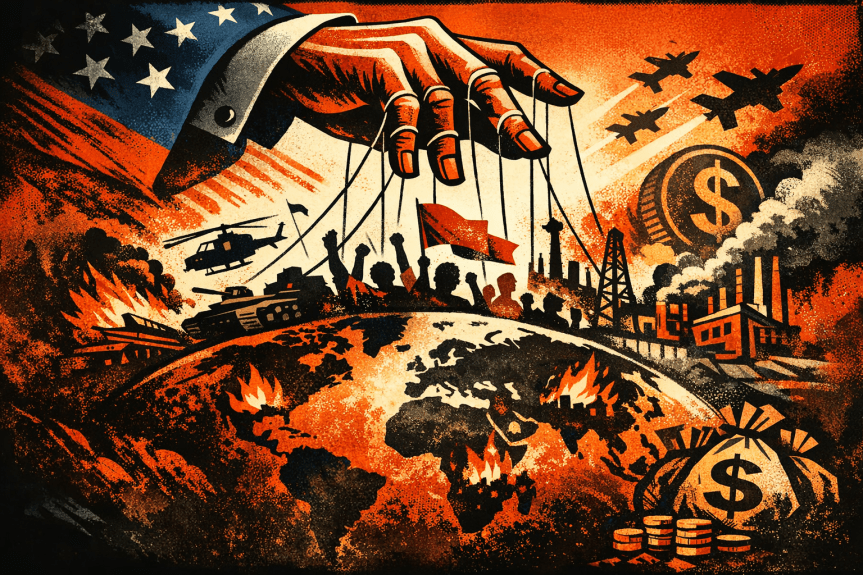
For the last hundred years, the United States has repeatedly intervened—covertly, economically, and sometimes militarily—against governments that tried to redistribute wealth, nationalise resources, or break from Western corporate and strategic influence. Historians argue that these actions were driven by Cold War ideology, corporate lobbying, and the desire to maintain a U.S.-led global order.

What was good for a country, its people and it’s ability to stand taller on it’s own two feet would not necessarily match with what would be in the interests of the US. When an agenda of profit over people would and continues to override the agenda, then something was going to have to give and yes people are going to suffer at the expense of profit. This is not a question of simply destroying possible authoritarian undemocratic non US influenced countries across the globe that worked against the interests of the US. But often a case of destroying left leaning democracies of countries that no longer saw the US as having their democracies interests at heart and looked to stand on their own two feet rather than in someone else’s corporate shadow. Israel’s belief to wipe out infrastructure and opposition across the middle east at this present time with the support and backing of Donald Trumps government appears to come across as regime destruction on steroids.

Below is tour of ten countries where left‑leaning governments attempted major reforms—and what happened next.

Iran (1953) — Oil Nationalisation Meets Cold War Anxiety

Mossadegh nationalised Iran’s oil to fund national development. The U.S. and UK removed him, restoring Western control of oil and installing the Shah. Impact: dictatorship, repression, and decades of instability.

Guatemala (1954) — Land Reform vs. United Fruit

Árbenz redistributed unused land, including United Fruit’s vast holdings. A CIA-backed coup followed. Impact: a 36‑year civil war and mass atrocities.

Congo (1960–61) — Lumumba’s Independence Project

Lumumba wanted Congo’s mineral wealth to benefit its citizens. He was removed and later killed during Cold War manoeuvring. Impact: Mobutu’s long dictatorship and entrenched poverty.

Brazil (1964) — Social Reform Meets U.S. Alarm

Goulart pushed land and tax reform and expanded voting rights. Washington supported a military coup. Impact: 21 years of authoritarian rule.

Indonesia (1965) — The Anti‑Communist Purge

Sukarno balanced nationalist and communist factions. The U.S. supported forces that eliminated the PKI. Impact: mass killings and Suharto’s authoritarian regime.

Chile (1973) — Allende’s Democratic Socialism

Allende nationalised copper and expanded social programmes. The U.S. backed efforts to destabilise his government. Impact: Pinochet’s dictatorship and widespread human rights abuses.

Nicaragua (1980s) — The Sandinista Revolution

The Sandinistas expanded healthcare, literacy, and land reform. The U.S. funded Contra forces to undermine them. Impact: civil conflict and economic collapse.

Grenada (1983) — Maurice Bishop’s Vision

Bishop promoted workers’ rights and social programmes. The U.S. invaded after internal political turmoil. Impact: end of an independent development model.

Burkina Faso (1987) — Sankara’s Anti‑Imperialism

Sankara pursued vaccination, women’s rights, and debt rejection. He was killed in a coup widely viewed as externally influenced. Impact: reversal of reforms and renewed dependency.

Bolivia (2019) — Lithium, Gas, and Indigenous Power

Morales nationalised resources and reduced poverty. He was forced out amid disputed election claims. Impact: political instability and policy reversals.

The Pattern

Across these cases, historians highlight recurring themes:

  • Resource control: oil, copper, bananas, lithium, minerals.
  • Corporate lobbying: United Fruit, ITT, major oil firms.
  • Cold War containment: fear of Soviet influence.
  • Prevention of alternative models: successful left‑leaning democracies risked inspiring others.

The result was often the same: authoritarian regimes, economic dependency, and long-term instability, while the U.S. secured strategic allies, resource access, and corporate protection.

Trump as Continuity, Not Exception

Trump’s foreign policy sits in the same long arc of U.S. interventionism—but with a different style and toolkit rather than a different underlying logic.

Continuities with past interventions

  • Same core objectives: Regime alignment, not democracy per se. Like earlier coups and covert ops, Trump’s moves aimed to weaken governments seen as hostile to U.S. interests—especially left‑leaning or anti‑U.S. ones (Venezuela, Iran, Cuba, Nicaragua)—and to favour regimes or oppositions more open to U.S. strategic and corporate priorities.
  • Economic warfare instead of classic coups: Where the 1950s–70s used CIA coups and military backing, Trump leaned heavily on sanctions, financial strangulation, and diplomatic isolation—“maximum pressure” on Iran, crushing sanctions on Venezuela, tightening the embargo on Cuba. The mechanism changed, but the goal—forcing political change by making the economy scream—echoes Chile under Allende.
  • Targeting left or left‑populist governments:
    • Venezuela: Recognition of Juan Guaidó, sanctions on oil, and open talk of regime change mirror older U.S. hostility to resource‑nationalising, left‑populist governments in Latin America.
    • Cuba & Nicaragua: Expanded sanctions and rhetorical framing of these states as part of an “authoritarian socialist” axis continues the Cold War pattern of isolating left governments in the hemisphere.
    • Iran: “Maximum pressure” and talk of regime change fit the long line from the 1953 coup through to contemporary attempts to weaken the Islamic Republic.
  • Protection of strategic and corporate interests: Just as United Fruit, copper companies, and oil majors shaped earlier interventions, Trump’s policies aligned with energy, defence, and financial interests: backing Gulf monarchies, supporting fossil‑fuel exporters, and pushing for favourable investment conditions in Latin America while punishing governments that nationalised or tightly controlled key sectors.

What’s different about the Trump era

  • More overt, less covert: Earlier interventions were often deniable; Trump frequently said the quiet part out loud—talking openly about “taking the oil,” “dominance in the western hemisphere,” or regime change in Venezuela and Iran. The underlying logic wasn’t new; the candour was.
  • Transactional framing instead of grand ideology: Cold War presidents wrapped interventions in anti‑communist rhetoric and “freedom” language. Trump framed many moves as deals, leverage, and dominance—America First rather than a universal mission—though the effect on targeted states (economic collapse, political destabilisation) often resembled earlier anti‑left operations.
  • Less state‑building, more pressure and exit: Compared with Bush’s Iraq or earlier occupations, Trump was less interested in long‑term reconstruction and more in short, sharp pressure: sanctions, recognition of rival leaders, targeted strikes (e.g. killing Soleimani) and then stepping back, leaving fractured political landscapes behind.

How to read Trump in the longer history

If you zoom out, Trump looks less like a rupture and more like a loud, stripped‑down version of an old pattern:

  • Left‑leaning or anti‑U.S. governments that control strategic resources are pressured, isolated, or targeted.
  • Economic tools (sanctions, financial blockades) now do much of the work that coups and covert ops once did.
  • The language has shifted—from anti‑communism to “terrorism,” “dictatorship,” or “socialism”—but the structural aim is similar: prevent alternative economic and political models that might weaken U.S. strategic and corporate advantage.

Israel’s broken clock

If Israel dictates the terms of what is a just war in the Middle East at this moment in time across our media outlet’s, then our media outlets are wrong and in this particular circumstance are not telling the truth.

The bombing of Iran by the US and Israel is a brutal distraction from the coordinated genocide of the people and country of Palestine. While a bombing raid takes place in Iran the starvation and genocide of the Palestinian people is temporarily not needed to be explained and justified in the media. They say a broken clock face is said to tell the time correctly twice a day. The meaning of the broken clock symbolism is that just because someone or something is frequently wrong. or unreliable, it doesn’t mean they can’t occasionally be right. or provide valuable insight. The phrase comes from the idea of a clock. that has stopped working. and his hands are stuck at a specific time. Even though it doesn’t tell the correct time.

So for now in my country international news broadcasters are all reporting on the importance of why strikes are taking place in Iran. The Israel and US regimes perspective of what is the right thing to do concerning preventing Iran from having a nuclear weapon is a brutal show of force from those with might against those that do not have such mighty weapons. As well as an attempt to destroy nuclear facilities it is also an attempt at regime change.

I have been watching the Star Wars second series of Andor at the moment the political similarities between what is happening in Israel and the US and what is happening in the middle east with the ripples of potential consequences across the whole world is unnerving.

The British government is still supplying many weapons to Israel although it says it has stopped some. Again they continue to still sell others to them though. If profit is king instead of a belief in the importance and sanctity of human life being sacrosanct and far more important than a few dollars for arms deals then it seem my government and western media outlets are promoting and dictating nothing of value at this moment in time on the middle east bombings and wars propelled and started by Israel.

The expression of the media to style the victims as aggressors and aggressors as victims is a sad reality of how our media portrays reality to express the will of the status quo and not reach out for peace and prevention of genocide sentiments and justifying western and Israel actions across the media and then explained, played down or justified by our state governments.