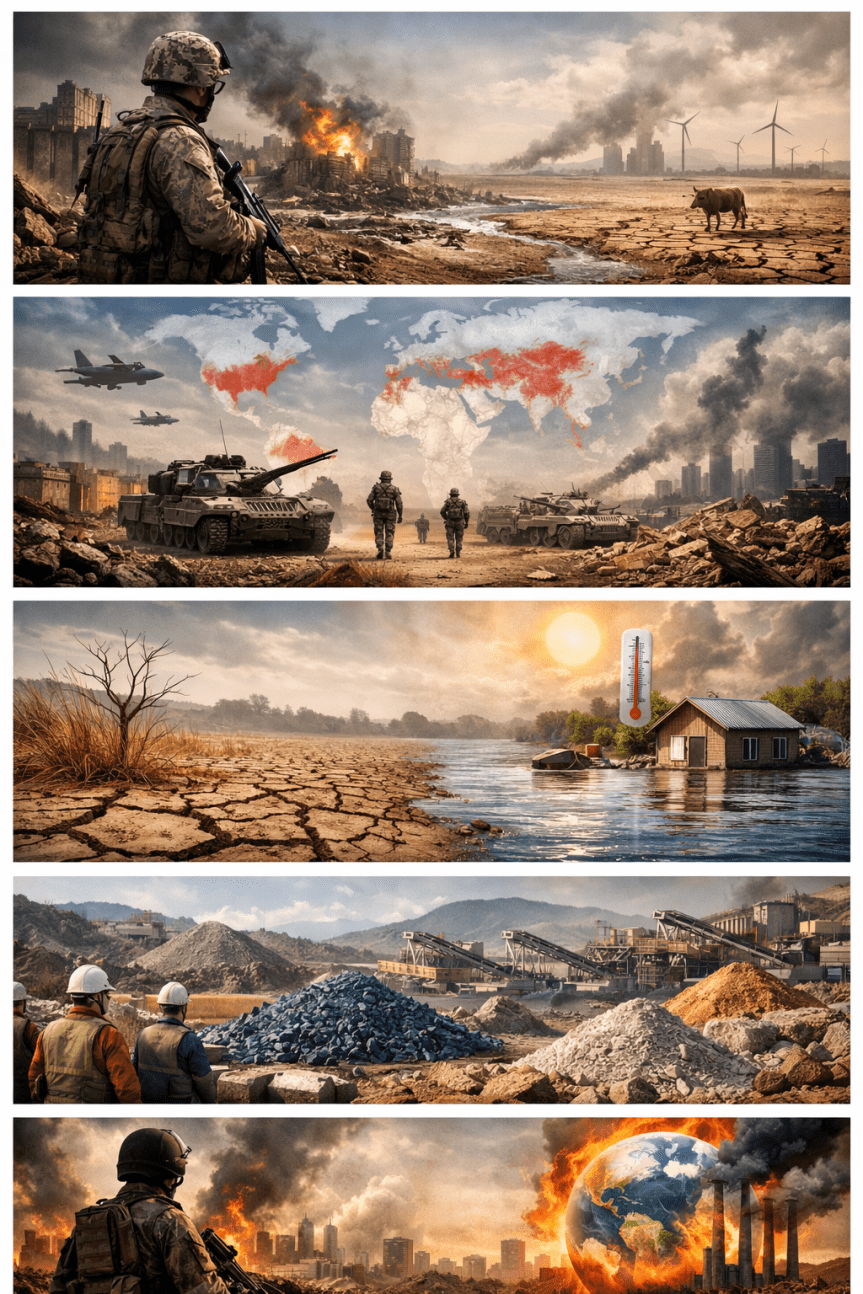
Understanding the Surge of Global Conflicts Amidst Climate Crises

The 2020s have unfolded as a decade of overlapping crises — pandemics, political instability, economic shocks, and a sharp resurgence of war. But beneath the headlines lies a deeper question: are wars genuinely more common today, and if so, are climate pressures and diminishing resources part of the cause?

Conflict research suggests the answer to the first question is yes. The second is more complicated.

Recent data from global conflict monitors shows that state‑based wars have reached their highest levels since World War II, driven by major conflicts in Ukraine, Gaza, Sudan, Ethiopia, and Myanmar. Wars and armed conflicts have become significantly more common and deadly since 2020, reaching their highest levels since World War II. This marks a clear break from the relative stability of the early 2000s and 2010s.

The New Landscape of War

The post‑2020 conflict environment is defined by several striking shifts:

  • Record-high active state conflicts
  • Annual battle deaths exceeding 240,000
  • Foreign interventions doubling since 2008
  • Global military spending rising to $2.9 trillion

These trends point to a world where diplomacy is weakening, geopolitical rivalry is intensifying, and international norms are eroding.

One particularly alarming metric is that peace agreements are failing, with only 4% of conflicts ending via treaties compared to 23% in the 1970s.

The machinery of peace is breaking down. There seems to be less will for peace and greater investment in sustained conflict.

Climate Change: Not the Spark, but the Fuel

Climate change and resource scarcity are often cited as causes of modern conflict. Yet the evidence shows they are not primary drivers — they are risk multipliers.

Climate as a Threat Multiplier

Climate change rarely ignites wars directly. Instead, it destabilises societies already under strain:

  • Droughts destroy crops and livelihoods
  • Floods displace communities
  • Desertification pushes pastoralists into farming regions
  • Extreme weather undermines fragile governments

Climate change does not typically cause direct inter-state warfare. Instead, it worsens underlying social and economic vulnerabilities.

When livelihoods collapse, recruitment by armed groups becomes easier. When governments fail to respond, grievances deepen. When desperation rises, violence follows.

Scarcity — and Abundance — of Resources

Resource scarcity fuels localised conflicts, especially in fragile regions:

  • Water shortages
  • Loss of arable land
  • Competition between herders and farmers

But abundance can be even more dangerous.

The global race for lithium, cobalt, nickel, and rare minerals — essential for green technology — has intensified geopolitical competition. In places like the DRC, resource wealth funds armed groups and prolongs war.

The War–Climate Feedback Loop

The relationship between war and climate is not one‑directional. It is a destructive cycle.

Global militaries account for roughly 5.5% of all global greenhouse gas emissions… war heavily accelerates climate change.

Conflict destroys infrastructure, burns cities, and releases massive emissions. Rebuilding after war produces even more.

Climate change increases conflict risk. Conflict accelerates climate change. A vicious loop.

Some might argue that the real drivers of Post‑2020 conflict are as follows – but these assumptions lead to more questions than answers

Despite environmental pressures, the perceived influential drivers of modern war remain political:

  • Weak governance and corruption
  • Breakdown of diplomacy
  • Major powers ignoring international norms
  • Foreign interventions escalating local conflicts
  • Rising authoritarianism and geopolitical rivalry

Climate change amplifies these forces, but for me increasing wars and fights for resources were very much predicted to be on the cards years ago as an output due to climate crisis, global warming and a hunt for resources.

Conclusion: A Hotter World, A Colder Politics

Wars are more common in the 2020s — not because the planet is simply running out of resources, but because political systems are failing to manage the pressures of a warming, crowded, unequal world.

Climate change doesn’t start wars. But it makes them easier to start, harder to stop, and far more devastating.

The 2020s show us a world where environmental stress and geopolitical instability now move in tandem. Understanding this relationship is essential if we hope to break the cycle.

What if 24 hour satellite television news had existed in 1945?

When Hitler invaded Poland and started World War 2 would the news stations have been beaming around the world his justification for going to war and would we have been relying on journalists cleared by or operating within the rules of what the Nazis deemed as appropriate to broadcast to ‘inform’ us of what is going on in Germany and the countries being conquered by the Nazi regime. What a question to consider you might say.

But it really does feel in Russia, Israel and to some extent news from the White House in the USA, it is very much in a one directional form of information presentation. Which we are handed on a plate and if unpalatable then tough luck sucker this is the perspective we are telling you is truth today.

For example Russia entered a righteous war in Ukraine and did not invade a sovereign state for its strategic advancement. You think the fascists in Russia are bad you should watch the videos about the fascists in Ukraine their much much worse than the Russian ones or so the propaganda machine journalists of the Russian state would have people believe as some conspiracist lap this up as so called food for thought.

In Gazza there is an outright genocide through starvation and bombing which our satellite television channels keep on tuning into Israel governments propaganda machine very much like if during World War 2 a Nazi spokesperson explaining live on TV the importance of workcamps to set people free and house jews within them and completely denying the gas chambers as malicious gossip.

In the USA millions of dollars of oversee life saving food, aid and healthcare programmes have been stopped overnight which will lead to the death of citizens across the globe whilst ICE’s US deportation teams kick people out of the country or detain them within the country with out due legal process if not costing lives certainly severally impacting on lives and the big lie reported live on satellite TV by the US governments team is that illegal immigrants are all rapists, murders and drug dealers and therefore need to go.

Its never been easier to report bullshit as fact and facts as bullshit on the TV. Truth is still truth though and facts are still facts, it just so happens I seem to spend more time these days trying to tune out the lies and bullshit than I do tune into fact and truths.

I’m as mad as hell, and I’m not going to take this anymore! Speech from Network (1976)

Make America Hate

Trump is an isolationist at heart. There are many things which Trump does not, cannot or has no will to understand when it comes to his world view and he views others as being weak or insignificant, if they do not think and feel the same as him and his outward reaction to those who do not share in his world view is divisive and in the short, medium and long-term extremely damaging to the US, it’s allies and enemies alike. No good will come from Trumps actions and inaction as he seeks to impose his world view on all of us.

With great power comes great responsibility normally and Trump is not responsible to anything or anyone if anything he is a reckless bully or reckless bull in a china shop. His actions and lack of political accountability when signing of executive order after executive order is mind boggling. His overstepping of his executive power with the sacking of state employees, shutting down of government programs is done on a whim and not with any true political oversight judgment or accountability.

With Trump offering trade wars to break up years of stable trading relations and treaties with Canada for what appear to be petty reasoning’s in response to complex problems for the USA e.g. Trump wants Canada to become part of the USA to be used as a strategic asset and profit from this and is punishing Canada for not being part of the USA. Trump is only able to do a lot of the negative things that he is doing because his country the USA is the most powerful trading nation in the world and he is using that power as leverage. If the UK or any other nation in the world tried to do this they would be punished by others and time will see if the US will be punished and how.

His cruel turn on Canada a historic partner and ally is in complete opposition to his views on Russia – Russia really does have an elusive hold over Trump. Not that any conspiracy theorists talk about it but I do wonder if Trumps first wife or current wife could be Russian sympathizers or even agents infiltrating Trumps inner circle and making him a bonified follow of Putin’s Russia as he really does love and respect Russia’s way of doing business and has an affection for Putin.

It’s not just Putin that Trump shows support for he likes and is attracted to the political perspective of authoritarian leaders across the globe and one most damagingly supporting is that of Netanyahu in Israel he does not force a peace deal on Israel and continues to offer them an open-ended offer of arms and a blank cheque to fight against those that wish for autonomy and self governance in Gaza. So he is a man of peace when it suits him in Ukraine but also a man of war when it suits him and the politicians he shows favor to and supports when seeking war in Gaza.

Just a final thoughts I am in no way mad at or wish to upset American citizens the reasons that brought people to vote and not vote for Trump are complex and diverse. I aim to respect and understand what drives people to resort to needing a leader like Trump to vote for whilst at the same time wholeheartedly hating and fearing what Trump is capable of, what he has already done and what he will do next he neither has a moral compass nor proven limits on his power yet.


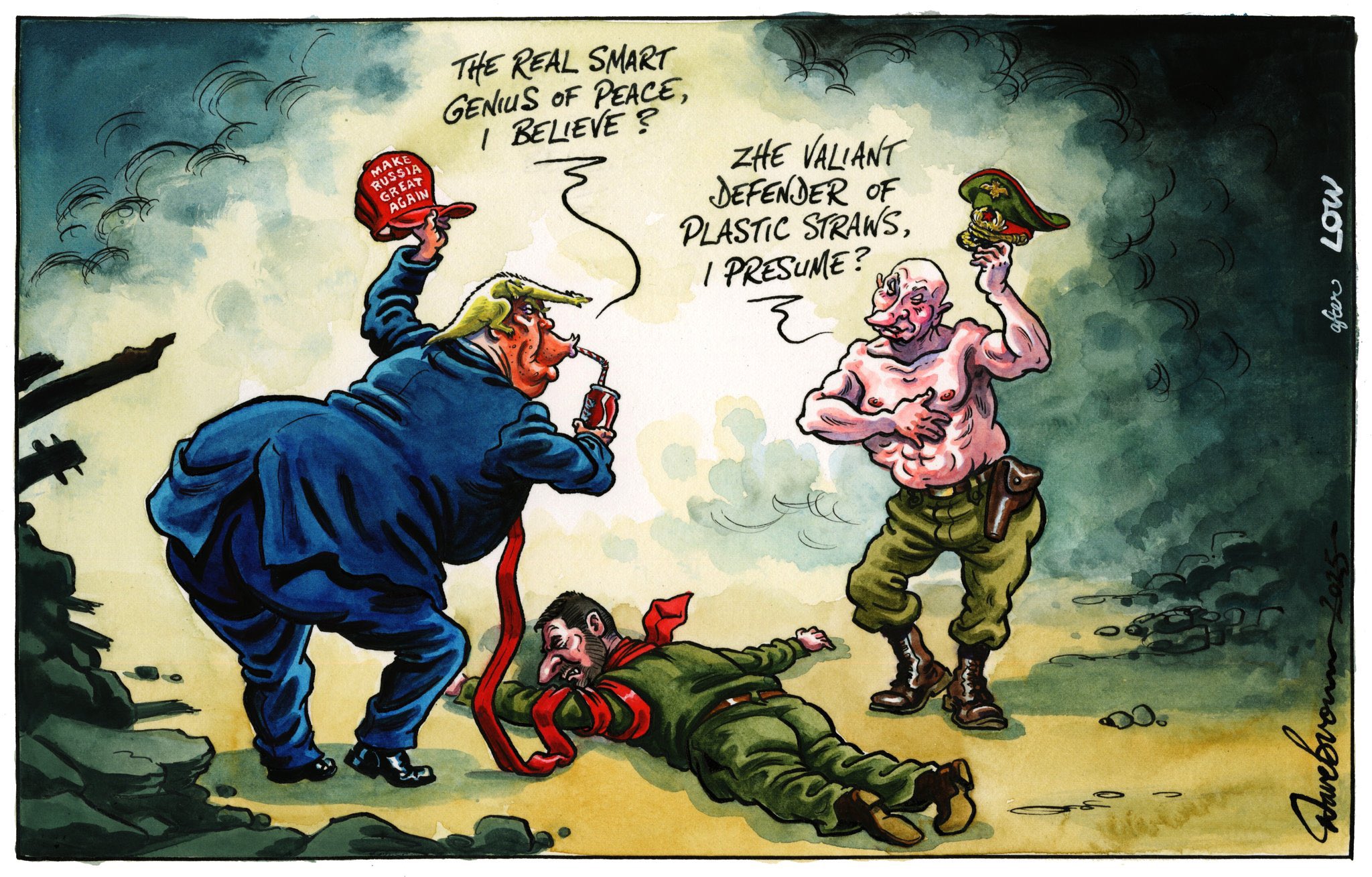
Trump’s Position: to embrace Putin over Zelensky

Trump is very attracted to Putin’s style of political manoeuvrings and that suits Putin at present – he is also very much moving towards Putin while moving away from Zelensky. Russia will aim to play Trump and his cards for all he is worth until he is spent.

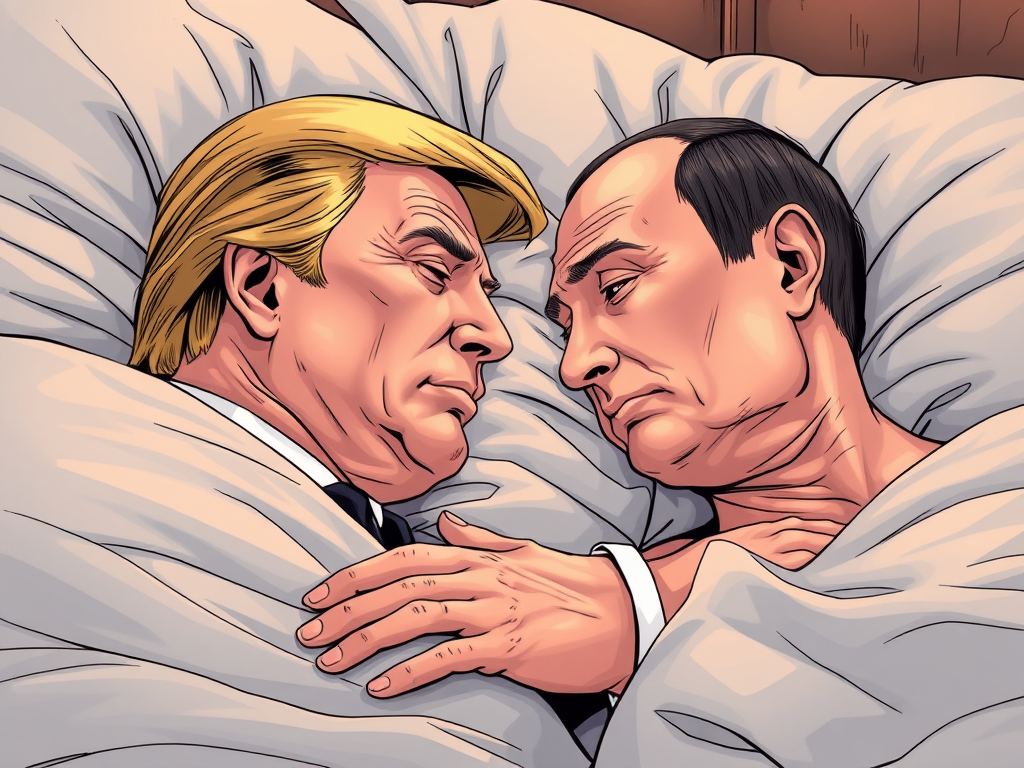
Pass me a cigarette darling

President Donald Trump has said Ukraine not Russia started the war. He’s called Ukrainian President Volodymyr Zelenskyy not Vladimir Putin a dictator. Meanwhile, Trump’s administration is standing down on a suite of tough anti-Kremlin policies.

In just over a month, Trump has executed a startling realignment of American foreign policy, effectively throwing U.S. support behind Moscow and rejecting the tight alliance with Kyiv cultivated by former President Joe Biden.

Trump may argue that by agreeing with Putin and disagreeing with Zelensky’s view of the war that he is in fact remaining neutral but that is just in my mind a convenient lie. Trump knows we must all have perspectives, truths, opinions and sides and all his point to being closely aligned with Putin.

He also implies that he sees Europe as a weak democratic collection of nations very much in the mould of what the USA was before he started trying to make it great again. Describing immigration as in some way diluting the purity of the soul of a society and not in any strengthening it or making it better.

Flows of citizens across the globe are historically natural processes and in no way should be seen as immoral or deviant. The greater the level of upheaval, uncertainty, war and famine that happen this century will result in a greater flow of people across the globe – an America first policy and cutting of aid to the world is short sighted and will only result in more people looking to escape to America to escape the hell created somewhere else on the globe due to Trumps foreign policy’s lack of initiatives or initiatives.

Trumps policies are a direct result of conservative me first view that there is not enough money to solve the worlds problems and so why bother trying to solve any of them. As a fascist capitalist he shows no signs of care or empathy for others wadding in with trade tariffs on other nations to profit from them and taking away foreign aid and assets from them as he has no interest in helping them either, thus increase a cycle of suffering which will lead to more fleeing desperate places and ending up on the doors and shores of the USA.

Europe’s heart vs. Putin’s arsenal and Trump’s ego

Can Europe find what is at its heart as it tries to face Putin arsenal and negotiate away through Trump’s ego and attitude? The next four years of Trump being in power could be painful, worryingly unpredictable and unwrap over 80 years of global rules of law that brought stability in Europe in a way that damages all in the long run. Some might profit from this, whilst many will lose. Elections have resulted in people voting for change, whilst not knowing what that change will look like or more to the point what can be delivered or gotten away with. Change is constant and inevitable in life, you just hope to adapt or improved your present situation facing you.

This present modern phase of political problems and proposed solutions appears to be an age of populism where misinformation, impossible promises are made that cannot be delivered and then a blame game of blaming  “others” for what is happening to you.

The wealthy that are now in the mainstream of political power in Russia and the US are no longer playing from the sidelines anymore but are out in the open seeking to deregulation business, destroy or ignore international trade and climate cooperation and treaties, whilst making it easier for them to make even more money and further line the pockets of oligarchs and multimillionaires across the globe, who or what will they profit from or take power away from when they are profiting from and take power away from the people you are their commodities and it is from what they do to you that they will profit. They will take your freedom, finances and rights of autonomy whilst blaiming others and if need be you for what they do to you!

 The European Union’s world view against Putin and it’s need to try to advocate the defence of  Ukraine is because of a pivotal stand against aggression that threatens the very fabric of international law and European security. When considering both Vladimir Putin and Donald Trump in this context, the EU’s worldview encompasses concerns about authoritarianism, the undermining of democratic institutions, and the importance of solidarity among democratic nations and their citizens.

The EU perceives Putin’s actions—beginning with the annexation of Crimea in 2014 and escalating to the full-scale invasion of Ukraine in 2022—as blatant violations of a sovereign nation’s territorial integrity. This aggression is not just an assault on Ukraine but a challenge to the post-World War II international order that prohibits the forcible acquisition of territory.

Putin’s military endeavours are seen as a threat that extends beyond Ukraine’s borders, destabilizing the entire European continent. The EU fears that unchecked aggression could set a dangerous precedent, encouraging other nations to disregard international norms and territorial boundaries. For the EU, supporting Ukraine is synonymous with defending democracy, human rights, and the rule of law right on the edge of Europe. Ukraine also aspires to integrate more closely with Western institutions aligns with the EU’s vision of a Europe whole, free, and at peace.

The EU has implemented comprehensive sanctions targeting key sectors of the Russian economy, provided humanitarian and military aid to Ukraine, and sought to isolate Russia diplomatically. These actions aim to pressure Russia to cease its aggression while supporting Ukraine’s defence and resilience. The US nwo looks to potentially reward Russia for it’s stance in creating new trade relations with Putin’s Russia and brining Russia in from the political cold by saying it’s war with Ukrain is not it’s fault and generating new business contracts with Russia benfiting Trump’s USA and Putin’s Russia and giving Russia a renewed voice and prestige on the global stage.

The EU’s stance is about more than just Ukraine or Russia—it’s about affirming a commitment to a world order based on rules, mutual respect, and peaceful coexistence. By taking a firm position against Putin’s actions, the EU hopes to discourage similar aggression elsewhere and promote a stable international environment.

The situation also raises fascinating questions about the shifting dynamics of global power. How might this conflict influence relationships between other major players on the world stage, like China or the United States? And what could this mean for the future of international alliances and partnerships?

If Russia is seen as winning or having won vs Ukraine will this then embolden China to invade Taiwan, will Trump turn Gaza into a new hot piece of real-estate for the wealthy in the middle east and will trade wars be based on Trump’s might and not upon whether his actions are of those of someone who is in the right.

Quite frankly Trump does not like or approve of democratic niceties or the rule of law which is very much at the heart of what the European Union stands for. Having had two world wars start and bloody the soil of Europe, Europe has learned a considerable amount about the importance of emancipation and freedom from tyranny and the will and power to dominate over others in a way that perhaps Trumps US, has yet to learn and Putin’s Russia has been blind by a will for vengeance against the EU for alleged harm and transgressions done to it due to the defeat of the USSR.

Why don’t East European Countries attack Russia first?

This is a question that has been going around my head for a while now and I have just tried doing a little basic AI chat bot research around this question. But putting it simply it seems only possible to defend and risk then losing against Russia. There is no desire or possible or probable scenario for countries in eastern Europe to attack Russia first. They are simply too small against Russia and need to rely on partner organisations such as NATO in order to have a chance to survive.

Image by Anthony Beck

These countries are looking for self determination not to dethrone Putin’s Russia. Putin on the other hand is old school and has dreams and is motivated by the past glory days of the USSR and would happily gobble up as much of Europe as it could possibly get away with consuming and his imagination and desires and ambition have no limits.

So how many soldiers does Russia have compared to eastern European countries he wishes to dominate?

Estimating the exact number of soldiers in Russia and the Eastern European countries it opposes can be challenging due to fluctuations in military personnel and the sensitivity of defense information. However, as of my knowledge cutoff in October 2023, I can provide approximate figures to offer a comparative perspective.

Russia’s Military Personnel

  • Active Duty Personnel: Approximately 1 million soldiers.
  • Reservists: Around 2 million reservists who can be mobilized if needed.

Russia maintains one of the largest military forces in the world, with significant investments in modernization and strategic capabilities, including nuclear arms.

Eastern European Countries

Let’s consider some Eastern European countries that have historically been concerned about Russia’s military posture. Many of these nations are members of NATO, which influences their defense strategies.

Poland

  • Active Duty Personnel: About 120,000 soldiers.
  • Reservists: Approximately 75,000.
  • Notable Aspects: Poland has been increasing its defense budget and modernizing its military equipment in response to regional tensions.

Ukraine

  • Active Duty Personnel: Roughly 250,000 soldiers.
  • Reservists and Paramilitary Forces: Over 400,000.
  • Context: Due to the ongoing conflict with Russia since 2014, Ukraine has significantly expanded and reformed its military forces.

Baltic States

  1. Estonia
    • Active Duty Personnel: Around 7,000 soldiers.
    • Reservists (Defense League): Approximately 15,000.
  2. Latvia
    • Active Duty Personnel: About 6,500 soldiers.
    • Reservists (National Guard): Approximately 8,000.
  3. Lithuania
    • Active Duty Personnel: Around 20,000 soldiers.
    • Reservists (Riflemen’s Union): Approximately 12,000.
  • Notable Aspects: The Baltic states focus on rapid mobilization and territorial defense, with strong support from NATO forces deployed in the region.

Romania

  • Active Duty Personnel: Approximately 70,000 soldiers.
  • Reservists: Around 50,000.
  • Notable Aspects: Romania emphasizes modernization of its forces and hosts elements of NATO’s missile defense system.

Bulgaria

  • Active Duty Personnel: About 30,000 soldiers.
  • Reservists: Approximately 300,000 (though not all are actively trained).
  • Notable Aspects: Bulgaria is modernizing its military but faces budgetary constraints.

Hungary, Slovakia, and the Czech Republic

  • Combined Active Duty Personnel: Each has around 20,000 to 25,000 soldiers.
  • Notable Aspects: These countries contribute to NATO missions and focus on niche capabilities within the alliance.

Collective Comparison

  • Total Active Duty Personnel of Mentioned Eastern European Countries: Approximately 500,000 soldiers.
  • Russia’s Active Duty Personnel: Approximately 1 million soldiers.

While individually these countries have smaller forces compared to Russia, their membership in NATO plays a crucial role. NATO’s collective defense principle means that an attack on one member is considered an attack on all, effectively amplifying their defensive capabilities through the support of other powerful member nations like the United States, the United Kingdom, France, and Germany.

Additional Considerations

  • Quality vs. Quantity: Military effectiveness isn’t solely about troop numbers. Training, equipment, technology, logistics, and morale are critical factors.
  • Modern Warfare: Cyber capabilities, intelligence, special forces, and precision weapons significantly impact military strength.
  • Economic Factors: Defense budgets influence the ability to maintain and modernize forces. Russia’s economy faces challenges due to sanctions and fluctuating energy prices.
  • NATO Presence: Enhanced Forward Presence battlegroups are deployed in Eastern Europe, providing deterrence and rapid response capabilities.

Final Thoughts

The military balance in Eastern Europe is complex and influenced by historical, political, and strategic factors. While Russia has a larger standing army, the collective defence mechanisms and modern capabilities of Eastern European countries and their NATO allies play a significant role in regional security dynamics.

Is Trump being played by Putin?

The United States’ steadfast allegiance to Ukraine during that country’s three-year war against Russia appears to be rapidly eroding under the Trump administration. President Donald Trump on Feb. 19, 2025, referred to Ukrainian President Volodymyr Zelenskyy as “a dictator” and inaccurately blamed him for the conflict that Russia instigated as part of a land grab in the border regions of the two countries.

Zelenskyy, meanwhile, said on Feb. 19 that Trump is trapped in Russian President Vladimir Putin’s “disinformation space.”

Earlier this week, the US president claimed America had given Ukraine at least $200bn (£158bn) more than Europe has since Russia invaded the country in February 2022.

Mr Trump said: “I think Europe has given $100bn (£79n)… and we’ve given, let’s say, $300bn (£237bn) plus.”

There are a number of figures available for the amount of money being given to Ukraine by different countries.

The Kiel Institute for the World Economy’s Ukraine Support Tracker shows that countries in Europe have allocated a total of €132bn (£109bn or $139bn) in help for Ukraine.

The tracker shows the US has allocated around €114bn (£95bn or $120bn).

There is also a debate about how much money countries say they have given to Ukraine has actually gone to the country itself.

According to The Washington Post, some of the money given by Washington includes sending money through “drawdowns” from US weapon stockpiles and money to pay US-based defence contractors for equipment.

One thing that has fuelled the fires of anti Ukrainian sentiment by both those on the left and right is the belief that the whole war is a money making scam – the sovereignty of the nation of Ukraine does not matter in this argument and their ability to self determination also unimportant, the more I think about it this perspective is very much one pushed by Putin onto the west and lapped up by President Trump and conspiracy theorists arguing the toss about money spent rather than a democratic right and mandate to defend and have ones own land.

Land, liberty, and the pursuit of happiness—those once beautiful values all democracies believed in and aspired to. Such views, though claimed by the right to be at the heart of their ideals, are no longer really recognized, sadly, by Trump’s America or by other rising stars of the right across the globe.

When the Brazilian president offered a chainsaw as a gift to Elon Musk, it carried deeply troubling connotations for me: this was a gift from a country that is razing one of the lungs of the Earth, the Brazilian rainforest, and the president of Brazil presents Musk with the very symbol of what is being used to destroy his own country’s rainforests – it feels like a flagrant display of right-wing fascism, tasteless and defiant, a blatant middle finger to the world under the banner of hate, cuts, and a conqueror’s philosophy.

With the climate breakdown and global warming, there were those that believed that the breakdown of social norms and an increase in wars would occur as the planet warmed and climate change impacted our lives, but I had underestimated and underfeared the true nature of the changes now occurring right in front of our eyes. I knew there would be wars, but I thought they would be over mineral deposits in Africa or oil in the middle east and not economic wars over the sovereignty of whole nations in what was once seen as relatively stable or growing democracies such as Ukraine or even well established democracies such as Canada are not safe against Trumps trade wars. Sadly know where is safe anymore; it’s mental, really, what is happening.

Teaching Donald Trump on Ukraine!

President Trump is leaning towards and learning more from Putin than he is from Zelensky. This reasoning sheds light on various aspects of his political behaviour and rhetoric.

Firstly, he’s a proven liar, often distorting the truth to suit his narrative and support his positions. This continuous pattern of misinformation creates an environment where trust becomes difficult to establish, not only with the general public but also with international allies.

Moreover, he does not accept that the war in Ukraine was an invasion by Putin’s Russia. This denial can be seen as a troubling alignment with Putin’s narrative, which ultimately undermines the sovereignty of Ukraine and the reality of the conflict at hand.

His lies must be supported by his allies, suggesting a need for a closed circle of support where dissenting opinions are unwelcome. This creates an echo chamber that amplifies falsehoods rather than fostering constructive dialogue or critical examination of facts.

In addition to misleading statements, he’s a proven bully. His brash demeanor and aggressive tactics in both personal and political arenas demonstrate a tendency to intimidate those who oppose him. Coupled with this is an ego that appears to need constant validation and massaging, further complicating his interactions with both leaders and constituents.

Furthermore, he often speaks out on matters that he does not care to understand fully. This lack of depth in comprehension can lead to misguided policies and decisions that have far-reaching implications, not just for the U.S., but for global stability as well.

Trump offers up taking resources off Ukraine, resources that do not belong to him and should be reserved for the needs of the Ukrainian people and their fight for independence. This approach reveals a troubling disregard for international norms and the principles of sovereignty.

Additionally, he accuses Zelensky of being a dictator, a claim that reflects more on Trump’s understanding of democracy than on the reality of Ukraine’s leadership under Zelensky. This kind of accusation showcases a broader tendency to mislabel opponents and allies alike, often for political gain rather than based on actual governance.

Finally, it seems Trump wishes for a world where the United States does not play an essential role. This sentiment, although echoed by some who are weary of entangling alliances, can lead to a dangerous isolationism that disregards the importance of U.S. involvement in global matters. Ironically, while many people share a desire for peace and self-sufficiency among nations, the path to achieving that vision lies through collaboration, not withdrawal.

How times change!

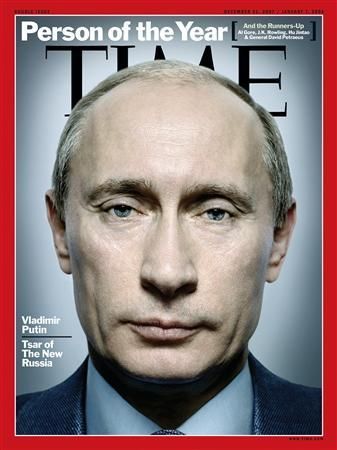
Back in 2007 Time magazine named Russia’s president Vladimir Putin as its person of the year. In explaining its decision, the magazine described him as a “steely and determined man” who had “emerged as a critical lynchpin of the 21st century.”

It added: “Putin is not a boy scout. He is not a democrat in any way that the West would define it. He is not a paragon of free speech. He stands, above all, for stability – stability before freedom, stability before choice, stability in a country that has hardly seen it for a hundred years.”

Where as as early as 2010 there were reports coming out of Russia into the press on the repression of the state stating that Russia was in fact a ‘mafia state’ with the Kremlin relying on criminals and rewarding them with political patronage, while top officials collect bribes ‘like a personal taxation system.

On the 24th September 2024 there was a Statement by Foreign Secretary David Lammy at the UN Security Council where he went on to say Putin’s Russia is a “mafia state” that is “built on lies”. Britain’s top diplomat directly accused Vladimir Putin of running a “mafia state” and likened him to a slave-owner in a fiery address at the United Nations Security Council.

David Lammy, the U.K.’s foreign secretary, took aim at the Russian president during the New York gathering Tuesday, telling Russia’s representative: “We know who you are.”

Lammy invoked the legacy of slavery to take aim at Putin’s conduct in the invasion of Ukraine, and accused the Russian government of running “roughshod over international law” while claiming to stand up for the “Global South.”

“Your invasion is in your own interests,” he said. “Yours alone. To expand your mafia state into a mafia empire. An empire built on corruption.”

He added, “Mr President, I speak not only as a Briton, as a Londoner, and as a foreign secretary.

“But I say to the Russian representative, on his phone as I speak, that I stand here also as a Black man whose ancestors were taken in chains from Africa, at the barrel of a gun to be enslaved, whose ancestors rose up and fought in a great rebellion of the enslaved.

“Imperialism: I know it when I see it. And I will call it out for what it is,” Lammy said.

Those on the right who loudly praised Putin have now fallen strangely silent | Vladimir Putin | The Guardian

https://www.theguardian.com/commentisfree/2022/mar/19/russia-ukraine-war-putin-right-conservatives