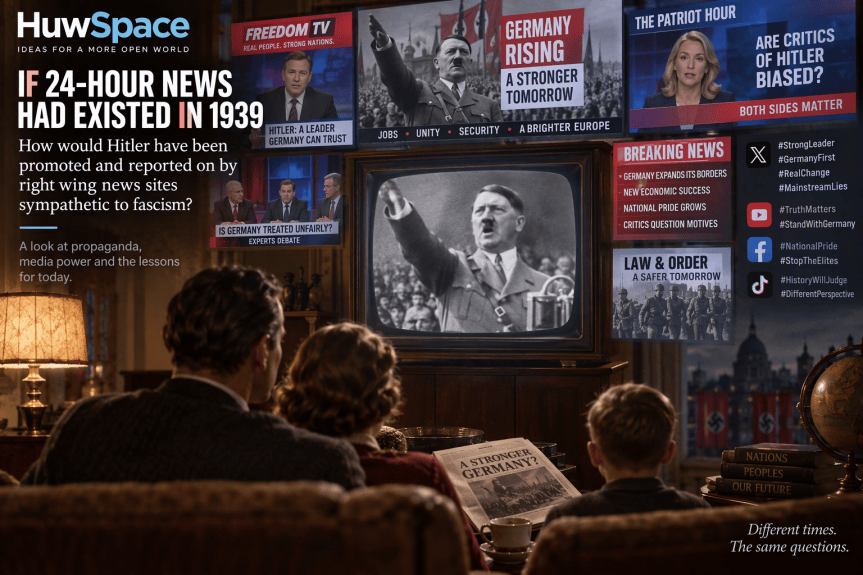
Would 24-Hour News Have Stopped Hitler—or Supercharged Him?

By Huw Edwards

History often feels inevitable when viewed through the lens of hindsight. We know who the villains were, how events unfolded, and the suffering that followed. Yet one of the most unsettling questions we can ask is this: if the modern media environment had existed in 1939, would we have recognised the danger of fascism any sooner, or would sophisticated media ecosystems have helped normalise it?

It is a question worth asking because the technologies have changed, but human nature has not.

The News Cycle That Never Sleeps

In 1939, news travelled through newspapers, radio broadcasts, and cinema reels. Information moved relatively slowly. Governments could control narratives, but they could not dominate every waking moment of public attention.

Today, audiences are immersed in a 24-hour news cycle. Political leaders are analysed, criticised, defended, and promoted continuously. Every action generates headlines. Every policy announcement becomes a panel discussion. Every controversy becomes a culture war.

Had these systems existed in the 1930s, Adolf Hitler would not simply have been a political leader. He would have been content.

His speeches would be streamed live. His rallies would dominate prime-time schedules. His provocations would generate endless debate. Outrage and attention would become part of the same business model.

The uncomfortable truth is that modern media often rewards engagement more than accuracy.

The “Strong Leader” Narrative

History tells us that many supporters of authoritarian movements do not initially support oppression. Instead, they support promises.

Promises of national renewal.

Promises of economic recovery.

Promises of security.

Promises that someone, somewhere, finally has a plan.

A hypothetical fascist-friendly news network in 1939 would likely have framed Hitler not as a dictator in waiting but as a decisive leader overcoming national decline.

Coverage might have focused on:

  • Falling unemployment.
  • Infrastructure projects.
  • Economic recovery.
  • National pride.
  • Military rebuilding.

Critics would be portrayed as pessimists, elitists, or opponents of national success.

The conversation would not begin with concentration camps or genocide because those horrors had not yet reached their full scale. Instead, audiences would hear discussions about borders, patriotism, economic revival, and law and order.

Authoritarianism rarely introduces itself honestly.

It arrives wrapped in the language of stability.

The Manufacture of Doubt

One of the defining features of many modern media environments is not necessarily persuading audiences of one position.

It is persuading them that objective truth itself is uncertain.

Imagine reports emerging about persecution of Jewish people in Germany.

Some outlets would investigate.

Others might respond differently:

“Are the reports exaggerated?”

“Can we trust the sources?”

“Both sides have arguments.”

“We should wait for more evidence.”

The goal would not necessarily be to deny reality outright. It would be to create enough uncertainty that audiences feel justified in looking away.

History offers many examples where atrocities proceeded because too many people convinced themselves that the warnings were probably overstated.

The Business of Outrage

Modern media rewards attention.

Attention often comes from conflict.

Imagine nightly television debates:

“Was Germany justified in reclaiming lost territory?”

“Has the international community treated Germany unfairly?”

“Are critics of Hitler ignoring economic progress?”

The loudest voices would attract the largest audiences.

Extreme viewpoints would become profitable.

Outrage would become programming.

The more controversial the statement, the more airtime it would receive.

In such an ecosystem, fascist rhetoric would not simply be tolerated. It would become valuable.

Rebranding Authoritarianism

One lesson repeated throughout history is that oppressive movements rarely market themselves as oppressive.

Rather than focusing on anti-democratic goals, sympathetic commentators might describe Hitler as:

  • A reformer.
  • A nationalist.
  • A defender of traditional values.
  • A protector of sovereignty.
  • A political outsider challenging established elites.

Language matters.

Changing the description changes how audiences interpret the reality.

An assault on democratic institutions can become a debate about efficiency.

An attack on minorities can become a discussion about social cohesion.

State repression can be presented as maintaining public order.

The message remains the same, but the packaging changes.

The Social Media Multiplier

If we extend the thought experiment further and imagine social media existing alongside 24-hour television news, the effects become even more concerning.

Algorithms prioritise engagement.

Fear engages.

Anger engages.

Identity-based conflict engages.

A modern fascist movement would not rely solely on government propaganda. It would benefit from millions of people voluntarily sharing content that reinforces their existing beliefs.

Conspiracy theories would spread instantly.

False stories would travel globally in minutes.

Fact-checks would rarely move as fast as emotionally satisfying narratives.

The result would be a fragmented public sphere where different groups inhabit entirely different realities.

Would The Media Have Stopped Hitler?

Perhaps.

Many journalists would have recognised the threat.

Many broadcasters would have sounded the alarm.

Many editors would have exposed the abuses.

Yet history suggests that warnings alone are not always enough.

The challenge is not simply access to information. It is whether people are willing to accept information that challenges their worldview.

Some audiences would have listened.

Others would have sought outlets confirming what they already wanted to believe.

That dynamic is not unique to Germany in 1939.

It is a recurring feature of human societies.

The Real Lesson

The most important lesson is not about Hitler.

It is about us.

It is comforting to imagine that people in the modern world would immediately recognise authoritarianism. It is comforting to believe that propaganda only works on other people.

History suggests otherwise.

The danger of fascism has never been that it appears obviously evil to everyone at the start. The danger is that it often presents itself as the answer to genuine grievances. Economic hardship, social uncertainty, political dysfunction, and cultural anxiety create fertile ground for leaders who promise simple solutions to complex problems.

The question is not whether a 24-hour news network could have promoted Hitler.

It almost certainly could have.

The more important question is whether modern societies have become any better at recognising the warning signs when charismatic leaders, media organisations, and powerful interests ask us to fear one another rather than understand one another.

History’s greatest warning may be this:

Authoritarian movements succeed not because everyone embraces them, but because enough people convince themselves that the threat is not yet serious enough to matter.

By the time the evidence becomes undeniable, the institutions designed to stop them may already be weakened beyond repair.

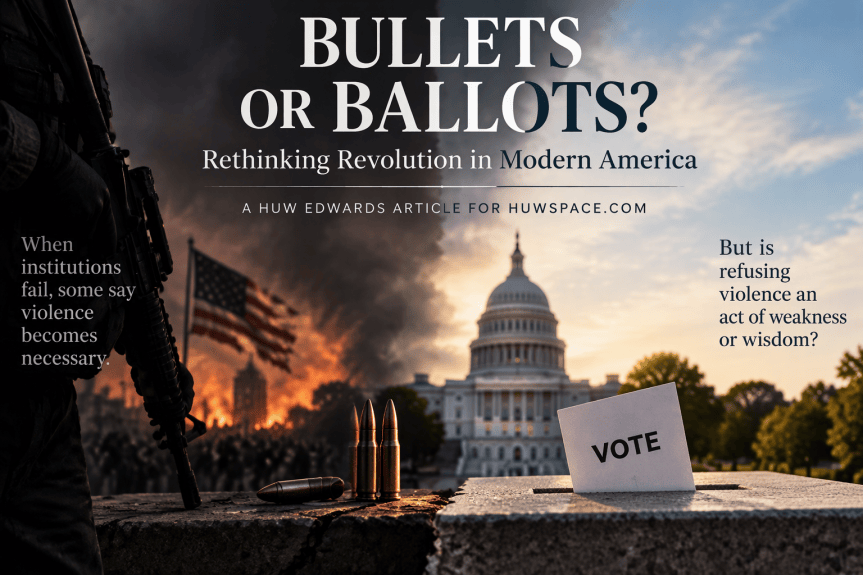
Guy Fawkes, Revolution and the False Promise of Political Violence

By Huw Edwards for Huwspace.com

The revolutionary argument is as old as politics itself. When institutions cease to serve the people, when governments become unresponsive, and when citizens lose faith that change can occur through democratic means, some begin to argue that violence becomes not merely justified but necessary.

It is a powerful idea. It is also one that deserves far greater scrutiny than it often receives.

Throughout history, revolutionaries have claimed that peaceful reform eventually reaches its limits. If the courts are corrupt, the legislature captured, and the political system incapable of meaningful change, then force becomes the only remaining instrument of political action.

Yet an uncomfortable question remains.

Even if institutions fail, why should anyone assume violence will make matters better?

In modern America, what exactly has failed so completely that civil conflict or revolution is seen by some as a rational answer? And what evidence exists that a bloody struggle would produce freedom rather than simply a different form of oppression?

These are not questions of left or right. They are questions of history, morality and common sense.

The Revolutionary Argument

The intellectual case for revolutionary violence is perhaps most closely associated with Frantz Fanon, whose writings on anti-colonial struggle argued that violence could become necessary when oppressed people were denied any meaningful path towards political self-determination. For Fanon, violence was not merely destructive. It could become a means through which the powerless reclaimed agency, dignity and freedom. [researchgate.net], [digitalcom…ns.usu.edu]

The logic is straightforward:

  • Institutions become irredeemably corrupt.
  • Peaceful reform becomes impossible.
  • Resistance becomes a moral obligation.
  • Violence becomes the mechanism through which freedom is achieved.

History contains examples where such arguments carried genuine force. Colonial subjects denied rights, representation and self-government often found themselves confronting systems designed to prevent peaceful change.

Yet accepting that violence may sometimes become understandable is not the same as concluding it is wise.

Hannah Arendt’s Warning

Political philosopher Hannah Arendt offered one of the most important critiques of revolutionary violence.

Arendt argued that violence and power are not the same thing. Violence can destroy institutions, but it cannot by itself create legitimate political authority. Freedom requires trust, participation, civic engagement and durable institutions. Guns alone cannot provide those things. [digitalcom…ns.usu.edu], [researchgate.net]

Her warning was simple but profound.

Revolutions are often successful at tearing down existing structures. They are far less reliable at constructing better ones.

The French Revolution toppled a monarchy only to descend into terror and eventually dictatorship.

The Russian Revolution overthrew Tsarist rule yet produced one of the most authoritarian systems of the twentieth century.

Again and again, history demonstrates that removing an unjust order does not automatically create a just one.

The assumption that freedom naturally follows violence is one of the most dangerous misconceptions in political thought.

America’s Contradiction

Modern America occupies a peculiar place within this debate.

Many political voices appeal to the language of revolution, resistance and even civil conflict. References to 1776 appear regularly in political discourse. The image of the armed citizen standing against tyranny remains deeply embedded in parts of American culture.

But unlike many societies that experienced genuine revolutionary conditions, America still possesses functioning democratic mechanisms.

Citizens vote.

Governments change peacefully.

Political parties compete for power.

Courts continue to rule against governments.

Journalists openly criticise political leaders.

Citizens organise, campaign, protest and publish freely.

None of this means America does not face serious challenges.

Political polarisation has deepened. Trust in institutions has declined. Economic inequality remains severe. Housing costs, healthcare costs and social division continue to affect millions of lives.

These are serious problems.

But serious problems are not the same as complete institutional collapse.

One can argue passionately for reform. It is considerably harder to argue that all peaceful means of reform have been exhausted.

What Exactly Is Failing?

This is perhaps the question most absent from modern revolutionary rhetoric.

What precisely has failed so completely that violence represents a preferable alternative?

If elections still occur, why abandon elections?

If courts still function, why abandon courts?

If free speech exists, why abandon persuasion?

If activism remains legal, why abandon organisation?

Too often, calls for revolution seem rooted less in objective institutional failure and more in political frustration.

An increasing number of people appear willing to regard democratic institutions as legitimate only when those institutions produce outcomes they personally favour.

That is not necessarily opposition to tyranny.

It may simply be disappointment with democracy itself.

Democracy is frustrating by design. It guarantees disagreement, compromise and political defeat as much as it guarantees victory. It promises a process, not a predetermined outcome.

Remember, Remember the Fifth of November

It is fitting that these questions are being asked on Guy Fawkes Night.

Remember, remember, the fifth of November,
Gunpowder, treason and plot.
I see no reason
Why gunpowder treason
Should ever be forgot.

The rhyme recalls the failed Guy Fawkes plot to destroy Parliament in 1605.

Today, some view Guy Fawkes as a symbol of resistance against a broken system. Yet the same question remains as relevant now as it was then: does violence create freedom, or merely more violence?

Had the Gunpowder Plot succeeded, would England have become freer, or would it simply have descended into retaliation, repression and further bloodshed?

That is the challenge modern advocates of revolution must answer. Destroying a political system is far easier than creating a better one. History is filled with movements that successfully overthrew institutions only to replace them with fresh forms of tyranny.

The Fifth of November reminds us not only to remember the plot itself, but to think carefully about what comes after the explosion.

The Historical Record of Political Violence

Supporters of revolutionary violence often emphasise successful struggles for independence and liberation.

Far less attention is given to the countless movements that produced chaos, instability and suffering.

Civil wars are among the most destructive experiences a society can endure.

Even after the fighting ends, the consequences frequently remain for generations.

Communities fracture.

Infrastructure is destroyed.

Political extremism becomes normalised.

Retaliation follows retaliation.

Research into revolutions suggests that violent revolutions can sometimes prove more resistant to counter-revolutionary threats because they create strong security structures capable of defending the new order. [cambridge.org], [cambridge.org]

Yet that observation raises another dilemma.

A state capable of enforcing stability through force is not necessarily a freer state.

Many revolutionary governments become highly effective at suppressing dissent once they achieve power.

The revolution survives.

Liberty does not.

The Liberal Dilemma

Liberals are often criticised for placing too much faith in institutions.

They are accused of excessive patience, endless compromise and a reluctance to confront injustice.

Sometimes those criticisms contain an element of truth.

Yet liberal democracy rests upon a recognition that violence develops its own momentum.

Once violence becomes an accepted political tool, it rarely remains confined to a single purpose.

It changes societies.

It changes movements.

It changes leaders.

Eventually, it changes the people who employ it.

The danger is not merely that violence might fail.

The greater danger may be that it succeeds.

A successful armed movement acquires armed leaders, armed structures and armed habits. Political disagreements that were once settled through debate increasingly become questions of force.

History suggests those habits often outlive the revolution itself.

Wisdom or Weakness?

Some will always argue that refusing violence is an act of weakness.

That real change requires force.

That power never concedes anything voluntarily.

Perhaps there are moments in history where such arguments carry weight.

But there is another perspective.

Perhaps refusing violence reflects an understanding of human nature itself.

Perhaps wisdom lies in recognising that the destruction of institutions is easier than their construction.

Perhaps wisdom lies in understanding that violence often unleashes forces far beyond the control of those who initiate it.

And perhaps wisdom lies in preserving democratic processes precisely because they provide a way of resolving disagreement without killing one another.

Conclusion

On this Fifth of November, as bonfires burn and fireworks illuminate the night sky, it is worth remembering that political violence has always carried an allure far greater than its actual record of success.

The revolutionary argument deserves to be taken seriously. History contains moments when oppression became so severe that resistance appeared unavoidable.

But modern America is not colonial Algeria. It is not Tsarist Russia. It is not a military dictatorship that has extinguished every avenue for peaceful reform.

Before anyone speaks casually about revolution, two questions deserve answers.

What exactly has failed?

And why should anyone believe that bullets will produce a better future than ballots?

The burden of proof lies with those advocating force, not with those exercising restraint.

History suggests that removing what we hate is often much easier than building what we hope for. The wisdom of democracy may not be that it prevents conflict, but that it offers a way of navigating conflict without setting society on fire.


References

As America wrestles with growing political polarisation and increasingly revolutionary rhetoric, the central question is not whether institutions are imperfect, but whether violence has ever proved a reliable route to freedom. On Guy Fawkes Night, Huw Edwards examines the historical case for revolution and the stronger case for restraint.

Van William – Revolution (Music Video) ft. First Aid Kit

The Gathering Storm: Part One

Navigating a Future of Debt, AI Disruption, Climate Breakdown and Economic Uncertainty

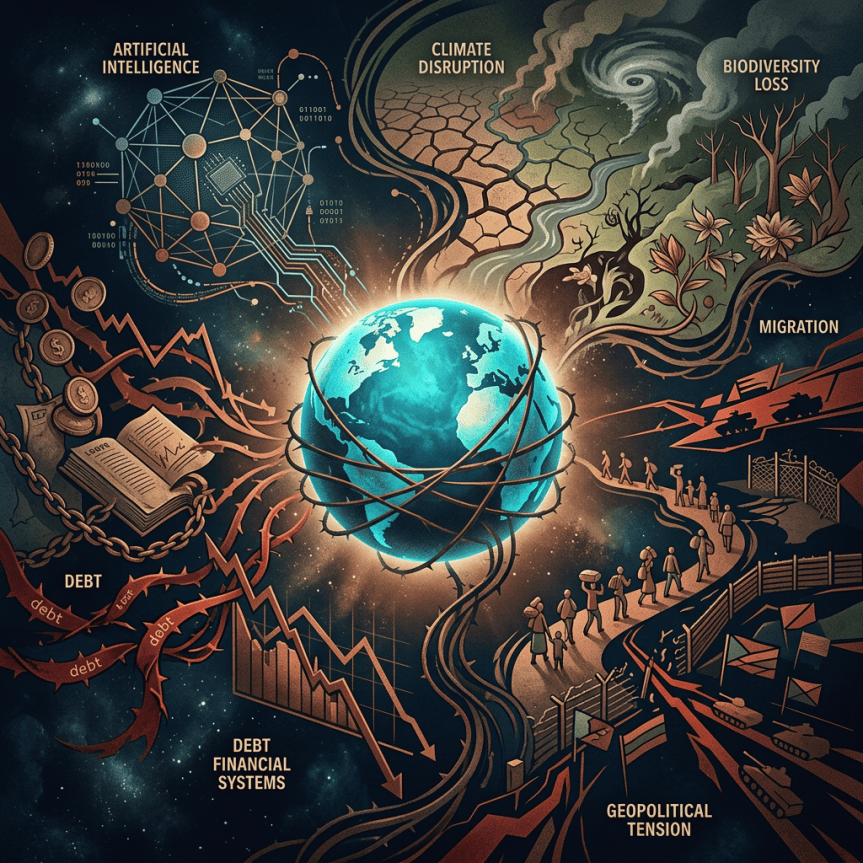
There is a growing sense that the world is entering a period unlike anything experienced in recent decades. Across developed and developing economies, government debt is rising, geopolitical tensions are intensifying, artificial intelligence is reshaping labour markets, climate impacts are accelerating, and biodiversity continues to decline. Rather than existing as separate challenges, these pressures increasingly interact with one another, creating what many analysts describe as a “polycrisis” – a situation where multiple systemic risks amplify each other simultaneously.

The question is not simply whether one crisis will occur. The deeper concern is whether several crises could unfold together, testing governments, economies and communities at the same time.

The Great Debt Dilemma

Governments across the world emerged from financial crises, pandemics and economic shocks with unprecedented levels of debt. While debt itself is not unusual, growing concerns centre on whether governments can continue servicing their obligations if economic growth slows while spending demands continue to rise.

Many advanced economies face a difficult combination of ageing populations, rising healthcare costs, infrastructure demands, military spending commitments and climate adaptation requirements. At the same time, taxation systems struggle to keep pace with changing economic realities.

As AI automates more administrative, analytical and professional roles, governments may face declining income tax receipts from traditional employment. Meanwhile, globalisation and digital commerce enable capital and profits to move across borders more easily than labour, potentially limiting national governments’ ability to expand their tax bases.

This creates a dangerous feedback loop:

  • Higher spending requirements.
  • Slower economic growth.
  • Reduced tax revenues.
  • Larger government borrowing.
  • Rising debt-servicing costs.

The risk is not necessarily an immediate collapse, but a gradual erosion of governmental capacity and public trust.

AI: Productivity Miracle or Employment Shock?

Artificial intelligence presents one of humanity’s greatest opportunities and one of its greatest uncertainties.

Optimists point to enormous gains in productivity, scientific discovery and healthcare. Pessimists highlight the possibility of large-scale disruption to knowledge work and professional occupations.

Unlike previous technological revolutions, AI does not simply replace manual labour. It increasingly performs functions that were previously considered uniquely human, including writing, analysis, design, administration, coding and decision support.

The danger lies not in AI itself but in the speed of transition. If millions of workers are displaced faster than new industries emerge, societies could face:

  • Reduced consumer spending.
  • Higher unemployment or underemployment.
  • Lower income tax revenues.
  • Greater pressure on welfare systems.
  • Increased political instability.

The challenge for governments is ensuring that AI-generated wealth benefits society broadly rather than concentrating in a handful of corporations and asset owners.

Climate Change: The Hidden Economic Multiplier

Climate change is often discussed as an environmental issue, but it is increasingly an economic one. Extreme weather events damage infrastructure, reduce agricultural productivity and increase insurance costs.

The climate crisis acts as a threat multiplier, worsening existing vulnerabilities.

Heatwaves reduce productivity. Floods destroy homes and businesses. Droughts raise food prices. Storms disrupt supply chains.

These impacts create inflationary pressures that ripple through economies. As adaptation costs increase, governments find themselves spending more while often collecting less tax revenue from affected regions.

The result is another cycle of rising debt and economic fragility. Climate-related disruptions may become a permanent feature of the global economy rather than occasional emergencies.

Biodiversity Loss: The Overlooked Crisis

While climate change dominates headlines, biodiversity loss may prove equally significant.

Healthy ecosystems provide services that modern economies largely take for granted:

  • Pollination of crops.
  • Water purification.
  • Carbon storage.
  • Flood protection.
  • Soil fertility.

As species disappear and ecosystems degrade, these natural systems become less resilient.

The economic consequences are often invisible until critical thresholds are crossed. Food production becomes less reliable. Natural disasters cause greater damage. Water systems become more expensive to maintain.

Societies have traditionally treated nature as an infinite asset. Increasing evidence suggests that assumption is no longer sustainable.

Conflict, Migration and Global Fragmentation

The post-Cold War vision of increasing global integration appears increasingly uncertain.

Regional conflicts, competition between major powers and resource scarcity are fragmenting global supply chains. These disruptions can lead to:

  • Higher energy prices.
  • Increased commodity volatility.
  • Reduced international investment.
  • Greater military expenditure.

At the same time, climate impacts and conflict may increase migration pressures. Millions of people could be forced to move due to environmental degradation, water scarcity or instability.

Migration itself is not the problem. The challenge emerges when institutions fail to manage integration effectively or when receiving communities feel economically insecure.

Without social cohesion, economic shocks can be transformed into political crises.

Is the Economic Bubble About to Burst?

Many commentators argue that we are approaching the limits of a debt-fuelled economic model. Others point out that similar predictions have emerged repeatedly throughout history and that economies possess remarkable adaptive capacity.

The truth may lie somewhere in between.

Rather than a single catastrophic collapse, the future may involve a prolonged period of:

  • Lower growth.
  • Higher volatility.
  • Recurring financial instability.
  • Rising fiscal pressures.
  • Political fragmentation.
  • Greater environmental stress.

History suggests that societies rarely collapse overnight. More often, they experience periods of adjustment that can last decades.

The critical question is whether governments, businesses and communities can adapt quickly enough.

Building Resilience Instead of Fear

If these risks are real, the most productive response is neither denial nor panic. It is resilience.

Strengthening local economies, reducing dependence on fragile supply chains and investing in practical skills can provide protection against uncertainty. The original document highlights mutual aid networks, local food production, skill diversification and community resilience as practical responses to systemic risks.

Strengthen Communities

Strong communities often weather crises better than isolated individuals.

This may include:

  • Community-owned energy projects.
  • Local food initiatives.
  • Tool-sharing networks.
  • Skills exchanges.
  • Cooperative enterprises.

When national systems face stress, local relationships become increasingly valuable.

Invest in Human Skills

While AI will automate many tasks, some skills remain difficult to replace:

  • Caregiving.
  • Healthcare.
  • Education.
  • Skilled trades.
  • Ecological restoration.
  • Community leadership.

Developing adaptable capabilities may prove more valuable than specialising exclusively in highly automated sectors.

Restore Nature Locally

Biodiversity restoration does not require waiting for international agreements.

Communities can support:

  • Native species planting.
  • Urban rewilding.
  • Habitat restoration.
  • Pollinator corridors.
  • Community conservation projects.

Small local actions can create meaningful ecological benefits when multiplied across many communities.

A Choice Between Fragmentation and Renewal

The coming decades will likely be defined by how societies respond to converging pressures from debt, technological disruption, climate change and ecological decline.

The future is not predetermined. Economic systems are human creations, and they can be redesigned. Technologies can be governed. Communities can become more resilient. Nature can recover if given space and protection.

The real danger is not that debt bubbles burst, AI transforms work, or climate impacts intensify. It is the failure to prepare for these realities while time remains.

A more resilient future may require moving beyond an obsession with short-term growth and towards measures of long-term wellbeing, ecological health, community strength and economic security.

The challenges ahead are immense, but history repeatedly demonstrates that societies are capable of remarkable adaptation when they recognise problems early and act collectively.

The question is whether we will do so before the pressures of the polycrisis become overwhelming.

Frank Turner – The Next Storm (Official Video)

Do Bad Things Happen Because of Greed or Poor Choices?

Terrible events — wars, ecological collapse, climate destabilisation — often feel like they erupt out of chaos. But when you trace them back, you find something more mundane and more uncomfortable: human decisions. Some are made out of fear, some out of short‑term thinking, and some out of outright greed. Together, they shape the world we live in.

This article explores how greed and poor choices contribute to three major global crises: war, global warming, and biodiversity loss — and why understanding these drivers matters for building a better future.

⚔️ 1. War: When Greed Meets Fear

Modern research shows a strong link between environmental vulnerability and conflict, especially where resources are scarce or degraded. Environmental stress can increase the likelihood of conflict, particularly in regions already facing political instability . Biodiversity loss and environmental degradation can also interact with social tensions, influencing pathways to conflict.

But environmental stress alone doesn’t cause war. Human choices do.

Greed’s role

  • Control of oil, minerals, land, or strategic territory
  • Expansion of political or economic influence
  • Capture of wealth by elites at the expense of the population

Poor choices

  • Leaders escalating tensions instead of negotiating
  • Nations prioritising military spending over diplomacy
  • Short-term political gains trumping long-term stability

Greed creates incentives for conflict; poor choices remove the brakes.

🌡️ 2. Global Warming: A Crisis Built on Short-Term Thinking

Climate change is the most predictable disaster humanity has ever created — and one of the most preventable.

Greed’s role

  • Fossil fuel industries protecting profits
  • Governments prioritising economic growth over sustainability
  • Corporations externalising environmental costs

Poor choices

  • Delaying climate action for decades despite clear warnings
  • Designing cities around cars instead of people
  • Treating nature as infinite rather than fragile

Climate change is not an accident. It is the cumulative result of billions of decisions made without considering long-term consequences.

🐾 3. Biodiversity Loss: The Silent Catastrophe

Biodiversity loss is less visible than war or climate change, but it is just as dangerous. Research shows that environmental degradation can contribute to social instability and conflict, creating feedback loops between ecological decline and human insecurity .

Greed’s role

  • Overexploitation of forests, oceans, and wildlife
  • Industrial agriculture prioritising yield over ecosystems
  • Illegal wildlife trade driven by profit

Poor choices

  • Destroying habitats for short-term development
  • Ignoring ecological warnings
  • Failing to protect species until they are nearly gone

Biodiversity loss is a slow-burning tragedy caused by treating nature as expendable.

🔍 So… Is Greed the Root Cause? Or Poor Choices?

Greed is a powerful accelerant. Poor choices are the spark.

But the deeper truth is this:

Terrible things happen when societies reward short-term gain over long-term wellbeing.

Greed is simply one expression of that imbalance. Poor choices are another. Together, they create systems where destructive outcomes become almost inevitable.

🌱 What Would Better Choices Look Like?

1. Long-term thinking

Policies that look beyond election cycles and profit margins.

2. Shared responsibility

Recognising that environmental and social stability are collective goods.

3. Valuing nature

Treating ecosystems as assets, not obstacles.

4. Reducing inequality

Because unequal societies are more vulnerable to conflict and ecological harm.

5. Transparent governance

Greed thrives in secrecy; accountability reduces its power.

✨ A More Hopeful Ending

The world is not doomed to repeat its mistakes. Greed and poor choices are human behaviours — and humans can change. We can design systems that reward sustainability, cooperation, and long-term thinking. We can choose leaders who value peace over profit. We can build economies that regenerate rather than extract.

Terrible things happen when we fail to act wisely. Better things happen when we decide to.

Breaking the Bad News Cycle: A Healthier Way to Stay Informed

Humans are drawn to media outlets that produce bad news primarily because of evolutionary survival mechanisms, brain chemistry, and cognitive biases that make negative information inherently more captivating than positive information.

But also to be fair the reporting of bad news highlights important information within which we want and need to react against and from in order to have an impact of positive change.

This psychological draw creates a powerful feedback loop: because audiences naturally click on distressing headlines, media companies prioritize sensationalism and crisis reporting to drive engagement and revenue.

The core psychological and biological reasons behind this preference include:

1. The Evolutionary Negativity Bias

From a survival standpoint, early humans who were hyper-alert to dangers (like predators or poisonous food) were much more likely to survive and pass on their genes than those who focused on pleasant things. This is known as the negativity bias. In the modern world, the potential cost of ignoring “bad news” (like an economic crash, a pandemic, or local crime) feels much higher than the potential benefit of missing out on good news.

2. Brain Chemistry and Stress Responses

When you encounter a negative or threatening headline, your amygdala—the brain’s alarm system—immediately lights up, triggering a physical state of heightened alertness by releasing stress hormones like cortisol and adrenaline. Interestingly, this same negative stimulus also triggers a release of dopamine, the brain’s reward chemical. This neurochemical hit creates a literal addiction to our own stress response, keeping us hooked and scrolling for more information.

3. The Illusion of Control (Doomscrolling)

Psychologists note that tracking bad news is often an attempt by our nervous system to find safety. The subconscious logic dictates: “If I fully understand everything terrible that is happening, I can prepare for it and keep myself safe.” This turns compulsive news consumption—or “doomscrolling”—into a misguided coping mechanism for dealing with anxiety and a perceived lack of power over the world.

4. Surprise and Salience

Because most people generally expect their personal daily lives to go smoothly and turn out fine, bad news stands out. It breaks the monotony of the norm. A plane that lands safely isn’t news, but a plane crash is a massive shock to our baseline expectations, making it highly salient and impossible to ignore.

Summary of the News Cycle Loop

The table below outlines how our internal psychology interacts with external platforms to keep us consuming bad news:

Human FactorMedia/Platform ReactionResulting Behavior
Threat DetectionOutlets use fear-driven headlines.High click-through rates.
Dopamine HitsAlgorithms serve endless feeds of crisis.Extended time spent on apps.
Emotional ArousalOutlets frame stories with heroes/villains.Negative news is shared up to 2x more than positive news.

Beyond the Doomscroll: Why the News is Broken (and Where to Find Real Stories)

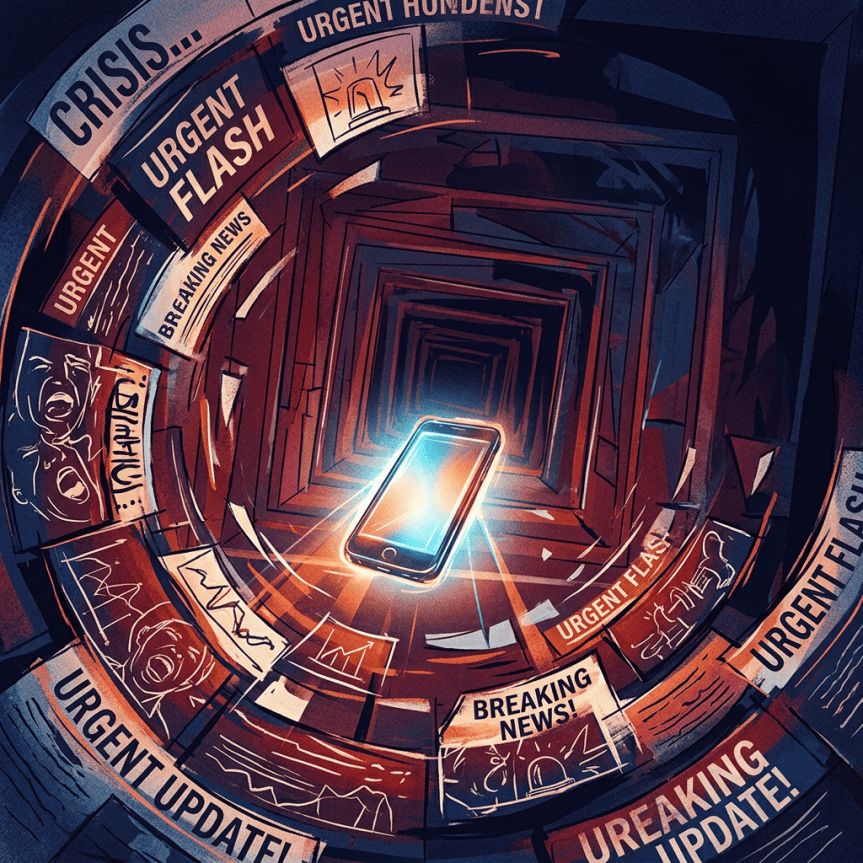
We have all been there. You pick up your phone for a quick five-minute break, and forty-five minutes later, you are buried in an avalanche of headlines about economic collapse, political warfare, and climate anxiety. Your chest feels tight, your mood is ruined, and the world feels entirely broken.

This isn’t an accident. It is the result of a highly sophisticated system designed to keep your eyes glued to the screen.

But why are major media outlets so obsessed with the worst-case scenarios, and more importantly, how can we break free without putting our heads in the sand? Let’s pull back the curtain on the attention economy and explore a healthier way to stay informed.


Why Major Outlets Are Addicted to Bad News

It is easy to blame journalists for being cynical, but the reality is structural. Major news organizations produce bad news because outrage and fear are the most profitable commodities on the internet.

1. The Algorithm of Attention

In the digital age, media outlets no longer make money simply because you bought a newspaper. They survive on clicks, impressions, and time spent on their pages. Social media algorithms are programmed to maximize engagement, and psychological data shows that negative headlines receive up to 60% more clicks than positive ones. Outlets are simply giving the algorithms—and our biology—what they demand to stay financially viable.

2. Exploiting Our “Negativity Bias”

Humans possess an evolutionary quirk called the negativity bias. Thousands of years ago, paying attention to a threat (like a predator) was a matter of life or death, while ignoring something pleasant (like a beautiful sunset) had no consequences. Major media outlets capitalize on this deeply hardwired survival mechanism. A headline that triggers fear instantly activates your amygdala, compelling you to click to find out if you are in danger.

3. The Definition of “Newsworthiness”

In traditional journalism, the baseline assumption is that the world functions normally most of the time. Therefore, “news” is defined as an interruption to the norm. A plane landing safely or a community library successfully mentoring teenagers isn’t considered disruptive enough to be deemed “newsworthy.” This creates a funhouse-mirror effect: when you only report on the exceptions to the rule, the exceptions start to look like the reality.


The Rise of the Alternatives: Constructive Media

Constantly consuming a diet of tragedy doesn’t make us better citizens; it makes us cynical, exhausted, and passive. When we feel overwhelmed by problems, we experience “learned helplessness” and throw our hands up in defeat.

Fortunately, a growing movement of journalists is fighting back. They aren’t offering naive “feel-good” fluff pieces. Instead, they practice Solutions Journalism and Constructive Journalism. These alternatives focus on rigorous reporting that addresses problems and investigates how people are actively solving them.

If you are ready to heal your relationship with the media, here are the best alternative spaces to look:

🌟 Solution-Oriented Media Networks

  • The Solutions Journalism Network: An organization dedicated to reporting on responses to social problems, focusing on what works rather than just what is broken.
  • Positive News / Reasons to be Cheerful: Independent media outlets that publish high-quality, rigorous journalism about progress, innovation, and human ingenuity across the globe.

🌍 Long-Form & Independent Newsletters

  • Substack and Independent Journalists: Moving away from ad-driven clicks allows writers to focus on deep, nuanced analysis rather than reactionary headlines. Look for writers specializing in specific industries (like green energy tech or local governance) where progress is happening daily.
  • Niche Scientific and Progress Trackers: Outlets like Our World in Data or tech-focused journals present long-term human trends, which almost universally show that global health, literacy, and poverty rates are improving over decades, even if the daily news cycle suggests otherwise.

Understanding the Surge of Global Conflicts Amidst Climate Crises

The 2020s have unfolded as a decade of overlapping crises — pandemics, political instability, economic shocks, and a sharp resurgence of war. But beneath the headlines lies a deeper question: are wars genuinely more common today, and if so, are climate pressures and diminishing resources part of the cause?

Conflict research suggests the answer to the first question is yes. The second is more complicated.

Recent data from global conflict monitors shows that state‑based wars have reached their highest levels since World War II, driven by major conflicts in Ukraine, Gaza, Sudan, Ethiopia, and Myanmar. Wars and armed conflicts have become significantly more common and deadly since 2020, reaching their highest levels since World War II. This marks a clear break from the relative stability of the early 2000s and 2010s.

The New Landscape of War

The post‑2020 conflict environment is defined by several striking shifts:

  • Record-high active state conflicts
  • Annual battle deaths exceeding 240,000
  • Foreign interventions doubling since 2008
  • Global military spending rising to $2.9 trillion

These trends point to a world where diplomacy is weakening, geopolitical rivalry is intensifying, and international norms are eroding.

One particularly alarming metric is that peace agreements are failing, with only 4% of conflicts ending via treaties compared to 23% in the 1970s.

The machinery of peace is breaking down. There seems to be less will for peace and greater investment in sustained conflict.

Climate Change: Not the Spark, but the Fuel

Climate change and resource scarcity are often cited as causes of modern conflict. Yet the evidence shows they are not primary drivers — they are risk multipliers.

Climate as a Threat Multiplier

Climate change rarely ignites wars directly. Instead, it destabilises societies already under strain:

  • Droughts destroy crops and livelihoods
  • Floods displace communities
  • Desertification pushes pastoralists into farming regions
  • Extreme weather undermines fragile governments

Climate change does not typically cause direct inter-state warfare. Instead, it worsens underlying social and economic vulnerabilities.

When livelihoods collapse, recruitment by armed groups becomes easier. When governments fail to respond, grievances deepen. When desperation rises, violence follows.

Scarcity — and Abundance — of Resources

Resource scarcity fuels localised conflicts, especially in fragile regions:

  • Water shortages
  • Loss of arable land
  • Competition between herders and farmers

But abundance can be even more dangerous.

The global race for lithium, cobalt, nickel, and rare minerals — essential for green technology — has intensified geopolitical competition. In places like the DRC, resource wealth funds armed groups and prolongs war.

The War–Climate Feedback Loop

The relationship between war and climate is not one‑directional. It is a destructive cycle.

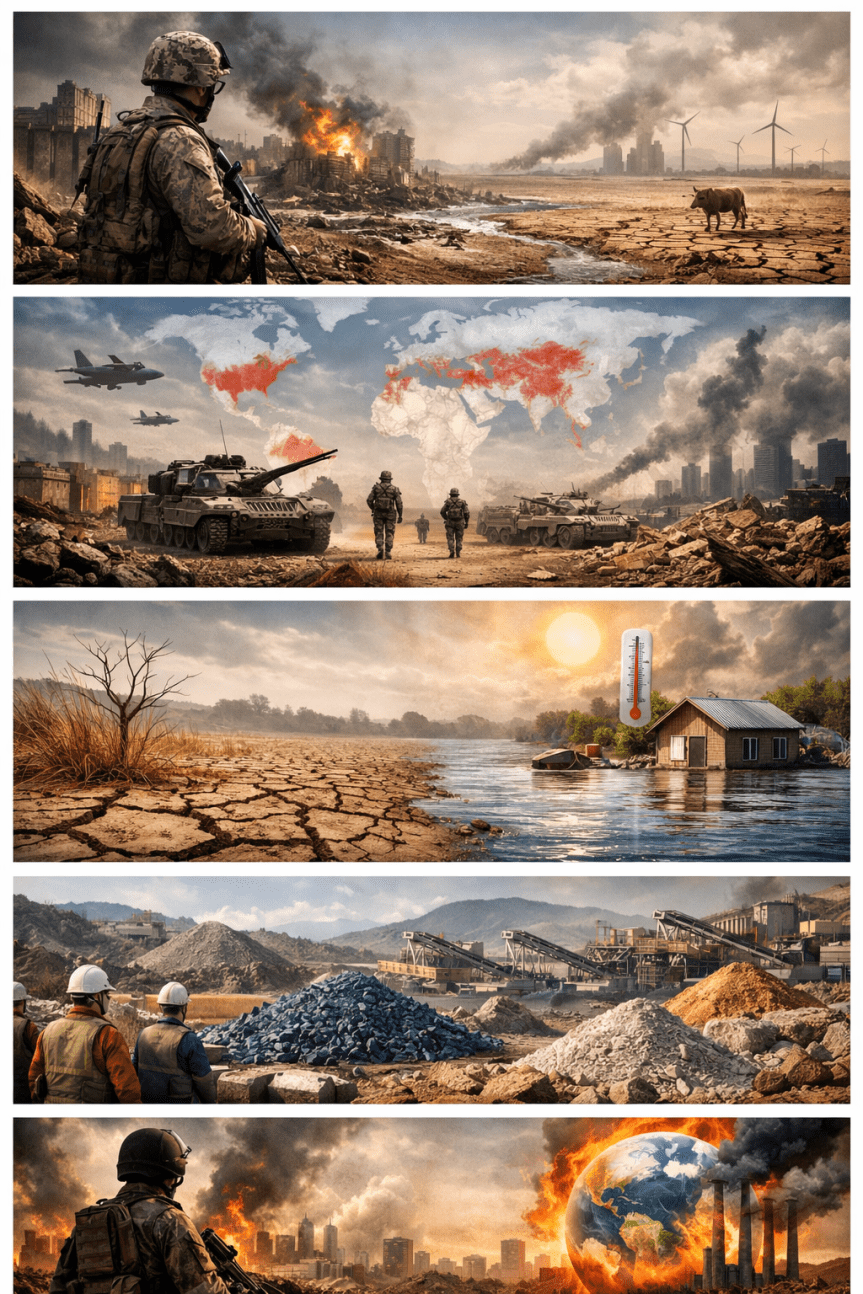
Global militaries account for roughly 5.5% of all global greenhouse gas emissions… war heavily accelerates climate change.

Conflict destroys infrastructure, burns cities, and releases massive emissions. Rebuilding after war produces even more.

Climate change increases conflict risk. Conflict accelerates climate change. A vicious loop.

Some might argue that the real drivers of Post‑2020 conflict are as follows – but these assumptions lead to more questions than answers

Despite environmental pressures, the perceived influential drivers of modern war remain political:

  • Weak governance and corruption
  • Breakdown of diplomacy
  • Major powers ignoring international norms
  • Foreign interventions escalating local conflicts
  • Rising authoritarianism and geopolitical rivalry

Climate change amplifies these forces, but for me increasing wars and fights for resources were very much predicted to be on the cards years ago as an output due to climate crisis, global warming and a hunt for resources.

Conclusion: A Hotter World, A Colder Politics

Wars are more common in the 2020s — not because the planet is simply running out of resources, but because political systems are failing to manage the pressures of a warming, crowded, unequal world.

Climate change doesn’t start wars. But it makes them easier to start, harder to stop, and far more devastating.

The 2020s show us a world where environmental stress and geopolitical instability now move in tandem. Understanding this relationship is essential if we hope to break the cycle.

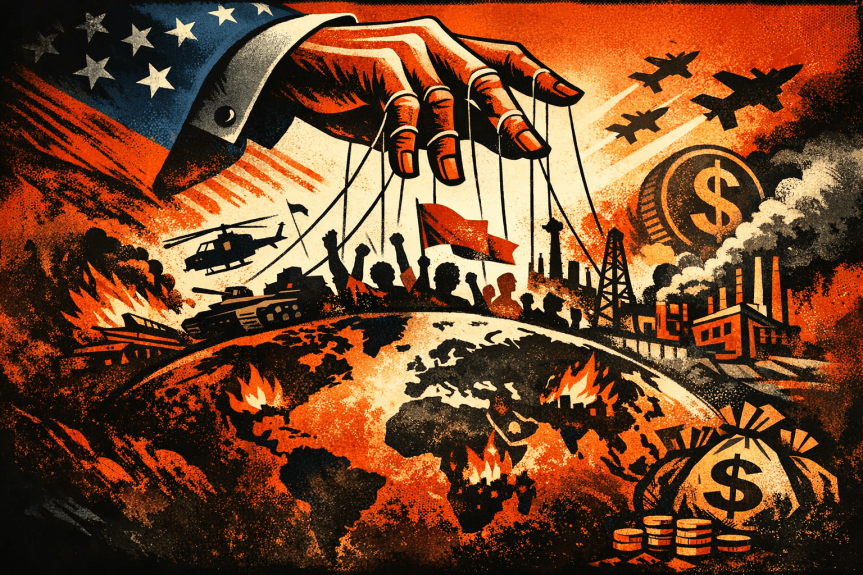
Darkside Of A Super Power: How U.S. Undermined Left‑Leaning Governments Worldwide

For the last hundred years, the United States has repeatedly intervened—covertly, economically, and sometimes militarily—against governments that tried to redistribute wealth, nationalise resources, or break from Western corporate and strategic influence. Historians argue that these actions were driven by Cold War ideology, corporate lobbying, and the desire to maintain a U.S.-led global order.

What was good for a country, its people and it’s ability to stand taller on it’s own two feet would not necessarily match with what would be in the interests of the US. When an agenda of profit over people would and continues to override the agenda, then something was going to have to give and yes people are going to suffer at the expense of profit. This is not a question of simply destroying possible authoritarian undemocratic non US influenced countries across the globe that worked against the interests of the US. But often a case of destroying left leaning democracies of countries that no longer saw the US as having their democracies interests at heart and looked to stand on their own two feet rather than in someone else’s corporate shadow. Israel’s belief to wipe out infrastructure and opposition across the middle east at this present time with the support and backing of Donald Trumps government appears to come across as regime destruction on steroids.

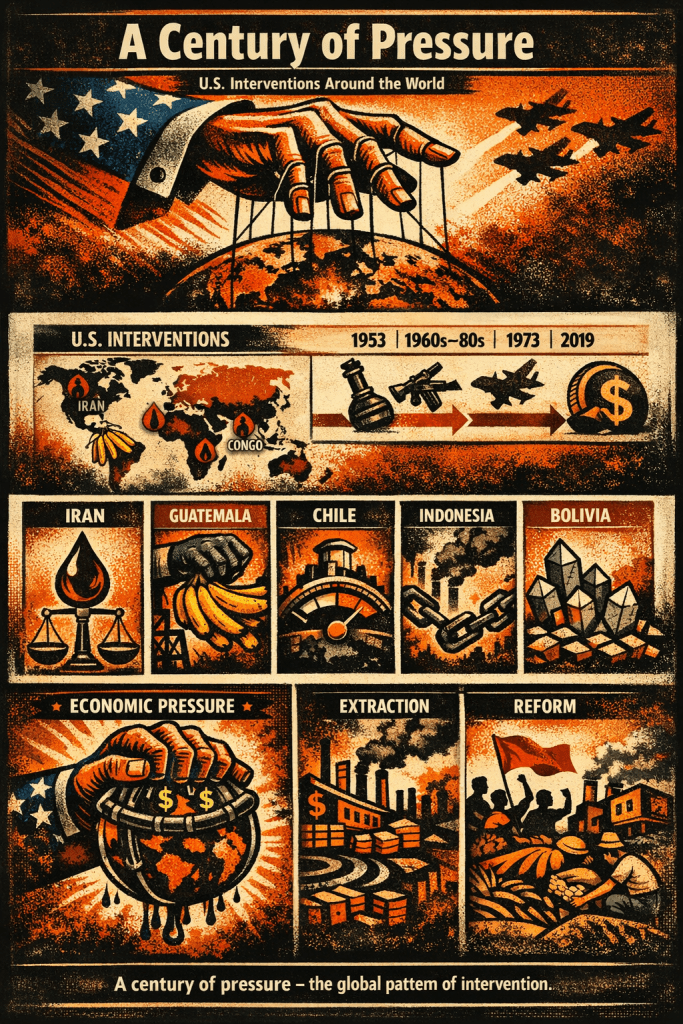
Below is tour of ten countries where left‑leaning governments attempted major reforms—and what happened next.

Iran (1953) — Oil Nationalisation Meets Cold War Anxiety

Mossadegh nationalised Iran’s oil to fund national development. The U.S. and UK removed him, restoring Western control of oil and installing the Shah. Impact: dictatorship, repression, and decades of instability.

Guatemala (1954) — Land Reform vs. United Fruit

Árbenz redistributed unused land, including United Fruit’s vast holdings. A CIA-backed coup followed. Impact: a 36‑year civil war and mass atrocities.

Congo (1960–61) — Lumumba’s Independence Project

Lumumba wanted Congo’s mineral wealth to benefit its citizens. He was removed and later killed during Cold War manoeuvring. Impact: Mobutu’s long dictatorship and entrenched poverty.

Brazil (1964) — Social Reform Meets U.S. Alarm

Goulart pushed land and tax reform and expanded voting rights. Washington supported a military coup. Impact: 21 years of authoritarian rule.

Indonesia (1965) — The Anti‑Communist Purge

Sukarno balanced nationalist and communist factions. The U.S. supported forces that eliminated the PKI. Impact: mass killings and Suharto’s authoritarian regime.

Chile (1973) — Allende’s Democratic Socialism

Allende nationalised copper and expanded social programmes. The U.S. backed efforts to destabilise his government. Impact: Pinochet’s dictatorship and widespread human rights abuses.

Nicaragua (1980s) — The Sandinista Revolution

The Sandinistas expanded healthcare, literacy, and land reform. The U.S. funded Contra forces to undermine them. Impact: civil conflict and economic collapse.

Grenada (1983) — Maurice Bishop’s Vision

Bishop promoted workers’ rights and social programmes. The U.S. invaded after internal political turmoil. Impact: end of an independent development model.

Burkina Faso (1987) — Sankara’s Anti‑Imperialism

Sankara pursued vaccination, women’s rights, and debt rejection. He was killed in a coup widely viewed as externally influenced. Impact: reversal of reforms and renewed dependency.

Bolivia (2019) — Lithium, Gas, and Indigenous Power

Morales nationalised resources and reduced poverty. He was forced out amid disputed election claims. Impact: political instability and policy reversals.

The Pattern

Across these cases, historians highlight recurring themes:

  • Resource control: oil, copper, bananas, lithium, minerals.
  • Corporate lobbying: United Fruit, ITT, major oil firms.
  • Cold War containment: fear of Soviet influence.
  • Prevention of alternative models: successful left‑leaning democracies risked inspiring others.

The result was often the same: authoritarian regimes, economic dependency, and long-term instability, while the U.S. secured strategic allies, resource access, and corporate protection.

Trump as Continuity, Not Exception

Trump’s foreign policy sits in the same long arc of U.S. interventionism—but with a different style and toolkit rather than a different underlying logic.

Continuities with past interventions

  • Same core objectives: Regime alignment, not democracy per se. Like earlier coups and covert ops, Trump’s moves aimed to weaken governments seen as hostile to U.S. interests—especially left‑leaning or anti‑U.S. ones (Venezuela, Iran, Cuba, Nicaragua)—and to favour regimes or oppositions more open to U.S. strategic and corporate priorities.
  • Economic warfare instead of classic coups: Where the 1950s–70s used CIA coups and military backing, Trump leaned heavily on sanctions, financial strangulation, and diplomatic isolation—“maximum pressure” on Iran, crushing sanctions on Venezuela, tightening the embargo on Cuba. The mechanism changed, but the goal—forcing political change by making the economy scream—echoes Chile under Allende.
  • Targeting left or left‑populist governments:
    • Venezuela: Recognition of Juan Guaidó, sanctions on oil, and open talk of regime change mirror older U.S. hostility to resource‑nationalising, left‑populist governments in Latin America.
    • Cuba & Nicaragua: Expanded sanctions and rhetorical framing of these states as part of an “authoritarian socialist” axis continues the Cold War pattern of isolating left governments in the hemisphere.
    • Iran: “Maximum pressure” and talk of regime change fit the long line from the 1953 coup through to contemporary attempts to weaken the Islamic Republic.
  • Protection of strategic and corporate interests: Just as United Fruit, copper companies, and oil majors shaped earlier interventions, Trump’s policies aligned with energy, defence, and financial interests: backing Gulf monarchies, supporting fossil‑fuel exporters, and pushing for favourable investment conditions in Latin America while punishing governments that nationalised or tightly controlled key sectors.

What’s different about the Trump era

  • More overt, less covert: Earlier interventions were often deniable; Trump frequently said the quiet part out loud—talking openly about “taking the oil,” “dominance in the western hemisphere,” or regime change in Venezuela and Iran. The underlying logic wasn’t new; the candour was.
  • Transactional framing instead of grand ideology: Cold War presidents wrapped interventions in anti‑communist rhetoric and “freedom” language. Trump framed many moves as deals, leverage, and dominance—America First rather than a universal mission—though the effect on targeted states (economic collapse, political destabilisation) often resembled earlier anti‑left operations.
  • Less state‑building, more pressure and exit: Compared with Bush’s Iraq or earlier occupations, Trump was less interested in long‑term reconstruction and more in short, sharp pressure: sanctions, recognition of rival leaders, targeted strikes (e.g. killing Soleimani) and then stepping back, leaving fractured political landscapes behind.

How to read Trump in the longer history

If you zoom out, Trump looks less like a rupture and more like a loud, stripped‑down version of an old pattern:

  • Left‑leaning or anti‑U.S. governments that control strategic resources are pressured, isolated, or targeted.
  • Economic tools (sanctions, financial blockades) now do much of the work that coups and covert ops once did.
  • The language has shifted—from anti‑communism to “terrorism,” “dictatorship,” or “socialism”—but the structural aim is similar: prevent alternative economic and political models that might weaken U.S. strategic and corporate advantage.

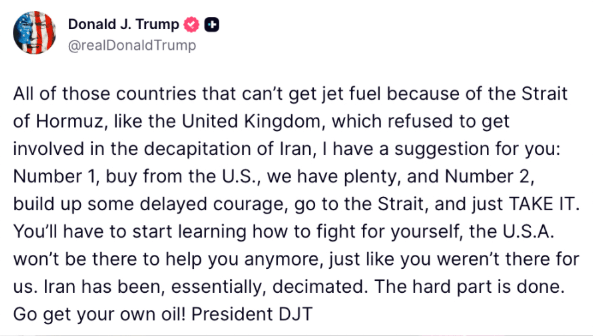
Cometh the hour, cometh the mad king DJT

You just can’t make this stuff up in a very Game of Thrones style the President of the USA has just tweeted the above tweet. Just when countries are trying to deal with Trump and Netanyahu’s oil war Trump decides to set fire to social media with a Molotov cocktail. He is certainly no cool and calm head in a self engineered social, political and economic storm or war.

Matthew E. White – Rock & Roll Is Cold (Official Video)

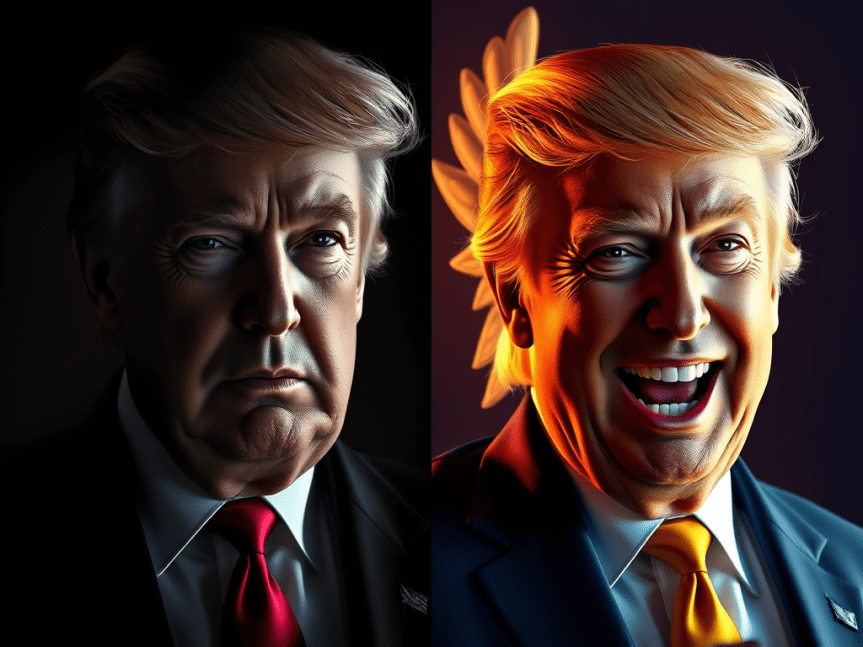
Is Donald Trump a ‘Saint’ or a ‘Sinner’ in the time of political echo chambers?

Whether Donald Trump is “evil” is a matter of intense public debate and subjective judgment, with no consensus. The term is used by various critics, supporters, and observers to describe his character, policies, and political impact from widely differing perspectives.

Arguments for Characterizing Him as evil

Critics and some public figures often use the term “evil” to describe Trump based on his actions and rhetoric:

  • Moral and Ethical Critique: Figures like actor Robert De Niro have explicitly called him “evil,” citing a lack of morals, ethics, or regard for others.
  • Impact of Policies: Some commentators argue that his policies, such as certain immigration measures or his handling of the COVID-19 pandemic, have caused significant suffering and death, which they categorize as a form of “multidimensional evil”.
  • Political Rhetoric: His use of language to demonise domestic political opponents—labelling them as “evil”—is seen by some as a dangerous shift in American political discourse.
  • Cultural Symbolism: In popular culture and media, Trump has been frequently depicted or used as a template for villainous characters, representing archetypes of greed and cynicism. 

Counter-Perspectives and Alternative Labels

Other observers reject the “evil” label, offering different interpretations:

  • Incompetence vs. Malice: Some critics argue he is not evil but rather a “chaotic fool” or “buffoon” whose detrimental impacts stem from ego and incompetence rather than calculated malevolence.
  • “Necessary Evil”: Some supporters or pragmatic observers have characterized him as a “necessary evil”—a disruptive force required to challenge established political systems.
  • Psychological Framing: Many analysts prefer clinical or psychological terms, such as “narcissistic” or “pathological,” to describe his behaviour rather than moralistic terms like “evil”.

Perception and Bias

Research suggests that whether an individual perceives Trump as “devil or messiah” is often influenced by their own pre-existing biases or political echo chamber and how they weigh his public persona as a successful businessman against his controversial actions as a political leader.

Sinner or saint in the time of political echo chambers/

Maybe in a time of political echo chambers where environments are often created by social media algorithms and selective exposure, where individuals only encounter information, opinions, and beliefs that reflect and reinforce their own. These insular spaces, sometimes termed “neotribalism,” intensify political polarization, normalize extreme views, and shield users from opposing perspectives. such a time is the perfect time to create a sinner or a saint in Donald Trump. We don’t want to see the good in what we perceive to be bad and alternatively those that see only the good in what he does are ignorant to the bad.

But also on the other hand if Donald Trump himself only chooses to listen and follow his own political echo chambers perspective and train of thought, then what will he loose out on or what damage will be done or has or is already being done by ignoring a more overarching or balanced set of views and perspectives on politics and the globe. Presidents can now be hoodwinked just as easily as people can by their own political echo chambers.

Final a religious perspective to Trumps entourage

Pastors pray over Trump in the Oval Office

In Matthew 23:3, Jesus tells his followers to obey the teachings of the scribes and Pharisees, but not to follow their actions, stating: “for they talk but do not do”. This is a warning against hypocrisy, specifically criticizing religious leaders who preach the law but do not practice it themselves. 

Key details regarding this, and similar phrasing:

  • Context: Jesus was calling out hypocritical leaders who “tie up heavy, cumbersome loads” (strict religious rules) but are unwilling to lift a finger to help.
  • Meaning: This is a command to follow the authorized, sound doctrine (“what they say”), but avoid copying the behaviour of those who fail to live up to it (“what they do”).

Have people forgotten about Gaza due to the invasion of Iran

From the murder of many thousands of civilians in Gaza not even perceived to be human by some of their killers to a change in pace and pursuit of an illegal invasion of an unlawful nation state. As of late February 2026, the estimated number of Palestinians killed in the ongoing war has reached significant levels, with official and independent sources reporting varying figures based on direct and indirect causes.

Reported Death Toll (Gaza)

  • Official Recorded Deaths: At least 73,188 Palestinians have been reported killed in the Gaza Strip since the conflict began on 7 October 2023.
  • Total Reported Deaths (Including West Bank): Some sources indicate the total number of Palestinians killed across both Gaza and the West Bank exceeds 80,692.
  • Indirect Deaths: Independent studies, including those published in The Lancet, suggest the total death toll could be significantly higher—possibly surpassing 186,000 to 335,500—when accounting for indirect causes such as starvation, disease, and the collapse of the healthcare system.
  • Demographics: Women and children are estimated to make up approximately 70% of the total fatalities

The vast majority of the West see Israel as a beacon of democracy in the middle east with a right to exist sadly leading to inherent will and right to enter ongoing wars to fight for its survival against its enemies that it sees if it does not destroy will destroy her.

While the Israel-Palestine conflict remains a critical, ongoing situation, the new, high-intensity conflict with Iran—which has included strikes on Tehran and retaliation from Iranian forces—has created a “Tale of Two Wars,” where the latter dominates international headlines and diplomatic focus.

Here is a breakdown of the situation as of March 2026:

  • Shifting Focus & “Forgotten” Fears: Palestinians in Gaza have expressed deep concern that their ongoing, dire situation is being overlooked as the world focuses on the rapidly escalating conflict between Israel, the US, and Iran.
  • Impact on Humanitarian Aid: The outbreak of the Iran conflict has had direct, immediate consequences for Gaza. Israel blocked border crossings to Gaza following air strikes on Iran, causing fear of renewed famine and causing supply lines for humanitarian aid to be severely disrupted.
  • Ongoing Catastrophe in Gaza: Despite the shift in attention, the situation in Gaza remains critical, with reports of continued, intense, and, in some cases, widening, military actions, following a two-year period of severe destruction.
  • The “Two Wars” Context: The 2026 conflict is being characterized by the simultaneous, yet competing, catastrophes of a new war with Iran and the continuing humanitarian crisis in Gaza, with the former often acting as a “shadow” that masks the ongoing devastation in the latter. 
  • While international awareness of the situation in Gaza remains, the intensity and potential for a massive, regional war with Iran have altered the primary focus of international media and political leaders, creating a perception that Palestine is being forgotten.

The main justification for war with Iran is the fear that Iran will develop a nuclear bomb capacity if not stopped. This would be an existential threat to Israel, given Tehran’s frequent rhetoric calling for the destruction of the Israeli state. So although the war with Iran might be seen as one that must be fort, must it be thought unlawfully and does it excuse or explain Israel’s actions in Palestine.

Gaza by David Rovics