Darkside Of A Super Power: How U.S. Undermined Left‑Leaning Governments Worldwide

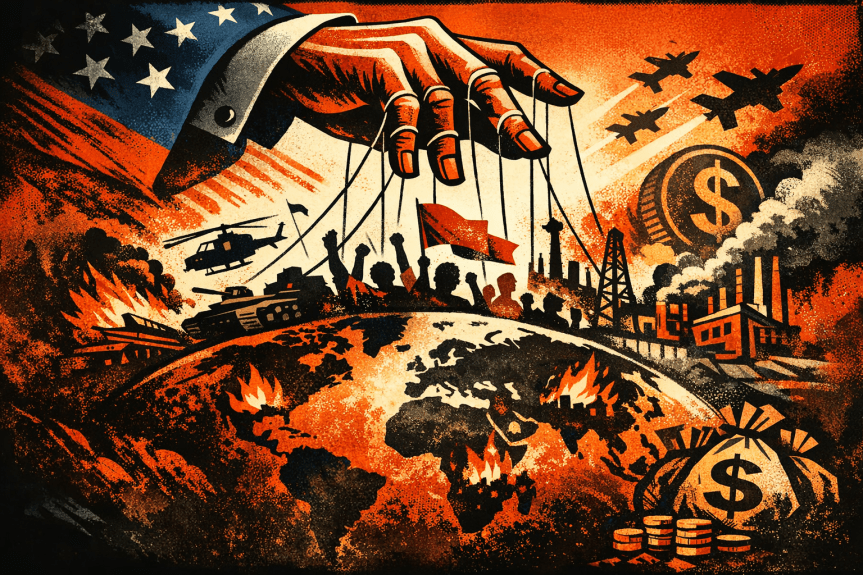
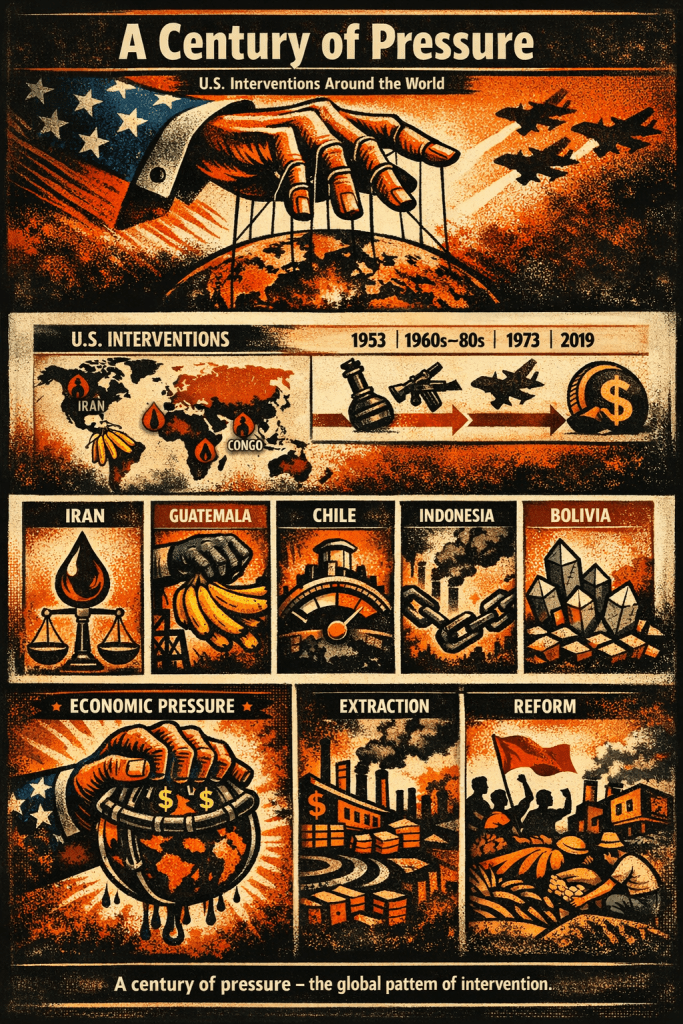
For the last hundred years, the United States has repeatedly intervened—covertly, economically, and sometimes militarily—against governments that tried to redistribute wealth, nationalise resources, or break from Western corporate and strategic influence. Historians argue that these actions were driven by Cold War ideology, corporate lobbying, and the desire to maintain a U.S.-led global order.

What was good for a country, its people and it’s ability to stand taller on it’s own two feet would not necessarily match with what would be in the interests of the US. When an agenda of profit over people would and continues to override the agenda, then something was going to have to give and yes people are going to suffer at the expense of profit. This is not a question of simply destroying possible authoritarian undemocratic non US influenced countries across the globe that worked against the interests of the US. But often a case of destroying left leaning democracies of countries that no longer saw the US as having their democracies interests at heart and looked to stand on their own two feet rather than in someone else’s corporate shadow. Israel’s belief to wipe out infrastructure and opposition across the middle east at this present time with the support and backing of Donald Trumps government appears to come across as regime destruction on steroids.

Below is tour of ten countries where left‑leaning governments attempted major reforms—and what happened next.

Iran (1953) — Oil Nationalisation Meets Cold War Anxiety

Mossadegh nationalised Iran’s oil to fund national development. The U.S. and UK removed him, restoring Western control of oil and installing the Shah. Impact: dictatorship, repression, and decades of instability.

Guatemala (1954) — Land Reform vs. United Fruit

Árbenz redistributed unused land, including United Fruit’s vast holdings. A CIA-backed coup followed. Impact: a 36‑year civil war and mass atrocities.

Congo (1960–61) — Lumumba’s Independence Project

Lumumba wanted Congo’s mineral wealth to benefit its citizens. He was removed and later killed during Cold War manoeuvring. Impact: Mobutu’s long dictatorship and entrenched poverty.

Brazil (1964) — Social Reform Meets U.S. Alarm

Goulart pushed land and tax reform and expanded voting rights. Washington supported a military coup. Impact: 21 years of authoritarian rule.

Indonesia (1965) — The Anti‑Communist Purge

Sukarno balanced nationalist and communist factions. The U.S. supported forces that eliminated the PKI. Impact: mass killings and Suharto’s authoritarian regime.

Chile (1973) — Allende’s Democratic Socialism

Allende nationalised copper and expanded social programmes. The U.S. backed efforts to destabilise his government. Impact: Pinochet’s dictatorship and widespread human rights abuses.

Nicaragua (1980s) — The Sandinista Revolution

The Sandinistas expanded healthcare, literacy, and land reform. The U.S. funded Contra forces to undermine them. Impact: civil conflict and economic collapse.

Grenada (1983) — Maurice Bishop’s Vision

Bishop promoted workers’ rights and social programmes. The U.S. invaded after internal political turmoil. Impact: end of an independent development model.

Burkina Faso (1987) — Sankara’s Anti‑Imperialism

Sankara pursued vaccination, women’s rights, and debt rejection. He was killed in a coup widely viewed as externally influenced. Impact: reversal of reforms and renewed dependency.

Bolivia (2019) — Lithium, Gas, and Indigenous Power

Morales nationalised resources and reduced poverty. He was forced out amid disputed election claims. Impact: political instability and policy reversals.

The Pattern

Across these cases, historians highlight recurring themes:

  • Resource control: oil, copper, bananas, lithium, minerals.
  • Corporate lobbying: United Fruit, ITT, major oil firms.
  • Cold War containment: fear of Soviet influence.
  • Prevention of alternative models: successful left‑leaning democracies risked inspiring others.

The result was often the same: authoritarian regimes, economic dependency, and long-term instability, while the U.S. secured strategic allies, resource access, and corporate protection.

Trump as Continuity, Not Exception

Trump’s foreign policy sits in the same long arc of U.S. interventionism—but with a different style and toolkit rather than a different underlying logic.

Continuities with past interventions

  • Same core objectives: Regime alignment, not democracy per se. Like earlier coups and covert ops, Trump’s moves aimed to weaken governments seen as hostile to U.S. interests—especially left‑leaning or anti‑U.S. ones (Venezuela, Iran, Cuba, Nicaragua)—and to favour regimes or oppositions more open to U.S. strategic and corporate priorities.
  • Economic warfare instead of classic coups: Where the 1950s–70s used CIA coups and military backing, Trump leaned heavily on sanctions, financial strangulation, and diplomatic isolation—“maximum pressure” on Iran, crushing sanctions on Venezuela, tightening the embargo on Cuba. The mechanism changed, but the goal—forcing political change by making the economy scream—echoes Chile under Allende.
  • Targeting left or left‑populist governments:
    • Venezuela: Recognition of Juan Guaidó, sanctions on oil, and open talk of regime change mirror older U.S. hostility to resource‑nationalising, left‑populist governments in Latin America.
    • Cuba & Nicaragua: Expanded sanctions and rhetorical framing of these states as part of an “authoritarian socialist” axis continues the Cold War pattern of isolating left governments in the hemisphere.
    • Iran: “Maximum pressure” and talk of regime change fit the long line from the 1953 coup through to contemporary attempts to weaken the Islamic Republic.
  • Protection of strategic and corporate interests: Just as United Fruit, copper companies, and oil majors shaped earlier interventions, Trump’s policies aligned with energy, defence, and financial interests: backing Gulf monarchies, supporting fossil‑fuel exporters, and pushing for favourable investment conditions in Latin America while punishing governments that nationalised or tightly controlled key sectors.

What’s different about the Trump era

  • More overt, less covert: Earlier interventions were often deniable; Trump frequently said the quiet part out loud—talking openly about “taking the oil,” “dominance in the western hemisphere,” or regime change in Venezuela and Iran. The underlying logic wasn’t new; the candour was.
  • Transactional framing instead of grand ideology: Cold War presidents wrapped interventions in anti‑communist rhetoric and “freedom” language. Trump framed many moves as deals, leverage, and dominance—America First rather than a universal mission—though the effect on targeted states (economic collapse, political destabilisation) often resembled earlier anti‑left operations.
  • Less state‑building, more pressure and exit: Compared with Bush’s Iraq or earlier occupations, Trump was less interested in long‑term reconstruction and more in short, sharp pressure: sanctions, recognition of rival leaders, targeted strikes (e.g. killing Soleimani) and then stepping back, leaving fractured political landscapes behind.

How to read Trump in the longer history

If you zoom out, Trump looks less like a rupture and more like a loud, stripped‑down version of an old pattern:

  • Left‑leaning or anti‑U.S. governments that control strategic resources are pressured, isolated, or targeted.
  • Economic tools (sanctions, financial blockades) now do much of the work that coups and covert ops once did.
  • The language has shifted—from anti‑communism to “terrorism,” “dictatorship,” or “socialism”—but the structural aim is similar: prevent alternative economic and political models that might weaken U.S. strategic and corporate advantage.

Britain Isn’t Working

Chained To A Past That Locks Away Its Future!

I’ve lived in the UK long enough to know its contradictions intimately. This is a country that can produce Oxford mathematicians, Glastonbury headliners, and Nobel‑winning scientists — yet can’t run a functioning train network on a rainy Tuesday. A country that invented the industrial revolution but now struggles to build a railway line without it becoming a national scandal.

The UK isn’t a failed state. It’s a stalled one. And the data backs that up.

This isn’t a doom‑scrolling exercise. It’s an attempt to understand why a country with so much potential consistently underperforms — and what it would take to turn it around.

Britain’s Economy Has Been Flatlining for 15 Years

Let’s start with the numbers, because they’re brutal.

  • GDP per capita in the UK has grown only 6% since 2007. The US grew 21% in the same period. Germany: 15%.
  • Productivity — the engine of living standards — has grown at 0.3% per year since 2008. Before the financial crisis, it was 2%.
  • Real wages are still below their 2008 level. That’s not normal. It’s unprecedented in modern British history.

This is the longest period of wage stagnation since the Napoleonic Wars. Think about that. Two centuries of progress — and then a flatline.

Why it matters

When productivity stalls, everything else stalls: wages, public services, investment, optimism. You can feel it in the national mood — the sense that the country is working harder but getting nowhere.

Why it’s happening

Because the UK rewards rent‑seeking (property, financial extraction) more than value creation (innovation, skills, manufacturing). Because we underinvest in infrastructure, R&D, and people. Because our planning system is a productivity‑killing machine.

What would make it better

  • A national investment strategy focused on green energy, AI, biotech, and advanced manufacturing.
  • Planning reform so we can actually build things again.
  • Tax incentives that reward innovation, not speculation.
  • A skills system that treats vocational excellence as a national asset.

Britain doesn’t lack talent. It lacks a system that knows what to do with it.

Public Services Are Failing Because They’re Designed for a Different Century

You don’t need statistics to know the NHS is struggling — but the statistics are still shocking.

  • NHS waiting lists: 7.6 million people.
  • Average time to charge an offender in England: over 400 days.
  • Local councils: 1 in 5 at risk of effective bankruptcy.
  • Train cancellations: highest on record.

This isn’t because people aren’t working hard. It’s because the system is structurally broken.

The deeper issue

Britain runs 21st‑century problems on 19th‑century institutional architecture. Westminster is hyper‑centralised, overloaded, and allergic to long‑term planning.

What would make it better

  • Multi‑year funding settlements so services can plan instead of firefight.
  • A national digital transformation programme across health, justice, and local government.
  • Workforce strategies that treat staff as humans, not line items.
  • Radical simplification: fewer agencies, clearer accountability.

We don’t need to spend like Scandinavia to get Scandinavian outcomes. We need to design like Scandinavia.

The UK Has a Confidence Problem — and It Shows Up in the Data

This is the part that feels personal.

Britain has slipped into a cultural posture of low expectations. We’ve normalised decline. We’ve become experts at explaining why things can’t be done.

And the data reflects that psychology:

  • The UK invests less than 1% of GDP in public R&D. South Korea invests 4.9%.
  • Business investment is 30% below the OECD average.
  • The UK builds half as many homes per capita as France.
  • We take longer to build infrastructure than almost any developed country.

This isn’t just economics. It’s culture. A country that doesn’t believe in its future won’t invest in it.

What would make it better

  • A national narrative of renewal, not nostalgia.
  • Civic education that builds agency and critical thinking.
  • A media ecosystem that rewards depth, not outrage.
  • A political class that talks about the future instead of the past.

Britain needs to rediscover ambition. Not arrogance — ambition.

Our Democracy Doesn’t Feel Democratic

Trust in politics is at historic lows. And again, the numbers tell the story:

  • The UK has one of the least proportional electoral systems in the developed world.
  • Millions of votes effectively don’t count in safe seats.
  • Turnout among young people is collapsing.

People aren’t apathetic. They’re alienated.

What would make it better

  • Proportional representation or a hybrid system.
  • Citizens’ assemblies for long‑term issues like climate, AI, and constitutional reform.
  • Radical transparency in political funding.
  • Digital participation tools that bring people into policymaking.

Democracy isn’t just voting. It’s agency. And Britain has been quietly stripping agency away.

The Real Problem: Britain Has No National Project

This is the heart of it.

Countries that thrive have a mission. A story about what they’re building and why it matters.

Japan: robotics and advanced manufacturing. South Korea: technology and innovation. Denmark: green energy. The US: AI, biotech, and frontier science.

The UK? We don’t know. We haven’t known for a long time.

What would make it better

Britain needs a national project big enough to unite people and concrete enough to guide policy. For example:

  • Becoming the world leader in green energy.
  • Building the most advanced digital public services on the planet.
  • Creating Europe’s innovation supercluster.
  • Designing a new social contract for the 21st century.

A country without a project becomes a museum. A country with a project becomes a magnet.

Britain Isn’t Broken — It’s Under‑Designed

This is the part where I get frustrated, because the UK’s problems are not mysterious. They’re structural, cultural, and entirely fixable.

Britain has the talent. Britain has the resources. Britain has the institutional memory.

What it lacks is the decision to reinvent itself.

A better Britain isn’t a fantasy. It’s a design challenge. And like all design challenges, it begins with imagination, clarity, and the courage to build something new.

Britain must learn from its past but not live within its past – reform the monarchy, tax those that profit from others at no expense to themselves. Free people to work and be creative. Do not punish those that can’t work because of those that won’t work. Create a state that does not promise all to everyone and consistently delivers nothing to no one.

Amy Macdonald – The Human Demands

Live, Work, Die Repeat

The UK economy consists of workers, unemployed and those that profit from the status quo.  

The UK economy in 2026 is characterized by a high-inequality structure where the richest 1% own roughly 21% of wealth, while over 14 million people live in poverty. A weakening labor market has seen unemployment rise to 5.2% with over 9 million economically inactive, often due to long-term sickness, while corporate profits have contributed significantly to cost-of-living pressures.

Those that Work (75.0% employment rate): As of Oct-Dec 2025, approximately 34.24 million people are in work, though the labor market has loosened, with payrolled employees falling in early 2026.

Those that Don’t (20.8% inactivity rate): Economic inactivity remains high, driven primarily by long-term sickness, and an aging population, with youth unemployment (18-24) hitting high levels in early 2026.

Those that Profited: Wealth concentration is high; the richest 56 billionaires hold more wealth than 27 million other people combined. This group’s wealth has grown significantly faster than earnings, benefiting from capital growth, while many households face stagnant incomes and high costs. 

The UK economy in 2026 is defined by a widening gap between earned income and accumulated wealth, with persistent “economic inactivity” and high levels of wealth concentration among a small minority. 

1. Those Who Work (The Employed)

The workforce remains the primary driver of the economy, though it faces significant pressure from “fiscal drag” and rising costs. 

Employment Rate: As of late 2025/early 2026, the UK employment rate stands at approximately 75.0%.

Tax Burden: Many workers are paying more in direct taxes due to frozen income tax thresholds (Personal Allowance remains at £12,570), a phenomenon known as “fiscal drag” that brings more people into higher tax brackets as nominal wages rise.

Income Inequality: The top 1% of income taxpayers account for 12.9% of all pre-tax income, while the bottom 10% account for just 0.3%. 

2. Those Who Don’t (The Unemployed and Inactive)

This group includes both those looking for work and a historically large number of people who are “economically inactive.” 

Unemployment: The unemployment rate has risen to 5.2% (approx. 1.88 million people), with youth unemployment (ages 16–24) being particularly high at 16%–17%.

Economic Inactivity: Roughly 20.8% of the working-age population (over 9 million people) is economically inactive.

Health Drivers: A major driver of this inactivity since 2020 has been long-term health conditions, which remain at historically high levels. 

3. Those Who Have Profited (The Wealthy)

Wealth in the UK is increasingly decoupled from active work, favoring those with existing assets like property and pensions. 

Wealth Concentration: The top 10% of households own more than one-third of the national wealth, with an average of roughly £2.3 million per person. The bottom 10% have almost no net wealth.

Asset Divide: Total household wealth is over 15 times higher for those who own their homes outright compared to those who rent.

Difficulty of Advancement: In 2008, it took 10 years of typical earnings to move from the middle to the top of the wealth distribution; by 2018, this had increased to 16 years, making it harder for working families to “climb” through labor alone.

Corporate Profiteering: Some analysis suggests a “profiteering crisis,” where corporate profits have outpaced wage growth, further concentrating gains among shareholders and asset owners. 

Survive, vote and demand change for the better for you and all.

Those of us blessed to live in democracies should vote for and advocate for positive political and economic change. With the rise of the green party as a potential political and economic force for good in the UK this can only be positive for all. Old invested interests will fight hard for the states quo to continue but what even if there reaches a threshold when even the statues quo of profiting at the expense of everything else also ultimately becomes unsustainable then change must and will come. We should vote and advocate for what shape that change must and will be in the form of.

With rising pressures on human employment stability and continued worsening growths in gaps in wealth between those that exploit others and those that are exploited, political change needs to take place to readdress a balance between the humans that have a right to live and exist over those that wish to dominate for their own self interests at the expense of others.

Is Our Global System Corrupt or Immoral? Insights and Impacts

Whether our global system is immoral or corrupt is one of the most debated questions in modern philosophy, economics, and sociology. There isn’t a single factual answer, but rather a tension between two primary perspectives:

The Argument for Systemic Corruption

Critics argue the system is inherently flawed because it often prioritises capital accumulation over human well-being. They point to: 

  • Extreme Inequality: A tiny percentage of the population holds more wealth than the bottom half of the globe combined.
  • Environmental Exploitation: Economic growth often relies on the depletion of natural resources, leading to the climate crisis.
  • Power Imbalance: Large corporations and wealthy individuals often have disproportionate influence over political legislation, which can undermine democratic processes. 
  • Environmental Degradation: The current economic model relies on extracting natural resources, which has led to overshooting planetary boundaries. Seven out of eight earth system boundaries—including climate, biodiversity, and fresh water—have been breached.
  • Inequality: Despite overall growth in global GDP, wealth inequality is increasing in most countries. This leads to a concentration of power and wealth, where “marginalized communities often bear a disproportionate burden of environmental pollution and degradation”.
  • Unsustainability: The focus on short-term profit and “planned obsolescence” results in excessive waste and pollution. The current model is described by some researchers as an “environmental pyramid scheme” that depends on intergenerational theft.
  • Social Distress: Modern economic life, characterized by high-demand jobs and job insecurity, is linked to lower social connectedness and higher mental distress. 

The Argument for Systemic Progress

Conversely, proponents argue that the current global exchange has done more to improve the human condition than any previous system. They point to: 

  • Poverty Reduction: Global extreme poverty rates have plummeted over the last 50 years.
  • Innovation: Competition drives advancements in medicine, technology, and renewable energy.
  • Rule of Law: While imperfect, modern systems have established human rights frameworks and international trade laws that provide a level of stability unprecedented in history. 

Conclusion on Future Outlook

Ineffective Decoupling: It is unlikely that economic growth can be fully decoupled from environmental damage at a global scale, meaning a, “selective downscaling of production and consumption” is necessary to lower the ecological footprint.

Fundamental Transformation Needed: Research indicates that to ensure a “good life for all within the planet’s limits,” the current system must be drastically restructured.

Towards a “Wellbeing Economy”: Many experts advocate for a shift toward “wellbeing economies” that prioritize sustainability, social health, and environmental safety over purely economic, growth-based metrics like GDP.

Amazon and Red Nose Day: A Controversial Partnership

Jeff Bezos outsourced his staff and tax responsibilities while asking us to raise funds for red nose day to help fight local and global poverty.

The Red Nose Day Controversy

Partnership Role: Since 2023, Amazon has been the official home of the Red Nose, handling the production and distribution of the noses and related merchandise.

Public Reaction: Critics and some members of the public have labelled the partnership as hypocritical, arguing that a company accused of aggressive tax avoidance is being positioned as a champion for addressing poverty and the cost of living in the UK.

Employee Fundraising: While Amazon encourages its staff to participate in fundraising activities like virtual photobooths and fancy-dress walks, critics point out that these same workers have reportedly faced benefit cuts to fund their own pay rises. 

Staff and Outsourcing Allegations

Worker Conditions: Reports have surfaced of Amazon warehouse workers being under significant pressure to meet targets, with some reportedly sleeping in tents because they cannot afford local rent on their wages.

Relief Fund Backlash: During the pandemic, Amazon faced intense criticism for allowing the public to donate to a relief fund for its own contract and seasonal workers, despite the company’s multi-billion dollar profits. 

UK Tax Responsibilities

Reported Tax Gap: Campaigners estimate that Amazon’s “systematic corporation tax avoidance” may have cost the UK Treasury as much as £575 million in 2024 alone.

Tax Credits: Investigations by Tax Justice UK highlighted that Amazon’s main UK division paid no corporation tax in 2022 and instead received millions in government tax credits for infrastructure investments.

The idea that “charity is people stepping in where governments are failing” is a widely discussed perspective, particularly in the context of rising demand for food banks, housing support, and social care in the UK. While charities have historically played a role in social welfare, evidence suggests they are increasingly serving as a, sometimes strained, safety net due to gaps in state provision.

Ani DiFranco – Work Your Way Out

Economic Black Holes: The Threat of Extreme Wealth Inequality

I think those with wealth and power seek to sustain or increase said wealth and power. The system’s not flawed from the players perspective it is simply one to be used and manipulated to bend to ones own rules and will.

We don’t need monarchs to supress and control us, as we now have a feudal system where the masses work or starve for millionaires and billionaires.

The desire for political and economic domination among wealthy individuals stems from a complex interplay of psychological factors, the nature of wealth accumulation, and systemic influences.

Key reasons include:

Power and Control Wealth provides power and influence, which some individuals enjoy exercising over others. The ability to control one’s own outcomes and exert influence over others becomes an appealing strategy for maintaining status.

Personality Traits Psychologists have noted a correlation between high socioeconomic status and certain personality traits referred to as the “dark triad”:

Machiavellianism: A willingness to manipulate and exploit others for personal gain.

Narcissism: An over-inflated sense of self-importance and entitlement, coupled with a lack of empathy.

Psychopathy: Characterized by a lack of empathy or remorse, antisocial behavior, and a desire to dominate others.

Systemic Reinforcement In highly unequal societies, dominance-based strategies can be more effective and carry less risk of backlash, as those with less power have fewer resources to resist. The existing system often rewards selfish actions, creating a feedback loop where those who engage in such behaviour become wealthier and more powerful.

Fear and Insecurity For some, the drive to accumulate and maintain power is rooted in fear—a fear of losing their status, security, or identity.

Addiction and Competition The pursuit of power and wealth can become an addiction, as achieving success can trigger dopamine responses in the brain. This is often reinforced by a competitive mindset, where status is a relative game, and there’s a constant drive to be “on top”.

Lack of Empathy The wealthy may live in social “bubbles,” isolating them from the realities of those with fewer resources and leading to a reduced capacity for empathy for those in lower socioeconomic classes.

Mega wealth can form economic black holes that suck up and damage alomst everything else in its path.

Extreme wealth concentration is widely reported by major economic institutions as an ongoing and accelerating issue that leads to significant economic and social damage, effectively acting as the “economic black holes” you describe. It exacerbates poverty, distorts democratic processes, and can impede overall economic growth, particularly in developing nations. 

Current State of Wealth Concentration

Recent reports from 2025 highlight the severity of the situation:

  • Millionaires own nearly half of the world’s total personal wealth.
  • The top 10% of earners in the U.S. owned almost two-thirds of the total wealth in Q1 2025, while the bottom 50% owned just 2.5%.
  • Between 2000 and 2024, the world’s top 1% captured 41% of all new wealth, compared to just 1% for the bottom 50%.
  • A recent study found that the world’s richest people own three times more wealth than the bottom half of the global population combined. 

Key Economic and Social Damages

The effects of this wealth concentration are far-reaching and consistently linked to negative outcomes:

  • Impeded Economic Growth: While some level of inequality might incentivize innovation in developed economies, research in 2025 indicates that excessive inequality generally acts as a brake on growth, especially in developing countries. This is partly due to reduced aggregate demand and underinvestment in human capital (education and healthcare) among lower-income groups.
  • Increased Poverty and Precarity: High wealth inequality drives poverty and economic insecurity for those at the bottom. The absence of a financial safety net means many households struggle to manage unexpected shocks, and a significant portion of the population can have net negative wealth (more debt than assets).
  • Distortion of Democracy and Power: Extreme wealth translates into disproportionate political power, allowing the rich to influence rules and policies in their favor, such as through lax inheritance tax laws. This creates a vicious cycle that entrenches inequality and erodes public trust in institutions.
  • Amplification of Other Inequalities: Wealth disparities amplify existing inequalities based on race, gender, and geography. For example, studies show significant wealth gaps between ethnic groups and a substantial difference in average wealth between men and women.
  • Environmental Harm: Consumption patterns of the wealthy elite drive higher carbon emissions, while the poorest populations, who contribute least to climate change, are often the most vulnerable to its impacts. 

Regional Inequality

Wealth inequality is a global issue but is most severe in certain regions. Brazil, Russia, and South Africa have the highest Gini coefficients for wealth inequality in 2024, indicating a highly concentrated distribution of assets. In contrast, countries like Slovakia and Belgium exhibit more even wealth distribution, often attributed to strong social safety nets and policies promoting broader asset ownership.

Future Outlook and Recommendations

Experts warn that without significant policy interventions, such as progressive taxation and stronger social safety nets, the current high levels of inequality are likely to persist or worsen. The next decade is projected to see trillions of dollars in wealth passed down through inheritance, which, in the absence of effective inheritance taxes, is expected to further entrench wealth disparities and undermine social mobility.

Our capitalist designed system is not set to act in our interest! 

Capitalism is an economic system where private individuals or businesses own capital goods like factories and resources, rather than the government or state. The goal is to produce goods and services and generate profit, with supply and demand playing a key role in determining prices and resource allocation. 

But in our global system, capitalism enables the wealthy and powerful to not just own business and means of production but ownership and direction of our governments, public perceptions of reality through the media and a persuasive overarching state of opinion on what should be considered successful, truthful and normal over what is considered a failed system, abnormal and even a lie. 

We operate and exist in extremely complicated economic global structures which dependent on where you look at it from can look extremely pleasing e.g. for those with wealth and power and control its a system within which they see considerable benefit for themselves but to those that live in areas of the world that are exploited such as taking away ecological resource being harvested and irreversible destroyed for economic gain such as the destruction of tropical rain-forest or the abstraction of finite minerals and other resources or even worse those living in an area where there are wars or violence inflicted on people as a means to obtain wealth, power and control things are a lot worse when your being exploited at the expense of the person that is exploiting you.This can be done through both legal and illegal means of exploitation.  

The most logical means of production and consumption to a maximum number of people at a competitive price should be by individuals and organisations but just as ‘power corrupts, and absolute power corrupts absolutely’. The cost to humanity, our ecosystem and our governments integrity should all be priced into production, the means of production and our ability to consume and sustain our ability to produce and consume. 

Our governments today are not deep thinkers and do not show signs of thinking outside of the box of tools within which they think they are provided with. Capitalism and consumption should not be at any cost. A system that eats itself, destroys its own environment and severely impacts on humans within its own sphere of influence is not a healthy form of government and should therefore not be aspired to or believed to be the only economic game in town.

Just because the exploitation that feeds your economy take place on  a global scale and not in your back yard does not mean that the people within positions of power whom exploit others that live within your countries are not in some way responsible for the exploitation of the globe, the chances are the greater wealth that is obtained by someone in this world will likely be at the expense of the planet or the humans within which live upon it that have been exploited in order to capitalize on said wealth   

Just as bees collect pollen and produce beautiful wondrous nests full of honey. We as creatures must consume to exist and wondrous things have and continue to be produced as we consume and exist. As we produce and engage in ever wondrous antics to assist us to hopefully at first survive and if and when possible thrive. Consumption to exist and where possible thrive is very much in our nature but just to be a capitalist being born to exploit at the expense of others is perhaps perceived as normal but not truly necessary or sustainable into the future. 

A healthy society of consumers needs to have strong and robust legal system designed to prevent genocide, ecocide and other forms of manipulation, destruction and death across society so as to maximize the amount of sustainable growth and consumption but not at the expense of those with power, wealth and money being entitled and enabled by our political, legal and media establishments to destroy the environments of others or itself merely for profit from such actions themselves. That is not just an unsuccessful use of a system but one that is inherently flawed for humanity and the planet within which we live upon and sustains our lives.


 We need to talk about wealth and tax the rich

It really is a taboo to talk about taxing the wealthy or super rich, let alone electing political officials that introduce such measures. Most people with millions and billions of pounds can not only afford to hire great minds and accountants to ensure they pay the bare minimum in taxes, they can also afford to fund political interests in both the left and right side of the mainstream political establishment to stand up and enforce a no tax policy for the super wealthy to such an extent that it is never mainstream enough political idea or policy that might be adopted by governments across the global mainstream of wealthy or developed economies and countries where such policies could truly save and enhance lives.  

In the US wealth is good and talking about taxing wealth in some way makes you a communist ,which is just nonsense, but again the propaganda painted like dirty mud on a wall it sticks backed up by both mainstream republican and democrat parties.  

In the UK the super wealthy people here are often landowners and royalty, asset owners and stripers but not really in the game of working or being out of work but like many with wealth very quick to judge those out of work or in low paid jobs. It is so taboo in the UK to say or even argue that the monarchy should pay its fair share of tax or live within the countries means and have money spent on it that the country can afford or even just pay for its own affairs AND be taxed too – such views are heresy and taboo.  No knighthoods for the PM that advocates the downsizing of a royal budget. Its in the interest of the wealthy of the UK to see the defence of the monarchy and the money that is spent on maintaining it and not taxing it as sacrosanct because it also keeps in line the rest of the population with the illusion that no super wealthy people should be taxed of their wealth especially the royals and their chums.

Since Covid-19 the amount of money that has gone to the super rich and already wealthy has sky rocketed and they will do all they can to keep hold of said wealth even though they will do vary little with it accept have a few more digits on a bank account or two.

When money is given an opportunity to be earned or provided to those that are deemed working class, underclass or even middle class the vast majority of that finance will be ploughed back into the consumption economy which will be good for jobs and consumer spending and retailers. But when money just becomes digits in a bank account sitting generating interest for the super rich, it has no capacity to oil the wheels of an economy like it can seeing real finance in the hands of those that are able to directly spend said finance into a consumption economy.

The UK labour government are bending over backwards at present to please people that have no interest in being pleased by them. You have Trump taxing the globe for trade arguments and divisiveness generating dollars for a US government that is presently stopping many good products and services it delivers to its own citizens as well as those around the world as a huge experiment in how to screw things up that will likely go badly wrong. You have Labour in the UK rolling out Austerity 2.0 for those on benefits in the UK there is no plan 1.0 let alone 2.0 on how to modernise the monarchy or increase wealth generation from the rich in the UK, you can in no way provide for a society by piddling around at the edges of an already failing wealth maintaining system as is the UK. Those across the globe that increase their own wealth and fortune at the expense of the spending power of others often seem more like black holes absorbing and destroying other areas of the economy and sucking out the life of all in their way without replacing the taken away wealth with a a positive generated benefit at all.

This is not just a collection of theories but an unsustainable model of consumption and wealth generation. Just as economic drivers and wealth holders do not care for the wildlife and environment that sustains us all, that their wealth generation has destroyed, shock horror they also do not care about the people damaged and destroyed in the process of this pattern of wealth creation either. Hence tax the wealth before it destroys us all and there is then nothing left to be destroyed or taxed at all.   

If governments are not their to save lives and enhance the way we live then what are we voting for at all, we don’t vote for slightly better terms or existence. We vote to be given an opportunity to be alive and thrive not just to survive or slowly be chipped away at or suddenly stolen from us until we die.

Running To Stand Still – Elbow