A Century of Global Health Interventions: From Smallpox to COVID-19

Over the past 100 years, several coordinated global interventions have significantly improved human health, reduced poverty, and increased life expectancy… These actions were primarily driven by international organizations (UN, WHO), specialized global alliances, national governments, and large philanthropic foundations.

The most dramatic improvements came from global health campaigns that targeted the diseases and conditions that once defined human life.

Smallpox is the clearest example. In 1967, the World Health Organization launched a global eradication campaign. By 1979, the disease was gone. The document notes that this effort “successfully eradicated smallpox, saving an estimated 50 million lives.” It remains one of the most extraordinary achievements in human history.
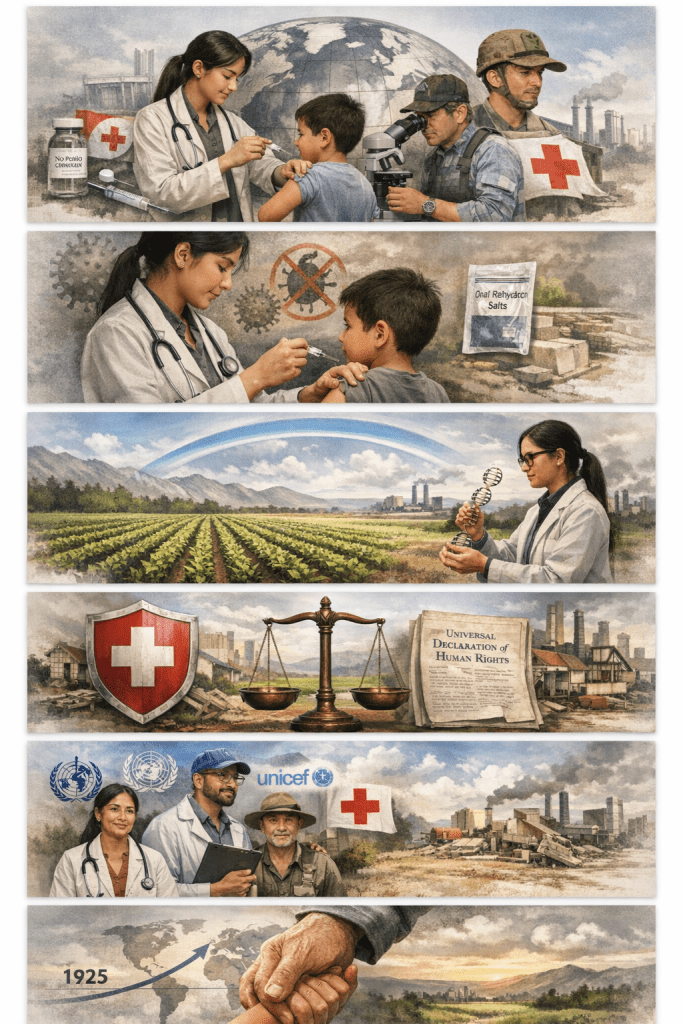
Polio followed a similar path. A coalition—WHO, UNICEF, Rotary International, and the CDC—drove cases down by more than 99%, preventing millions of children from lifelong paralysis.

Vaccination became the quiet infrastructure of global progress. Gavi, The Vaccine Alliance, helped immunise over a billion children, saving more than 17 million lives. The Global Fund, created in 2002, has saved over 44 million lives through its work on HIV, tuberculosis and malaria.

And sometimes the breakthroughs were beautifully simple. Oral Rehydration Therapy—a mixture of salts, sugar and water—has saved around 50 million lives, mostly children. It is a reminder that progress doesn’t always require cutting‑edge technology; sometimes it requires humility, persistence and the courage to scale what works.

Repairing the Planet We Live On

Not all interventions were medical. Some reshaped the environmental and technological foundations of modern life.

The Montreal Protocol stands out as a rare moment of global unity. When scientists warned that chlorofluorocarbons were destroying the ozone layer, governments acted. The 1989 treaty phased out ozone‑depleting substances and set the planet on a path to recovery. It remains the most successful environmental treaty ever signed.

The Green Revolution of the 1960s and 70s transformed global agriculture. High‑yield crops, fertilisers and irrigation systems dramatically increased food production in Asia and Latin America. Led by researchers like Norman Borlaug and backed by governments and philanthropic foundations, it helped avert famines that many believed were inevitable.

And in 2020, decades of research into mRNA technology suddenly became the backbone of the global COVID‑19 response. Governments, scientists, regulators and manufacturers collaborated at unprecedented speed to produce vaccines that saved millions of lives. It was imperfect, unequal and politically fraught—but it showed what coordinated science can achieve under pressure.

Building the Rules That Protect People

Some of the most important interventions weren’t about technology or medicine. They were about the rules that govern how humans treat one another.

After the Second World War, the Geneva Conventions were updated to protect civilians, medics and prisoners of war. The International Committee of the Red Cross became the custodian of these norms. They are violated often, but they exist—and they give the world a language for accountability.

The Universal Declaration of Human Rights, adopted in 1948, did something similar. It articulated a shared vision of dignity and rights that has shaped constitutions, treaties and social movements across the world. It didn’t create justice, but it gave people a tool to demand it.

The Marshall Plan, launched the same year, rebuilt Western Europe after the war. Beyond the money, it established a model of international cooperation that helped stabilise a continent that had torn itself apart twice in thirty years.

Who Made All This Happen

The cast of actors behind these interventions is broad and often surprising.

The World Health Organization sits at the centre of many of the major health victories. UN agencies like UNICEF, UNHCR and the World Food Programme have delivered food, vaccines and protection to hundreds of millions of people.

Philanthropic foundations—especially the Gates Foundation—have provided catalytic funding and political pressure for vaccines and disease eradication.

Researchers and academics have shaped the intellectual foundations of progress, from the creators of Oral Rehydration Therapy to economists like Amartya Sen, whose work reframed how we understand famine and democracy.

NGOs such as Médecins Sans Frontières, Oxfam, CARE and Save the Children have provided frontline action, advocacy and uncomfortable truths.

And behind all of this are the people who rarely get named: community health workers, farmers, teachers, parents, activists. They turn global policy into lived reality.

What Changed for People and Societies

The cumulative effect of these interventions is staggering. Life expectancy has roughly doubled in many parts of the world. Child mortality has fallen dramatically. Extreme poverty has declined. Diseases that once defined childhood—measles, diphtheria, tetanus—are now rare in many regions.

The document summarises this shift clearly:

“These efforts shifted humanity from a state of high infant mortality and disease prevalence toward a period where… human life expectancy has roughly doubled in the last century.”

This is not a story of inevitability. It is a story of choices—messy, political, imperfect choices—that nonetheless changed the trajectory of human life.

Why This Matters Now

It’s easy, especially in the UK’s current mood, to feel like the world is sliding backwards. But the last century shows that global interventions can work. They can save millions of lives. They can repair environmental damage. They can build norms that protect people even when politics fails.

The question for the next century is whether we still believe in that possibility. Whether we are willing to build institutions, share power and act collectively in the face of climate breakdown, antimicrobial resistance, AI governance and widening inequality.

The past 100 years offer a quiet but powerful answer: coordinated action works. The challenge is whether we choose to use it again.

Darkside Of A Super Power: How U.S. Undermined Left‑Leaning Governments Worldwide

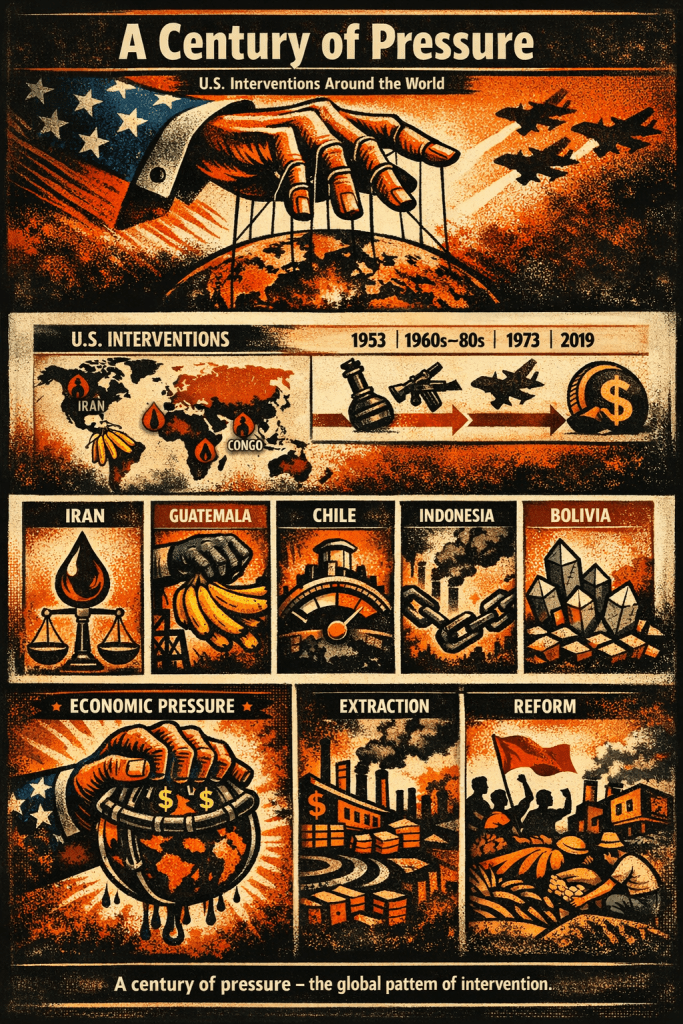
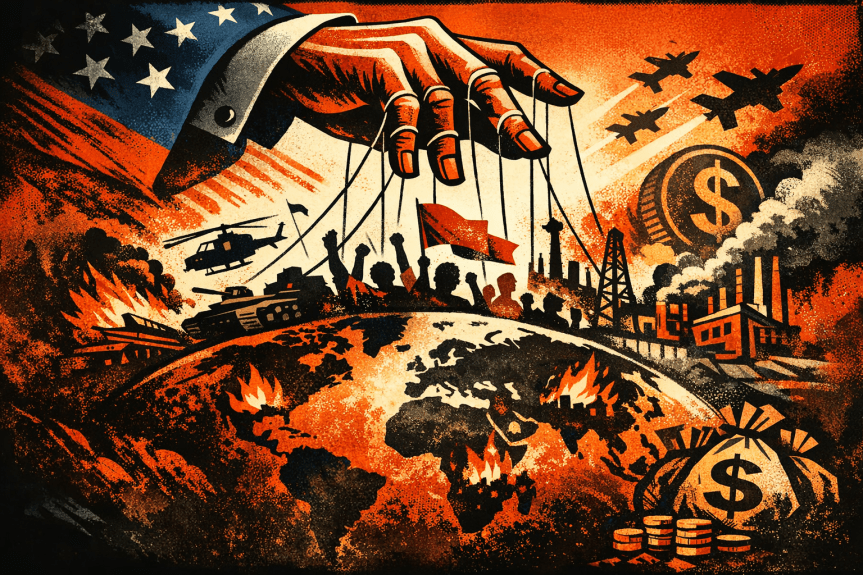
For the last hundred years, the United States has repeatedly intervened—covertly, economically, and sometimes militarily—against governments that tried to redistribute wealth, nationalise resources, or break from Western corporate and strategic influence. Historians argue that these actions were driven by Cold War ideology, corporate lobbying, and the desire to maintain a U.S.-led global order.

What was good for a country, its people and it’s ability to stand taller on it’s own two feet would not necessarily match with what would be in the interests of the US. When an agenda of profit over people would and continues to override the agenda, then something was going to have to give and yes people are going to suffer at the expense of profit. This is not a question of simply destroying possible authoritarian undemocratic non US influenced countries across the globe that worked against the interests of the US. But often a case of destroying left leaning democracies of countries that no longer saw the US as having their democracies interests at heart and looked to stand on their own two feet rather than in someone else’s corporate shadow. Israel’s belief to wipe out infrastructure and opposition across the middle east at this present time with the support and backing of Donald Trumps government appears to come across as regime destruction on steroids.

Below is tour of ten countries where left‑leaning governments attempted major reforms—and what happened next.

Iran (1953) — Oil Nationalisation Meets Cold War Anxiety

Mossadegh nationalised Iran’s oil to fund national development. The U.S. and UK removed him, restoring Western control of oil and installing the Shah. Impact: dictatorship, repression, and decades of instability.

Guatemala (1954) — Land Reform vs. United Fruit

Árbenz redistributed unused land, including United Fruit’s vast holdings. A CIA-backed coup followed. Impact: a 36‑year civil war and mass atrocities.

Congo (1960–61) — Lumumba’s Independence Project

Lumumba wanted Congo’s mineral wealth to benefit its citizens. He was removed and later killed during Cold War manoeuvring. Impact: Mobutu’s long dictatorship and entrenched poverty.

Brazil (1964) — Social Reform Meets U.S. Alarm

Goulart pushed land and tax reform and expanded voting rights. Washington supported a military coup. Impact: 21 years of authoritarian rule.

Indonesia (1965) — The Anti‑Communist Purge

Sukarno balanced nationalist and communist factions. The U.S. supported forces that eliminated the PKI. Impact: mass killings and Suharto’s authoritarian regime.

Chile (1973) — Allende’s Democratic Socialism

Allende nationalised copper and expanded social programmes. The U.S. backed efforts to destabilise his government. Impact: Pinochet’s dictatorship and widespread human rights abuses.

Nicaragua (1980s) — The Sandinista Revolution

The Sandinistas expanded healthcare, literacy, and land reform. The U.S. funded Contra forces to undermine them. Impact: civil conflict and economic collapse.

Grenada (1983) — Maurice Bishop’s Vision

Bishop promoted workers’ rights and social programmes. The U.S. invaded after internal political turmoil. Impact: end of an independent development model.

Burkina Faso (1987) — Sankara’s Anti‑Imperialism

Sankara pursued vaccination, women’s rights, and debt rejection. He was killed in a coup widely viewed as externally influenced. Impact: reversal of reforms and renewed dependency.

Bolivia (2019) — Lithium, Gas, and Indigenous Power

Morales nationalised resources and reduced poverty. He was forced out amid disputed election claims. Impact: political instability and policy reversals.

The Pattern

Across these cases, historians highlight recurring themes:

  • Resource control: oil, copper, bananas, lithium, minerals.
  • Corporate lobbying: United Fruit, ITT, major oil firms.
  • Cold War containment: fear of Soviet influence.
  • Prevention of alternative models: successful left‑leaning democracies risked inspiring others.

The result was often the same: authoritarian regimes, economic dependency, and long-term instability, while the U.S. secured strategic allies, resource access, and corporate protection.

Trump as Continuity, Not Exception

Trump’s foreign policy sits in the same long arc of U.S. interventionism—but with a different style and toolkit rather than a different underlying logic.

Continuities with past interventions

  • Same core objectives: Regime alignment, not democracy per se. Like earlier coups and covert ops, Trump’s moves aimed to weaken governments seen as hostile to U.S. interests—especially left‑leaning or anti‑U.S. ones (Venezuela, Iran, Cuba, Nicaragua)—and to favour regimes or oppositions more open to U.S. strategic and corporate priorities.
  • Economic warfare instead of classic coups: Where the 1950s–70s used CIA coups and military backing, Trump leaned heavily on sanctions, financial strangulation, and diplomatic isolation—“maximum pressure” on Iran, crushing sanctions on Venezuela, tightening the embargo on Cuba. The mechanism changed, but the goal—forcing political change by making the economy scream—echoes Chile under Allende.
  • Targeting left or left‑populist governments:
    • Venezuela: Recognition of Juan Guaidó, sanctions on oil, and open talk of regime change mirror older U.S. hostility to resource‑nationalising, left‑populist governments in Latin America.
    • Cuba & Nicaragua: Expanded sanctions and rhetorical framing of these states as part of an “authoritarian socialist” axis continues the Cold War pattern of isolating left governments in the hemisphere.
    • Iran: “Maximum pressure” and talk of regime change fit the long line from the 1953 coup through to contemporary attempts to weaken the Islamic Republic.
  • Protection of strategic and corporate interests: Just as United Fruit, copper companies, and oil majors shaped earlier interventions, Trump’s policies aligned with energy, defence, and financial interests: backing Gulf monarchies, supporting fossil‑fuel exporters, and pushing for favourable investment conditions in Latin America while punishing governments that nationalised or tightly controlled key sectors.

What’s different about the Trump era

  • More overt, less covert: Earlier interventions were often deniable; Trump frequently said the quiet part out loud—talking openly about “taking the oil,” “dominance in the western hemisphere,” or regime change in Venezuela and Iran. The underlying logic wasn’t new; the candour was.
  • Transactional framing instead of grand ideology: Cold War presidents wrapped interventions in anti‑communist rhetoric and “freedom” language. Trump framed many moves as deals, leverage, and dominance—America First rather than a universal mission—though the effect on targeted states (economic collapse, political destabilisation) often resembled earlier anti‑left operations.
  • Less state‑building, more pressure and exit: Compared with Bush’s Iraq or earlier occupations, Trump was less interested in long‑term reconstruction and more in short, sharp pressure: sanctions, recognition of rival leaders, targeted strikes (e.g. killing Soleimani) and then stepping back, leaving fractured political landscapes behind.

How to read Trump in the longer history

If you zoom out, Trump looks less like a rupture and more like a loud, stripped‑down version of an old pattern:

  • Left‑leaning or anti‑U.S. governments that control strategic resources are pressured, isolated, or targeted.
  • Economic tools (sanctions, financial blockades) now do much of the work that coups and covert ops once did.
  • The language has shifted—from anti‑communism to “terrorism,” “dictatorship,” or “socialism”—but the structural aim is similar: prevent alternative economic and political models that might weaken U.S. strategic and corporate advantage.

World Economic War 1

So rather than World War 3 has Donald Trump started an economic war and how has he done this and why? Well in simple terms he does not like the fact that US tends to buy more goods and services from other countries than other countries buy from the US. Secondly because he is a moron willing to do as yet incalculable damage to the global economy in the name of the USA and Trumpism Economics (whatever they might be) by raising tariffs against other countries across the globe that are looking to sell their goods and services to the US. A tarrif is a tax added to imported goods. Trump has done this for a variety of reasons such as A) he does not like a country that boarders his attitude to emigration and so wacked a tariff on, or B) because a countries goods and service are simply better or more competitive on the global market so he hits a tax on those too. Or finally C) where there are taxes already charged to US goods in the way of such as in the UK where nearly all goods and services including its own are charged VAT (value added tax) as an income stream for the UK. So Trump is adding this 20% tax to all goods imported from the UK too.   

Trumps Tariffs might make the US a considerable amount of taxable income in the short term but it will increase inflation and prices to US citizens as well as other citizens across the globe and as yet in world history I am not sure if anyone has won a trade war it just tends to unnecessarily hurt those countries and citizens of those countries that get caught up in it.  

Ultimately Trump is detonating an economic bomb simply because he can.