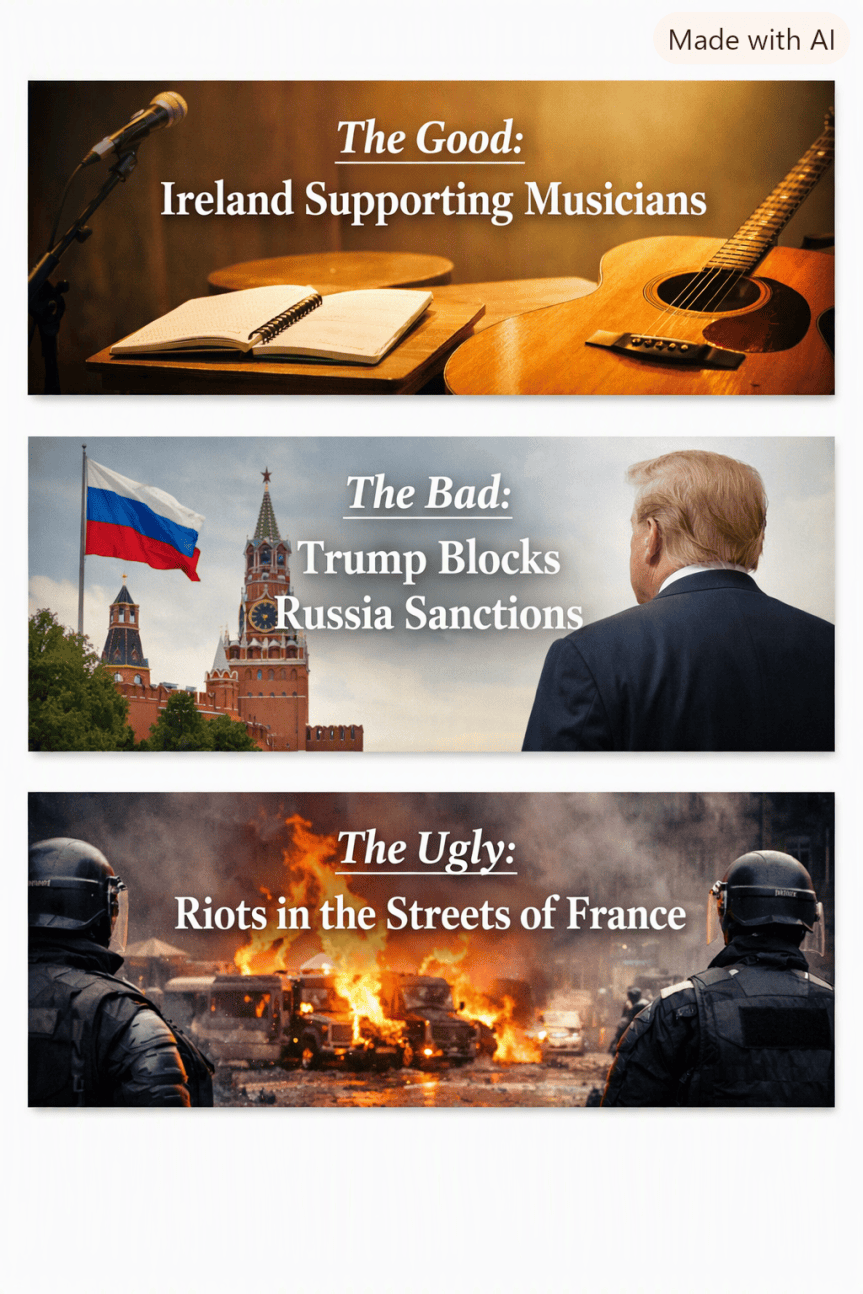
The world rarely moves in a straight line. Progress, backlash, and upheaval often arrive together, shaping a global landscape that feels contradictory and unstable. This week’s headlines capture that tension perfectly: a bold cultural investment in Ireland, a geopolitical shockwave from Washington, and explosive unrest on the streets of France.
Taken together, they reveal something deeper about the moment we’re living through — a world trying to reinvent itself while still wrestling with old fractures.
😇 The Good: Ireland Bets Big on Creativity
Ireland has done something quietly revolutionary: it has made its Basic Income for the Arts scheme permanent. According to the document, the government is committing €34.4 million over three years to support 2,000 professional artists and musicians, each receiving €325 per week to focus on their craft without the constant threat of financial precarity. Now I love to sing but there is no way on earth I could ever sing for my dinner I’m just not that great, but such good news for real artists in Ireland.
“Recipients get a €325 weekly stipend (€1,300 per month) to focus on their creative work without financial precarity.”
This isn’t just cultural generosity — it’s economic strategy. The pilot programme showed that every €1 invested generated €1.39 in social and economic value, a rare example of public funding paying for itself while enriching national culture.
Ireland is signalling something important: creativity is infrastructure. Cultural labour is real labour. And in a time when many countries are cutting arts budgets, Ireland is moving in the opposite direction — treating artists not as luxuries, but as essential contributors to national wellbeing.
😠 The Bad: Washington’s Sanctions Reversal Sends Shockwaves
Across the Atlantic, the mood is very different.
President Donald Trump has issued an executive order waiving Congress’s Russia sanctions package, specifically blocking the Lindsey O. Graham Sanctioning Russia and Iran Act of 2026. The document notes that this legislation was designed to slash funding for Russia’s war effort, making the waiver a dramatic geopolitical pivot.
“Trump suspended the implementation of the Lindsey O. Graham Sanctioning Russia and Iran Act of 2026.”
The move follows a controversial White House deal to import Russian diesel fuel to lower U.S. energy prices — a domestic economic calculation with global consequences.
Ukraine’s reaction was immediate and fierce. President Zelenskyy accused the administration of “completely disregarding” the law and providing a financial lifeline to Vladimir Putin.
This isn’t just a policy disagreement; it’s a fracture in Western unity at a critical moment. Energy politics, war economics, and domestic inflation pressures have collided, and Washington’s decision has left allies scrambling to interpret what comes next.
🛑 The Ugly: France’s School Protests Ignite Nationwide Riots
And then there is France — where frustration has boiled over into the country’s worst riots in years.
What began as high school student protests over teacher shortages, crumbling facilities, and overcrowded classrooms quickly escalated. Trade unions joined in. Yellow Vest activists mobilised. The grievances multiplied: cost of living, social service cuts, inequality, political disillusionment.
“Mass demonstrations across France have spiraled into the worst riots the country has seen in years, resulting in more than 1,200 arrests in a single weekend.”
The result was chaos. Fringe groups clashed with police, shops were looted, and public buildings torched — including the Limoges town hall, whose roof partially collapsed. Dozens of officers and demonstrators were severely injured.
France’s unrest is a reminder that social pressure doesn’t disappear when ignored; it accumulates. And when it finally erupts, it rarely stays contained to its original spark.
🌍 What These Three Stories Reveal About 2026
Individually, these developments seem unrelated. But together, they sketch a portrait of a world in transition:
- Ireland is experimenting with new social models that treat culture as a public good.
- The United States is navigating the tension between domestic economic pressures and global security commitments.
- France is confronting the consequences of long‑term social strain and institutional neglect.
The good, the bad, and the ugly are not separate categories — they are simultaneous realities. They show how nations are trying to adapt to economic shocks, political polarisation, and public frustration, each in their own way.
Some responses are constructive. Some are destabilising. Some are combustible.
But all of them matter.
🧭 Why This Matters?
This blog has always been about understanding the systems shaping our world — not just the headlines, but the underlying forces. These three stories highlight:
- The power of policy experiments (Ireland)
- The fragility of geopolitical alliances (U.S.–Ukraine)
- The volatility of social movements (France)
They also raise a deeper question: Are we entering an era where progress, crisis, and upheaval will increasingly coexist?
If so, the challenge for governments — and for citizens — is learning how to navigate a world where the forces of chaos and upheaval do not cancel out what is good from happening in our world.


