
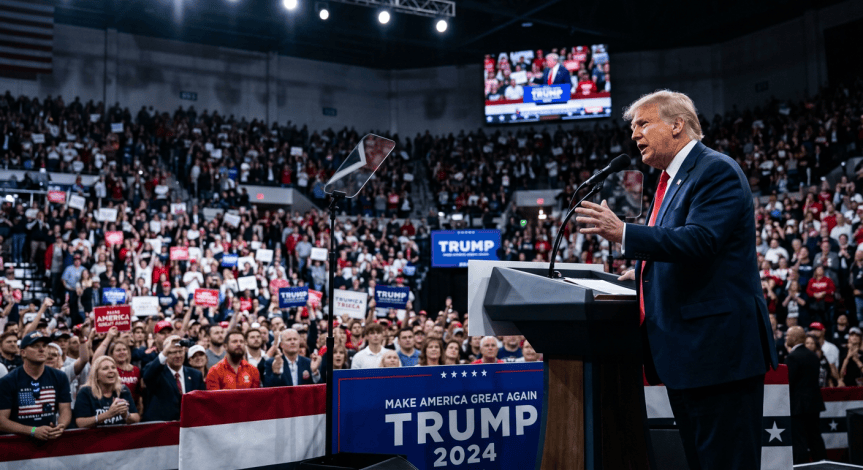
The Mouth That Makes and Breaks Power: Trump’s Persuasion Paradox
Trump’s rise and potential fall both hinge on the same thing: his mouth. His ability to speak plainly, emotionally, and provocatively has repeatedly helped him mobilise supporters — yet the very tactics that elevate him also generate backlash, fatigue, and political risk. This tension reveals something deeper about modern populist communication: persuasion and self‑sabotage can come from the same rhetorical toolkit.
Trump’s communication style — emotionally charged, simple, combative, and identity‑driven — is powerful in polarised environments but becomes counterproductive in moments requiring consensus, restraint, or institutional stability. His mouth is both his engine of mobilisation and his biggest liability.
Trump’s Persuasion Paradox in the Age of Emotional Politics

1. The Persuasion Engine
Trump’s ascent to power has always depended on one thing above all else: his mouth — the way he speaks, the emotional triggers he deploys, and the identity‑based narratives he repeats until they become political gravity.
His rhetoric operates on three powerful mechanisms:
- Emotional mobilisation — anger, fear, grievance, belonging
- Simplicity and repetition — short phrases, punchlines, slogans
- Dominance signalling — confrontation, certainty, defiance
Communication researchers note that this style works best in polarised environments, where voters respond more to emotional clarity than policy detail. Trump’s supporters often describe his speech as “saying what others won’t,” which creates a sense of authenticity even when statements are controversial or factually disputed.
In this sense, his mouth is not just a communication tool — it is a political engine.
2. The Digital Amplifier
Trump’s persuasion power is inseparable from the digital ecosystem that surrounds him. His words do not simply land — they echo, amplify, and mutate across platforms.
Three dynamics matter here:
- Networked audiences — supporters who share, remix, and defend his statements
- Algorithmic amplification — platforms that reward emotional content
- Media symbiosis — news cycles that react to his every phrase
This creates a feedback loop: Trump speaks → supporters amplify → media reacts → Trump responds → cycle intensifies. In this loop, his mouth becomes a central node in a vast communication network, capable of shaping national attention within minutes.
But amplification cuts both ways.

3. The Rhetorical Trap
The same communication style that elevates Trump also generates contradiction, fatigue, and backlash.
Researchers describe a phenomenon called discursive saturation: when a political figure speaks constantly, aggressively, and unpredictably, audiences eventually experience cognitive overload. Supporters may remain loyal, but undecided voters begin to disengage or push back.
Moments requiring consensus, calm, or institutional seriousness often expose the limits of Trump’s rhetorical approach. Statements that energise his base can alienate moderates, independents, and suburban voters.
This is the paradox: The mouth that mobilises can also exhaust.

4. The Boomerang Effect
Political communication scholars describe the boomerang effect: when persuasive tactics eventually produce the opposite of their intended outcome.
Trump’s communication style is particularly vulnerable to this dynamic because it relies on:
- High emotional intensity
- Constant conflict
- Identity‑based loyalty
These tactics are effective for mobilisation but risky for retention. Over time, emotional mobilisation can become emotional exhaustion, especially among voters who prefer stability or predictability.
In this sense, Trump’s mouth is both his greatest asset and his most persistent liability.

5. What This Reveals About Modern Politics
Trump’s persuasion paradox is not just about one man. It reveals something deeper about contemporary politics:
- Power now flows through emotional communication, not institutional authority.
- Digital ecosystems reward outrage more than nuance.
- Leaders can rise through speech alone — and fall the same way.
- Persuasion and self‑sabotage can come from the same rhetorical toolkit.
Trump’s mouth is a case study in how modern political power is gained and lost. It shows that communication today is not merely a tool of politics — it is politics.
Words matter in real life and politics because language shapes how we think, feel, and act, acting as the foundation for human relationships, laws, and power dynamics what Trump says can lead to what he does or who he does things to and if what you saying is full of hate and deception.
When Words Become Policy: Why Trump’s Language Matters More Than Most
Language is not decoration in politics — it is infrastructure. It shapes how societies think, feel, and act. It frames laws, legitimises power, and sets the emotional temperature of public life. Research on political rhetoric shows that leaders use language deliberately to frame issues, mobilise emotions, and steer public perception.
When Donald Trump speaks, the consequences ripple far beyond the microphone. His words influence how supporters interpret reality, how opponents mobilise, and how institutions respond. And when those words are saturated with anger, threat, or grievance, the policies that follow often carry the same emotional DNA.