A Democratic Point to view

The speaker and Senator Chuck Schumer of New York, the minority leader, have begun a media blitz to present an alternative message to the president’s lengthy daily briefings.

Speaker Nancy Pelosi has sat for 25 television interviews over the past three weeks.
Speaker Nancy Pelosi has sat for 25 television interviews over the past three weeks.Credit…Erin Schaff/The New York Times
Sheryl Gay Stolberg

By Sheryl Gay Stolberg

  • April 16, 2020

WASHINGTON — Speaker Nancy Pelosi doesn’t bother watching President Trump’s lengthy daily televised briefings on the coronavirus pandemic. “I don’t watch his shows,” she said in an interview Wednesday. “I don’t have time to watch him contradict himself from one day to the next.”

Still Ms. Pelosi, who is now deprived of the official trappings of the Capitol with Congress in an extended virus-instigated recess, is trying to counter the president’s White House sessions with her own media blitz from her kitchen in San Francisco.

Over the past three weeks, the speaker has sat for 25 television interviews, up from her typical one or two a month. On Monday, she told the “Late Late Show” host James Corden that Mr. Trump was “in denial” and called his push to swiftly reopen the country “really scary.” On Tuesday, she issued a blistering letter calling Mr. Trump an incompetent liar who had caused “unnecessary deaths and economic disaster,” and went on MSNBC to talk about it. On Wednesday, she appeared on CNN, calling Mr. Trump’s move to put his name on government stimulus checks “shameful.”

People in Washington have come to understand that if you want to communicate with Mr. Trump, the best way is to go on television, and Ms. Pelosi, who led the drive to impeach him, is a master at getting under the president’s skin. But Ms. Pelosi — in tandem with her Senate counterpart, Senator Chuck Schumer of New York, who is amping up his own media presence — is doing more than just taking potshots.

Eager to offer an alternate narrative to the one Mr. Trump has been presenting, the two are trying to play on what they regard as Mr. Trump’s biggest political weakness: For all the talking the president is doing, many Americans do not believe what he says.

Polls show that Mr. Trump’s rambling briefings, delivered from the White House briefing room or the Rose Garden just outside, are doing him little good. His job approval ratings, which saw a slight uptick when he first took to the airwaves, are stuck near 46 percent, the same as before the pandemic, according to an average calculated by Real Clear Politics. Surveys show that most Americans think the president waited too late to respond to the novel coronavirus. The nation’s governors are getting far better grades from the public.

  • Help us report in critical moments.

Subscribe today to support The Times

Ms. Pelosi and Mr. Schumer, looking toward the November elections amid deep anxiety among Americans about the pandemic, are trying to weaponize those sentiments. Sidelined from the Capitol, they lack Mr. Trump’s powerful megaphone. Ms. Pelosi is conducting interviews in front of a laptop in her well-appointed kitchen, with her high-end appliances in the background. Mr. Schumer has set up his iPad on a pile of books atop his dining room table in Brooklyn.

Latest Updates: Coronavirus Outbreak in the U.S.

See more updatesUpdated 14m agoMore live coverage: GlobalMarketsNew York

“It’s supposed to be at eye level,” he explained in an interview Thursday.

Despite their considerably less grand backdrops, the two have managed to play jujitsu with the president, by either baiting Mr. Trump with their own television appearances or commandeering at least some portion of his briefings by raising questions, reiterated by reporters who then push him to respond.

“Even if the public doesn’t hear them directly, Schumer and Pelosi still play a very influential role in shaping the debate in a way that affects what Trump has to answer for when he does his media circus,” said Geoff Garin, a Democratic pollster. “They may not always have the ear of the public, but they have Trump’s ear, and he is hypersensitive to what they have to say.”

As the highest-ranking Democrat in the country and Mr. Trump’s constitutional equal, Ms. Pelosi (and, to a lesser extent, Mr. Schumer) is also stepping into a void left by former Vice President Joseph R. Biden Jr., the Democrats’ presumptive nominee for president, who has been struggling to carve out a place for himself in the coronavirus debate.

Democrats say the pandemic has presented them with a powerful political hand to play.

“This is a perfect storm of messaging,” said Steve Israel, the former congressman from New York who ran the House Democrats’ campaign arm. “The three defining issues in this campaign were Trump’s competence as president, the strength of the economy and health care — and those three issues have now collided spectacularly.”Sign up to receive an email when we publish a new story about the coronavirus outbreak.Sign Up

Ms. Pelosi insists politics is not at work. “This is life and death,” she said.

But the Democrats have succeeded in elevating issues that Mr. Trump would rather not discuss. This month, for instance, Mr. Schumer used an appearance on MSNBC’s “Morning Joe” to urge Mr. Trump to appoint a military official as a “czar” to oversee the production and distribution of medical supplies and equipment. That led to a daylong verbal duel.

First, Mr. Trump blasted “Cryin’ Chuck Schumer” on Twitter. Mr. Schumer followed up with a letter to Mr. Trump reiterating his demand. They spoke by phone, and Mr. Trump threatened to send Mr. Schumer a “nasty letter.” He later did so, accusing the Democratic leader on formal White House stationery of exacerbating New York’s coronavirus outbreak by being distracted by the “ridiculous impeachment hoax.”

Mr. Schumer insisted that he and Ms. Pelosi were having some effect. In the weeks since that exchange, Mr. Trump has occasionally invoked the Defense Production Act, the Korean War-era law allowing him to compel manufacturers to produce vital equipment.

“One of the reasons the majority of people now realize the president is not doing a good job,” Mr. Schumer said, “is we’ve been pointing it out.”

The two have also been using their media appearances to demonstrate how Democrats might govern, even as they highlight the president’s shortcomings. They have been particularly focused on Mr. Trump’s failure to live up to his claim that any American who needed a coronavirus test could get one. On Wednesday, Democrats rolled out their own $30 billion national testing plan — an implicit attack on Mr. Trump that Ms. Pelosi reinforced later in the day when she went on CNN’s “State of the Union.”

ADVERTISEMENTContinue reading the main story

“It’s so important to come back to those three big words: testing, testing, testing,” she said, reiterating a phrase that she employs at almost every opportunity.

In the interview with The New York Times, Ms. Pelosi said she was not doing any more press than usual, noting that she frequently spoke to reporters in the Capitol. (She did her regular weekly news conference by telephone on Thursday.) But she has clearly expanded her reach and tried to meet Americans where they are.

That is one reason she went on Mr. Corden’s show. “It is especially important to reach out into the popular culture,” she said.

But excessive media exposure has its downsides, too. When the substance of her interview with Mr. Corden was over, the speaker — who is known for her love of chocolate — engaged in one of the host’s playful episodes of show-and-tell, pulling open her freezer to reveal a drawer full of neatly stacked containers of $12-a-pint artisan ice cream, including her favorite chocolate.

The clip quickly went viral, prompting Ms. Pelosi’s conservative critics to blast her as tone deaf and the Trump campaign to brand her an “ice queen.” Her Republican counterpart, Representative Kevin McCarthy of California, also chimed in, complaining to the Fox News host Bill Hemmer that the speaker was “more interested in showcasing her gourmet ice cream than securing the funding” necessary to keep small businesses afloat.

With Mr. Trump making one outlandish statement after another — he claimed last week that he had “total” authority in the pandemic, prompting a rebellion among governors, and on Wednesday he threatened to force Congress to adjourn — Ms. Pelosi said she was primarily interested in forcing the president to reckon with the truth.

“If he tells more falsehoods, if he conveys more falsehoods again and again, they almost become factoids — not quite a fact,” she said. “He is eclipsing the truth, and you cannot let somebody who is not telling the truth say it so often.”

She said she wrote the “Dear Colleague” letter she released Tuesday evening after reflecting about it over the Easter holiday. In it, she used the word “truth” 18 times to launch a string of broadsides against the president, including: “The truth is, a weak person, a poor leader, takes no responsibility. A weak person blames others.”

Mr. Trump obviously got the message.

“Crazy ‘Nancy Pelosi, you are a weak person. You are a poor leader,’” he wrote on Twitter on Thursday morning, quoting his friend Sean Hannity of Fox News. The president went on in his own voice: “She is totally incompetent & controlled by the Radical Left, a weak and pathetic puppet. Come back to Washington and do your job!”

ACRE NEWSFLASH

Corinium Suite, Unit 9
Cirencester Office Park
Tetbury Road, Cirencester Gloucestershire, GL7 6JJ

01285 653 477

www.acre.org.uk

@ACRE_national

PRESS RELEASE

For Immediate Release

How Helpful is the Chancellors Charity Support Package to rural communities?  

ACRE has been working with NCVO and other national charities to help Government get to grips with the impact of Covid-19 on rural people and community organisations throughout England.

A priority for ACRE is the small charities and community organisations that exist in every rural community; especially those delivering essential support to vulnerable rural people.  The greatest concern is that vulnerable people were already at risk of isolation and loneliness before the government’s ‘lockdown’ measures were introduced. The current situation has only made life more difficult for those in need of support.  

In the midst of a crisis of this kind it is understandable that maximum focus is being placed on the nation’s major urban centres, but are the 9.5 million people living in rural England, out of sight, and therefore out of mind?

Small rural community organisations and charities are heavily dependent on local events, fayres and other community-based fundraising.  They do not have the fundraising machinery or reserves that could help them survive the unforeseeable times we are living through; without fundraising, the future of those rural charities looks bleak.

The Chancellor’s support package is largely aimed at charities that are helping with the crisis and is, therefore, very welcome.  However, it will not help to sustain those whose viability is affected by the crisis.  A stark contrast to what has been done for profit making organisations in the retail, leisure and hospitality sectors.  

David Emerson, Chair of ACRE said:

 “The lifeline that very local charities provided to those who are vulnerable, lonely and isolated in rural areas is being wrenched away by this crisis.  No amount of money will restore the warmth of close human contact these organisations can no longer provide, but it will take more than this limited financial commitment to ensure they are still there when the crisis is over.”

ACRE remains fully operational throughout the pandemic and is committed to continue its work with other national charities, Government and DEFRA to make sure that England’s rural communities come out of this crisis in a healthier and more resilient state than when it started.

Ends   Issued 09 April 2020   Media contact: Flick Humphrey, Public Affairs and Communications Manager, 07842 820 592 f.humphrey@acre.org.uk Available for comment & interview: Jeremy Leggett, Policy Lead, 07787573658 j.leggett@acre.org.uk   Twitter @MrsFlickH   Tweet ACRE @ACRE_national     Notes to editor   Background ACRE (Action with Communities in Rural England) is the national body for 38 independent county based organisations that make up the ACRE Network. Our vision, to be the voice of rural communities, is supported by the wealth of evidence and intelligence on rural matters that we collect from our members. We use this evidence to influence national policy on rural issues, from housing, health and transport to broadband, services and fuel poverty.   We have a strong track record of speaking up for rural communities on the national stage and delivering multi-million pound projects that enable our communities to find innovative solutions to the challenges they face.   Our Network Members, many of whom date back 90 years, have a long, fruitful history of making a difference at grassroots level. They are charitable local development agencies, generally based at county level, which lead, support and enable community initiatives, reaching 52,000 grassroots organisations.

Corona-19 Devon strikes back

Email template of what Communities in Devon are doing to confront the Corona-19 virus. To be continued!!

  1. Community emergency grants for new & old resilience groups across Devon https://www.devoncommunities.org.uk/grant-funding-emergency-flood-resilience 

New groups that have been formed in response to the pandemic may wish to apply under scheme one to support costs associated with formalising the group into a community emergency planning group and creating a community emergency plan; a document that helps to plan your response and is shared with relevant local authorities and emergency services. We can also provide practical guidance, advice, and support around the creation of a community emergency planning group and writing a community emergency plan.

For questions and queries about grant applications please contact louise.macallister@devoncommunities.org.uk. For questions and queries about practical guidance and support in forming a community emergency planning group and writing an emergency plan please contact martin@devoncommunities.org.uk 

  1. Devon Highlights is a community project led by Devon Communities Together, that supports older people (aged 55+) living in 6 areas of Devon, who may be at risk of loneliness and isolation. The project has but in place a number of measures to help ensure that older people are still able to access the support of this project throughout the Covid19 restrictions, please do share this information with those you know who may benefit from this. We are now operating a one to one telephone service for those people that do not have access to the internet or are unsure how to use digital devices.  

We are also using Zoom to hold groups online, so that participants can still see each other in real time, and talk about activities they are doing. In fact, this is a great opportunity for anyone that is 55+ living in Devon who wants to get connected.  

Devon Highlights is here to connect you in this time of isolation. For anyone who wants to get involved they can contact us on – info@devoncommunities.org.uk, or via telephone: 01392 218919.

  1. A village community working together – practical  example – Ashreigney Village Hall have shared how they are looking after the hall and supporting the community during the Covid19 restrictions;

The Hall is now closed except for Friday mornings 0900-1100hrs when our Post Service operates.

The Foyer is cleaned on a Thursday afternoon each week prior to its opening and our Risk Assessment has been updated accordingly.

The Hall is physically checked twice a week by 2 Charity Trustees to ensure that all is fine.

We will look to turn off the heating in the next couple of weeks; all other electrical items have been switched off.

We have reduced the Committee to a quorum so that any decisions that have to be made can be done more quickly; this was done with all Trustees knowledge and agreement.

On the Contingency side, our Contingency Gold Group meets over Zoom and information is promulgated down through the ashreigneyhelp email. 

We have a list of volunteers who have all been individually contacted by email and been given guidance on protocol, health and safety and general well being.

We have also produced a list of local producers and shops with contact details and payment methods as well as price lists.

The Co-ordinator manages the list of volunteers and updates information as we feed it in to her.

Following the delivery of the Ashreigney and Riddlecombe Emergency Measures information sheet to all households which provides the names and contact details of the co-ordinators and how to seek assistance, we currently have a number of active requests for help which are being managed.

I should also say that the community is managing a lot of self help and care for neighbours and friends; the purpose of the volunteers is to fill the gaps where existing support networks fail or have not been established.

Our church bells ring out every Thursday at 8pm and last Thursday we had a wonderful accompaniment of drums as well as clapping!

Around a hundred of Devon’s towns and parishes have an Emergency Plan registered with Devon Community Resilience Board, others have unregistered* plans.

Many Emergency Plans include a local response team, ready to take action when an incident occurs.

  1. A message from Martin Rich (martin@devoncommunties.org.uk) We want to find out how the local emergency teams have become involved in the response to Covid 19:

Has your group been activated?

Is your group leading the community response?

Have you joined up with others in your community?

What are you doing?

What difficulties have you come up against and how have you resolved them?

Do you have any outstanding requirements?

How have you funded your activities?

How are you communicating with your community?

How are you communicating within your group?

What have you done that other groups might want to know about?

When circumstances permit, we want to hold a Resilience Forum event to learn from this emergency. It may not be a further hundred years until there is another comparable event; also learning and experiences from today may help address other events. 

Please tell us about your experiences and help us to compile an insight into Emergency Planning in action.

Thank you.

* Registration of a plan means that local details are available to the emergency services and primary response organisations in the event of an emergency and for data analysis.

5)Community Business Survey

We are keen to continue gathering more information to understand the many ways in which the Covid-19 crisis is affecting community businesses. So to help us to understand which government-backed support packages are actually being accessed by community businesses we are inviting you to please complete this short survey.

The document below is a scan and so unfortunately none of the links work but the info is still accurate on it.

Of rats and men

Coronavirus: Banksy makes ‘bathroom’ lockdown art

  • 16 April 2020

Related Topics

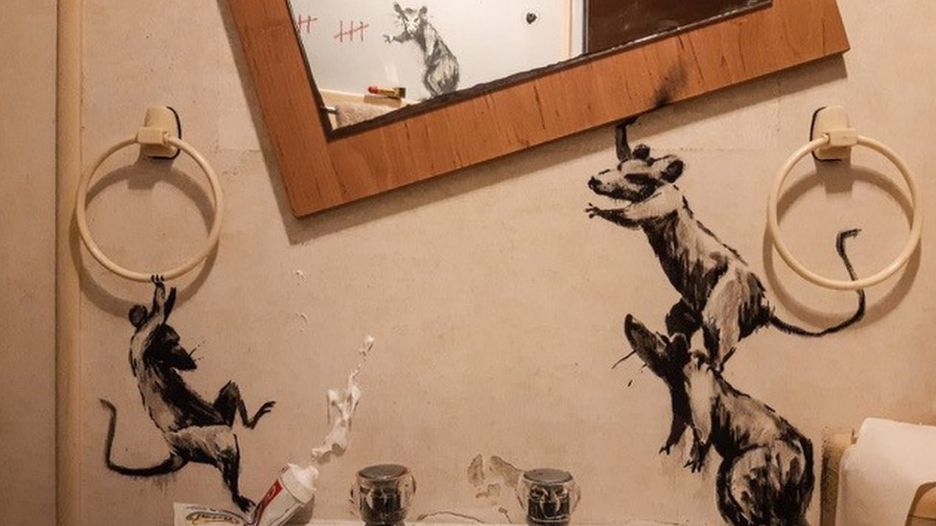
Bansky's latest artwork showing a group of rats in his bathroom
Image captionBanksy’s distinctive rats were seen wreaking havoc in a bathroom

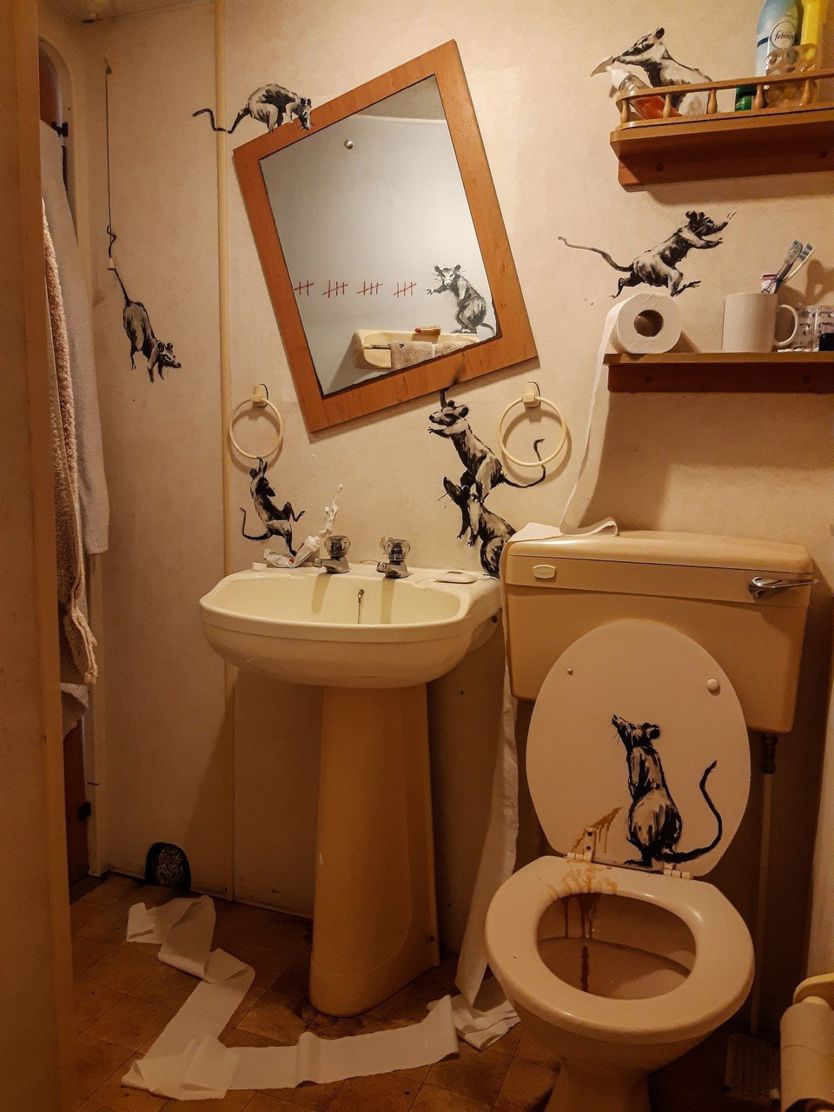
Banksy has published a series of pictures showing rats causing mayhem in a bathroom during the coronavirus lockdown.

The elusive artist, whose identity has never been publicly revealed, published five pictures on his Instagram account on Wednesday.

They show rats, which have featured in several of his pieces, wreaking havoc in what is assumed to be his home.

The caption on the picture reads: “My wife hates it when I work from home.”

One of the rats pictured in Banksy's latest artwork
Image captionThe mischievous rodents were seen jumping over toilet rolls and squeezing toothpaste tubes

Nine rats appear in the new pictures, hanging from the towel ring, stepping on a tube of toothpaste and knocking the bathroom mirror to one side.

One appears to be counting the days of lockdown while another is swinging from the light cord.

Who is the mysterious artist Banksy?

The entire piece published by Banksy on Wednesday
Image captionFive photographs appeared on the artist’s Instagram account

Banksy’s last public artwork appeared on Valentine’s Day in his home city of Bristol and showed a girl firing red flowers from a catapult.

It was vandalised 48 hours after it first appeared.

Large rat mural advertising Banksy's Exit Through the Gift Shop exhibition in Los Angeles
Image captionRats have often featured in Banksy’s work

Related Topics

Money for nothing get your clicks for free

If you have a WordPress.com account linked to your facebook page for your business there is a chance of obtaining funding from Facebook towards the running of your digital business.

Small Business Grants programme

We’ve heard from small businesses that a little financial support can go a long way, so we are offering USD 100M in cash grants and ad credits to help during this challenging time.Learn More

There is a catch though

You have to not be a sole trader so more than one person in your business. If you disagree with this choice Facebook have made you could always lobby Facebook to include sole traders.

Hope all is good in your neck of the woods.

Lots of Love

Huw x

2 close to heaven & 2 far away!!

I’ll be there in a minute – tidy!!

1) Twp – Hang on a minute, there are no vowels in that word I hear you cry. Well, the ‘w’ is pronounced like the ‘oo’ in ‘look’ and it is a nice way of calling someone daft or stupid.

              Example: “Don’t be so twp.” (tuts furiously)

2) Tidy – One of my least favourite of the Swansea/welsh sayings but it simply cannot go unmentioned. Britons everywhere know it to mean ‘clean’ ‘ship-shapely’ ‘ordered’ but here in Swansea it means something or someone is good.

             Example: “You’re coming to the gig tomorrow night in Uplands? Tidy.” 

2) Whose coat is that jacket? – A phrase meaning ‘Whose coat is this?’ – but we Swansea folk like to make sure you understood exactly what we were talking about by saying it twice. Tidy.

4) Cwtch –  A classic. One that is slowly but surely creeping over the border into England. Embrace it. It’s lush. It’s closest translation would be ‘a really warm, meaningful, special, heartfelt hug that make everything better.’

              Example: “Aww come here for a cwtch”

5) Tamping – …Raging, fuming. It means mad. Really mad.

             Example: “I’ve been waiting for twenty minutes in the cowin’ rain.

                              I’m absolutely tamping”.

6) Mun – This one doesn’t really have a meaning. It is more of a noise or word that people say after a sentence, usually depicting a sense of impatience or emphasis.

             Example: “Hurry up mun, we’re going to be late!”   

                              “Don’t ask me I dunno mun!”

7) Now in a minute – This is a baffling one to anyone outside of Wales. We aren’t even sure why we say it ourselves. It just doesn’t make sense. It contradicts itself. Do you mean now? or in a minute? It is used when someone is asked to do something/be somewhere and they are going to go right now, but also they might not show up for a bit longer.

             Example: “I’ll be there now in a minute, mun!”

8) Hanging – Gross, disgusting.

             Example: “That’s hanging that is”.

9) Butt – This is not a reference to a part of the body. Oh no. This is what you call a dear friend, a pal, a buddy.

             Example: “Fancy a pint later, Butt?” – Yes, yes we do.

10) Lush – Variations include ‘Cowing lush’. This is a super duper Swansea word which you will hear being used very often. It means, well, lush and it can be used for absolutely anything.

              Example: “He’s well lush.”   “His new puppy is so lush”.

11) Like – Another difficult one to explain. You will hear a lot of Swansea-folk adding the word ‘like’ onto the end of their sentences. The best way to describe it is probably a stalling tactic or to fill an awkward pause.

             Example: “I like him like, I just dunno like, if I really like, like him, like.” – Makes perfect sense.

12) Cheers Drive – Every bus or taxi driver in Swansea’s name is ‘Drive’. Use this when exiting the vehicle. It is polite and quite frankly, expected.

             Example: “Cheers Drive!”

He’s got no rights at all cause we are all God’s children – Tidy

Land Owns You

Keystone XL pipeline

Major blow to Keystone XL pipeline as judge revokes key permit

Campaigners welcomed Wednesday’s ruling as a victory for tribal rights and environmental protection

Nina Lakhani in New York

Thu 16 Apr 2020 02.33 BSTLast modified on Thu 16 Apr 2020 03.18 BST

Article licensed by and thanks to The Guardian Newspaper UK

`

 A judge has revoked a key permit for the controversial Keystone XL tar sands pipeline, in a victory to tribes and environmentalists. Photograph: Nati Harnik/AP

The controversial Keystone XL tar sands pipeline has been dealt a major setback, after a judge revoked a key permit issued by the US Army Corps of Engineers without properly assessing the impact on endangered species.

In a legal challenge brought by a coalition of environmental groups, a federal judge in Montana ordered the Army Corps to suspend all filling and dredging activities until it conducts formal consultations compliant with the Endangered Species Act.

The ruling revokes the water-crossing permit needed to complete construction of the pipeline, and is expected to cause major delays to the divisive project.

Topics

Love thy neigbour

Baal Shem Tov – Wikipediaen.wikipedia.org › wiki › Baal_Shem_Tov

Rabbi Israel ben Eliezer (born circa 1698, died 21 May 1760), known as the Baal Shem Tov (Hebrew: בעל שם טוב, /ˌbɑːl ˈʃɛm ˌtʊv, ˌtʊf/) or as the BeShT, was a Jewish mystic and healer from Poland, who is regarded as the founder of Hasidic Judaism.

Love thy neighbor as thyself. A version of the Golden Rule: Do unto others as you would have them do unto you. First found in the Old Testament. Jesus tells the parable of the Good Samaritan to illustrate this commandment.

If you know a friend or neighbor is vulnerable in your local community why not phone, knock on their door or drop them a letter to check how they are doing and see if they are ok. Make sure you give them your phone number so they can speak to you.Together we stand divided we fail. Thank you so much if you are willing and able to help.

Emergency services

Warning as UK coronavirus outbreak leads to sharp rise in deaths at home

A&E chiefs believe many people who could be saved are too scared to go to hospital

Denis CampbellSarah Marsh and Sarah Johnson

Thu 16 Apr 2020 07.18 BSTFirst published on Wed 15 Apr 2020 21.09 BST

Shares969

Paramedics say they are attending far more emergencies when the patient is already dead.
 Paramedics say they are attending far more emergencies when the patient is already dead. Photograph: Andrew Milligan/PA

The coronavirus crisis has led to a sharp rise in the number of seriously ill people dying at home because they are reluctant to call for an ambulance, doctors and paramedics have warned.

Minutes of a remote meeting held by London A&E chiefs last week obtained by the Guardian reveal that dozens more people than usual are dying at home of a cardiac arrest – potentially related to coronavirus – each day before ambulance crews can reach them.

‘It’s heartbreaking. People dying at home, help denied them’

 Read more

And as the chair of the Royal College of GPs said that doctors were noticing a spike in the number of people dying at home, paramedics across the country said in interviews that they were attending more calls where patients were dead when they arrived.

The A&E chiefs’ minutes said that on the weekend of 4-5 April the number of 999 calls in which someone had had a cardiac arrest rose from 55 a day in normal times to 140. Most of the people concerned died, doctors said.

The minutes also reveal acute concern among senior medics that seriously ill patients are not going to A&E or dialling 999 because they are afraid or do not wish to be a burden.

“People don’t want to go near hospital,” the document said. “As a result salvageable conditions are not being treated.”

The stark warning of another hidden toll caused by the pandemic followed the Guardian’s disclosure that hundreds of victims dying in care homes were not being included in official counts – with fears that the toll has since grown to thousands.

Those dying at home of coronavirus would also not be included in the initial daily government updates.

With the number of patients attending A&E plummeting, NHS leaders moved last week to urge the public to continue to seek help if they have a serious health problem. An NHS spokesperson said: “Anybody who needs urgent help – people experiencing heart failure, or expectant mums worried about their baby – should absolutely come forward and seek help from their local NHS.

“There is no doubt that, as the chief medical officer said, coronavirus is putting more pressure on NHS services, but NHS staff are freeing up thousands more beds for critical care whilst also keeping other essential services running, so parents, relatives and anyone worried about their health should continue to use their NHS.”

Coronavirus survivor: ‘I’m still asking myself why I’m here and others aren’t’

 Read more

The minutes of the online meeting, held on Monday 6 April, said that “some patients [are] coming to harm as not coming in or being brought in”.

“Patients with conditions that are time critical re not presenting and concerns rising as to how we manage these patients, eg, no longer able to perform an open appendectomy [for an inflamed appendix],” they continue.

A&E doctors believe that many of the extra deaths from cardiac arrest are due to Covid-19 which, by making it difficult for someone to breathe, puts serious strain on their heart. “Of these 85 extra cardiac arrest deaths a day in London, they must be mainly Covid,” said the head of one A&E department.

Leading medical organisations have voiced anxiety that some people are inadvertently damaging their own health, and even risking their life, by shunning NHS care. People are either too scared to go to hospital or do not want to add to the strain on the NHS when it is under its greatest ever pressure with Covid-19, they said.

“GPs are noticing an increase in people dying in the community, often at home,” said Prof Martin Marshall, the chair of the Royal College of GPs (RCGP). “If patients are dying at home because they are fearful of seeking medical attention, or concerned about being a burden, then it is incredibly concerning.

“We would reassure them that the NHS is here for them, and we will do whatever we can to keep them as safe as possible when they access care.”Quick guide

What to do if you have coronavirus symptoms in the UK

Show

Coronavirus: the week explained – sign up for our email newsletter

 Read more

Paramedics in London, other parts of England and Northern Ireland have told the Guardian how they are turning up at unprecedentedly large number of incidents where the ROLE – recognition of life extinct – procedure has been carried out because the patient is already dead.

“We are going to more people that we are pronouncing dead. We’d average one a week normally, but I had days a week ago when I was doing three or four a day,” said one London ambulance service (LAS) paramedic.

Sources at the LAS said that its crews are attending many more 999 calls than usual involving a cardiac arrest where the person has already passed away. It is unclear how many are occurring in people with Covid-19, said officials, speaking anonymously.

Those dying at home include people whose underlying health is poor because they have pre-existing conditions, and then they get Covid-19, according to a paramedic with the East of England Ambulance Service.

“For some with diabetes or chronic obstructive pulmonary disease it wouldn’t take much to tip them over the edge,” the paramedic said. “It’s quite scary. there are lots more out there that aren’t being counted.

“People are being told to self-isolate, they get poorly at home and speak to doctors or NHS 111 before they call us. They get to the point where they are already very poorly. Perhaps they’re on their own or haven’t recognised [how unwell they are].”

Dr Katherine Henderson, the president of the Royal College of Emergency Medicine, which represents A&E doctors, said she was worried that the recent 29% fall in people attending A&E may mean that people who need urgent medical help are not seeking it.

“We are concerned that some people, particularly parents of young children, might not be seeking medical help when they probably need it for fear of contracting Covid-19.

“Some may also not be seeking help as they worry about adding pressure to the NHS at a time of crisis. But patients should not risk their health – and lives – by staying away as part of an understandable but undue effort to help the NHS. They should seek help if they need it – it is what we are here for.”

Dr Simon Walsh, the British Medical Association’s lead for emergency care, voiced his unease too.

“While it’s understandable that there may be fewer broken bones and sprains because of the confinement, the reduction in patients with diseases such as heart attacks, strokes and appendicitis, which we would expect to occur at a relatively constant rate at any one time of the year, is of concern.”

Marshall, the chair of the RCGP, added: “It’s vital that during this Covid-19 pandemic people continue to seek medical attention for conditions and illnesses unrelated to the virus – and if it’s an emergency, that they call 999 for help.

“The last thing we want is for patients to wait too long before seeking help, and that help arriving too late as a result.”

Boggling my brain

I just have a quick question before I definitively go to bed. As I have been updating my site and expanding my reach I have been offered a lot of choices about whether or not to militarize my site with a financial income stream I decided this is completely unnecessary as I actually have a job in the real world.

I would be interested to hear from those that teach the good gospel of Christ the Redeemer and also profit form selling both material and digital goods such as baseball hats, selling extra access to your site and selling videos of yourself doing something or other with perfect white teeth and not much on in the clothes department! Do you think people are tunning in to hear about your views on God or something else and would Jesus have been impressed with your charitable goods?

Also Jesus In the Revised Standard Version, the nine Beatitudes of Matthew 5:3–12 read as follows: Blessed are the poor in spirit, for theirs is the kingdom of heaven. Blessed are those who mourn, for they shall be comforted. Blessed are the meek, for they shall inherit the earth and finally the Rich oh dear, dear. He says

Eye of a needle

From Wikipedia, the free encyclopediaJump to navigationJump to searchThis article is about the metaphor. For the parts of a needle, see Sewing needle. For other uses, see Eye of the Needle (disambiguation).Eye of a needledromedary camel passing through the eye of a needle, as a symbol of the improbable Peace of Westphalia. Engraving, Johann Vogel: Meditationes emblematicae de restaurata pace Germaniae, 1649.

The term “eye of a needle” is used as a metaphor for a very narrow opening. It occurs several times throughout the Talmud. The New Testament quotes Jesus as saying that “it is easier for a camel to go through the eye of a needle than for a rich man to enter the kingdom of God”.

The eye of a sewing needle is the part formed into a loop for pulling thread, located at the end opposite from the point.

Do digital bloggers turn there back or move there minds eye away from the treachings concerning poverty and wealth and community living or do you tackle these issues wiuth as much reverance as your boastful spirit about the death of your Christ.

Good night one and all God bless. Sweet digital dream.

Strict firearm laws reduce gun deaths: here’s the evidence

New Zealand will reform laws after the Christchurch massacre but how has gun control worked in other countries?

Nick Evershed @NickEvershed

Tue 19 Mar 2019 17.00 GMTLast modified on Wed 5 Jun 2019 09.13 BST

Shares628

Floral tributes to those who were gunned down in the Christchurch massacre outside the city’s Botanical Garden
 Floral tributes to those who were gunned down in the Christchurch massacre outside the city’s Botanical Garden. Photograph: Marty Melville/AFP/Getty Images

Following the Christchurch shooting, in which 50 people were killed, New Zealand’s government has announced it will be reforming the country’s gun laws.

According to the GunPolicy.org website maintained by the University of Sydney, New Zealand currently has gun laws that are more restrictive in comparison to some countries but more permissive than others, such as Australia’s.

People must have a licence to own guns, and the licence requires background checks. While dealers must keep a record of the guns they sell, most guns are not required to be tracked in a central register to monitor changes in ownership due to private sales.

Australian telcos block dozens of websites hosting Christchurch terror video

 Read more

New Zealand law also permits ownership of semi-automatic rifles, such as the AR 15-style gun, used previously in US mass shootings. These rifles are able to be bought under a category A licence, but the licence only covers magazines that hold seven cartridges. While it has been confirmed that the Christchurch shooter legally obtained at least four guns, included two semi-automatic rifles, the shooter also reportedly used larger magazines capable of holding more ammunition.

In a press conference on Monday, New Zealand’s prime minister, Jacinda Ardern, made specific reference to Australia’s implementation of stricter gun laws following the Port Arthur massacre in Tasmania in 1996, in which 35 people were killed and 23 were wounded.

So, what happened with Australia’s laws, and how has gun control worked in other countries?

The Australian situation

Following the Port Arthur incident, Australia implemented the National Firearms Agreement (NFA).

Prohibited firearms that were handed in under the Australian government’s buy-back scheme after the Port Arthur massacre
 Prohibited firearms that were handed in under the Australian government’s buy-back scheme after the Port Arthur massacre. Photograph: David Gray/Reuters

New, uniform state gun laws banned rapid-fire guns from civilian ownership except under certain, restricted licences, and established a government buyback of semi-automatic and pump-action rifles and shotguns.

Another requirement was that all guns must be individually registered, with all gun sales tracked to record changes in ownership. Previously, registration varied by state and gun type. The laws reduced guns in Australia by about one-fifth, with more than 700,000 guns removed and destroyed.

There have been a number of studies published on the impact of the NFA on firearm-related deaths in Australia. According to a 2011 summary of the research by the Harvard Injury Control Research Centre, a number of studies suggested beneficial effects from the law changes, with a reduction in mass shootings, and a reduction in the rate of firearm-related deaths (both homicides and suicides) overall.

Researchers from the University of Sydney and Macquarie University in 20062016 and 2018 looked at the number of mass killings before and after the NFA, and also whether the law changes affected the number of firearm-related deaths. They found that there was a drop in the rate of firearm deaths – particularly with suicides – but were cautious about attributing this to the NFA with the methods they used.

Their research also showed that while there had been 13 mass shootings (using the definition of five or more people killed) in the 18 years before the law changes, there had been none in the 22 years following (though there was one mass shooting involving seven members of one family at Margaret River in Western Australia in May 2018).

Modelling suggested that if shootings had continued at a similar rate as that prior to the NFA, then approximately 16 incidents would have been expected by February 2018.https://interactive.guim.co.uk/embed/reusable-charts/line-chart/index.html?key=1_1uo14z8RtDfKSun5_xW_46ihz8wpzDZLFPK0xLMna0

Another approach was taken by researchers from the Australian National University and Wilfrid Lauer University. In this study, the researchers used state-based differences in gun buybacks and showed “the largest falls in firearm deaths occurred in states where more firearms were bought back”.

While two studies found either no reduction in firearm deaths before and after the NFA, or a reduction only in firearm-related suicides, but not overall suicides, the methods for both of these studies were subsequently criticised by other researchers.

Facebook and YouTube defend response to Christchurch videos

A landmark, comprehensive review of studies looking at the effectiveness of gun control laws in 10 countries was published in 2016. Researchers at Columbia University reviewed 130 studies to compile an overall picture of how effective laws limiting firearms were in reducing deaths.

The authors concluded “the simultaneous implementation of laws targeting multiple elements of firearms regulations reduced firearm-related deaths in certain countries”, and “some specific restrictions on purchase, access, and use of firearms are associated with reductions in firearm deaths”.

More recently, further studies on gun control in the US have been released that show stricter laws by US state, and states nearby, are associated with reduced suicide and homicide rates.

● You can read more about New Zealand’s history with gun control here. Many thanks to German Lopez for this article at Vox, which is where I first saw several of the papers I’ve mentioned.

• Crisis support services can be reached 24 hours a day. In New Zealand, the crisis support service Lifeline can be reached on 0800 543 354. In Australia, Lifeline is 13 11 14. In the UK and Irish Republic, contact Samaritans on 116 123. In the US, the National Suicide Prevention Lifeline is 1-800-273-8255. Other international helplines can be found at www.befrienders.org.