

It turns out China has a great firewall, which it uses to block out information or views from places such as on WordPress and other sites from where people can express themselves and speak their minds. Who would have thought that thinking can be thought of as being such a radical thing to think!
The Great Firewall of China is the informal name for China’s system of internet censorship and control. It combines technology, laws, and government regulations to monitor and restrict access to parts of the global internet.
In practical terms, it can:
- Block entire websites and services.
- Slow down or filter traffic crossing China’s internet borders.
- Monitor certain online activities.
- Restrict access to information that Chinese authorities deem sensitive.
Some well-known services that have been blocked or heavily restricted at various times include:
- Google Search
- Gmail
- YouTube
- X (formerly Twitter)
- Many Western news websites
For WordPress users, the Great Firewall matters because many WordPress themes and plugins depend on resources such as:
- Google Fonts
- Google Analytics
- YouTube embeds
- reCAPTCHA
- Gravatar
If a visitor in mainland China tries to load a site that depends on those services, the webpage may load very slowly, partially fail, or appear broken.
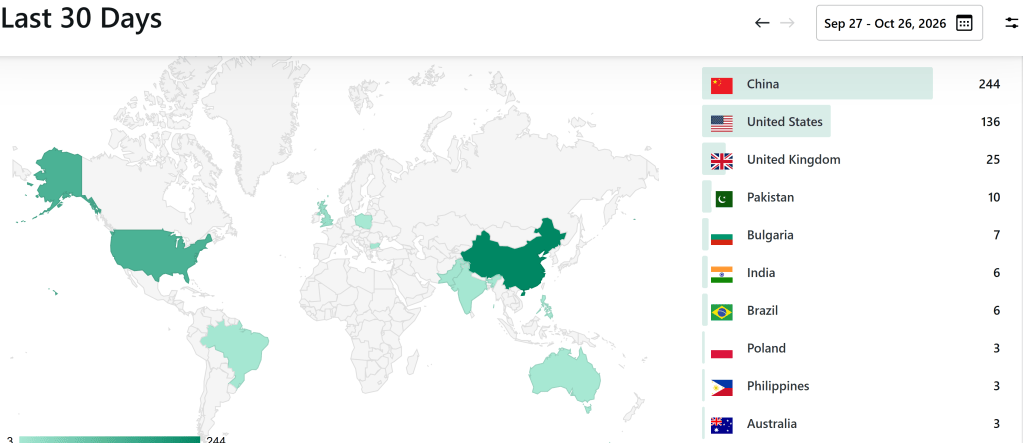
Relating this back to your Huwspace blog, the Great Firewall doesn’t itself explain why you’re seeing Chinese traffic. In fact, it’s a reason why many Chinese users would have a harder time accessing a typical WordPress site. The traffic you’re seeing is more likely to be a mix of:
- Search engine crawlers,
- AI training/indexing bots,
- Automated WordPress scanners,
- Genuine readers using a VPN or accessing from regions not affected by mainland restrictions.
One interesting possibility is that because your articles cover geopolitics, technology, climate, and international affairs, they contain the kinds of topics that AI crawlers and researchers often index extensively. That could explain broader international interest, including from infrastructure located in China.
A good analogy is that the Great Firewall is less like a wall around websites and more like a customs checkpoint for internet traffic entering and leaving China. Information isn’t automatically blocked, but it can be inspected, filtered, delayed, or denied passage.
WordPress sites are accessed from within China but the Great Firewall, also means that WordPress.org is accessible in China while WordPress.com websites are blocked, and many WordPress sites perform poorly there because they depend on blocked Google services. So maybe my site is being scanned to ensure it is blocked by the great firewall for regular Chinese readers and so does not even make it through to be seem y any real people at all – I hope that makes sense!
But what I want to know also is why are Chinese actors suddenly showing interest in my WordPress site?
There are several plausible explanations:
1. Automated scanning, not personal interest
The most common explanation is that the traffic is not from people reading your articles. Large networks of automated bots continuously scan WordPress sites worldwide looking for:
- Outdated plugins
- Vulnerable themes
- Exposed login pages (
wp-login.php) - XML-RPC endpoints
- Weak passwords
- Misconfigured installations
When analytics show visitors from China, a significant proportion can be automated security scanning rather than genuine readers.
2. WordPress is an attractive target
WordPress powers a very large share of the web. If an attacker finds a vulnerability in a plugin used by thousands of sites, automated tools can probe millions of WordPress installations globally. Your recent increase in publishing activity may simply coincide with wider scanning campaigns affecting WordPress generally.
3. Content discovery by AI crawlers
Many AI companies, search engines, and data collection services operate crawlers from infrastructure located in various countries, including China. If you’ve been publishing more original content on Huwspace, your site may have become more visible to indexing systems, crawlers, and content aggregators.
4. Genuine readership
Looking at your screenshots, several articles touch on:
- Global politics
- Climate issues
- Indigenous rights
- Technology and corporate power
- International affairs
These are topics with worldwide audiences. Some of the traffic may be genuine readers from China, Hong Kong, Singapore, Taiwan, Chinese diaspora communities, students, researchers, or people using VPNs.
5. Traffic attribution can be misleading
Many hosting and analytics platforms identify visitors by IP address. Traffic appearing as “China” could actually be:
- Cloud providers with Chinese infrastructure
- VPN exit nodes
- Security scanners
- Content delivery services
- Search-engine crawlers
The country attribution does not necessarily mean a person in China was actively reading your blog.
Looking at your screenshots
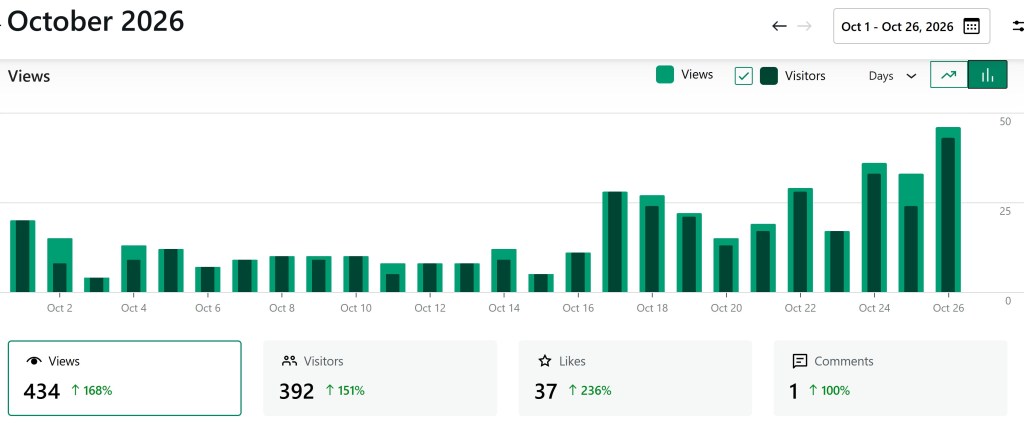
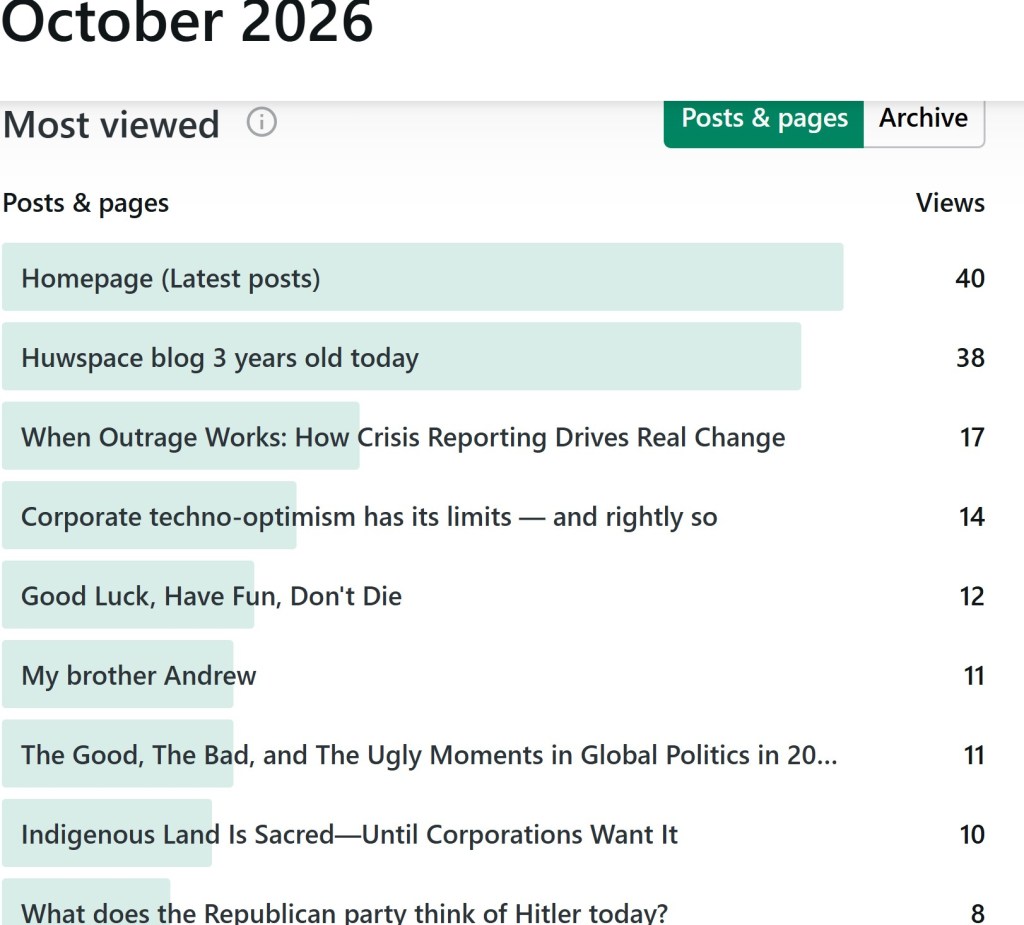
Your traffic increase appears broad rather than concentrated on one politically sensitive article. The homepage received 40 views, and your anniversary post received 38 views, with other articles receiving 10-17 views each. That pattern often suggests discovery through:
- Search engines
- Social sharing
- Crawlers exploring multiple pages
rather than coordinated interest in a single topic.
How to tell if it’s bots or readers
Check your WordPress statistics for:
- Referrers (Google, Bing, social media, direct)
- User agents (browser vs crawler)
- Bounce rates
- Session duration
- Requests to
/wp-login.php,/xmlrpc.php, or unusual URLs
If many of the Chinese visits are requesting login pages, XML-RPC endpoints, or non-existent plugin paths, you’re almost certainly seeing automated reconnaissance rather than readers.
My instinct, based on the traffic levels shown and the fact that you’re running a public WordPress blog, is that the majority of the apparent Chinese interest is probably routine automated scanning and indexing activity rather than Chinese government actors or people specifically targeting Huwspace. The numbers in the screenshots are also quite modest, which is consistent with ordinary web-wide bot activity rather than a focused campaign.





You must be logged in to post a comment.