
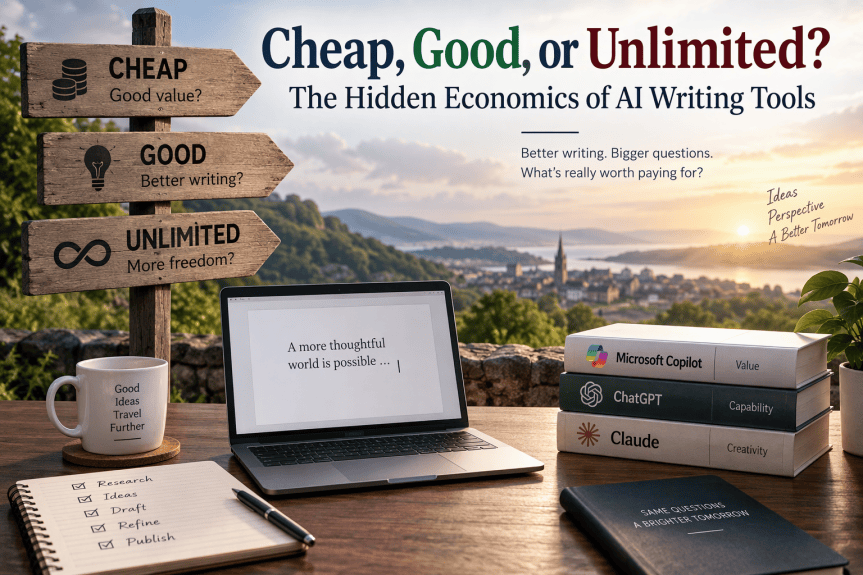
When people compare AI chatbots, they often focus on which model writes the prettiest paragraph or produces the cleverest answer. But for most writers the more important question is simpler: which tool offers the best value for money?
As someone already paying around £8 per month for Microsoft 365 Personal, I recently found Microsoft sending me warnings that I was reaching the limit of my account’s usage and would need to upgrade if I wanted to use more credits. This led me to ask myself the question whether there was any point spending another £20 per month on ChatGPT Plus or Claude Pro or Microsoft 365 Professional.
I have always completed research on Google when writing articles, and Google AI is excellent for up-to-date research information, very handy for the sphere of politics, economics and local, national and international issues, but Copilot imaging and article structure has just jetted my articles into another sphere. Making them come across as more professional-looking than I could ever produce on my own. So I do look to consider what the extra cost would result in and whether it would significantly help generate better HuwSpace.com articles, or is Microsoft Copilot along with WordPress good enough for me to continue to use?
The answer is surprisingly nuanced.
The AI Arms Race
The AI market has become crowded. Microsoft Copilot, ChatGPT, Claude and Google’s Gemini can all draft articles, generate ideas, summarise research and help structure complex arguments.
The differences between them are no longer as dramatic as they were two years ago (or so AI chat bots tell me!).
All can produce readable blog posts. All can help with research. All can generate outlines and rework sentences.
The real distinctions are now found in three areas:
- Quality
- Value
- Freedom of use
For many independent bloggers, those factors matter more than raw technical benchmarks.
Copilot vs ChatGPT vs Claude: The Real Cost for Bloggers
| Feature | Microsoft Copilot (M365 Personal ~£8/month) | ChatGPT Plus (~£20/month) | Claude Pro (~£20/month) |
|---|---|---|---|
| Monthly Cost | Lowest | Higher | Higher |
| Included Software | Word, Excel, Outlook, OneDrive and Copilot | AI only | AI only |
| Blog Writing Quality | Good | Very Good | Excellent |
| Reflective Essays | Good | Very Good | Best |
| Research & Citations | Strong | Strong | Good |
| Header Image Generation | Included | Included | Limited |
| Workflow Integration | Excellent within Word | Web-first | Web-first |
| Usage Limits | AI credit allocation applies | Higher usage allowances | Higher usage allowances |
| Best For | Existing Microsoft users | General AI power users | Writers focused on prose quality |
At first glance Copilot looks like the clear winner. The monthly cost is significantly lower and the subscription includes tools that many people already depend upon.
But the story becomes more complicated once usage limits enter the picture.
Where Copilot Wins: Value
If you already subscribe to Microsoft 365 Personal, Copilot effectively comes bundled alongside software you probably use every day.
That changes the calculation completely.
For roughly the cost of two coffees each month or nearly two pints of Guinness, Microsoft 365 Personal provides access to Word, Excel, Outlook, OneDrive storage and Copilot assistance. From a financial perspective, the AI capability is only one part of a much larger package.
For HuwSpace-style publishing, Copilot can already:
- Generate article outlines
- Suggest headlines
- Help structure arguments
- Fact-check claims with web sources
- Rewrite paragraphs
- Generate header images
- Integrate directly into Microsoft Word
For many bloggers, that’s enough.
The Catch: AI Credits Change the Equation
This is the detail that many reviews overlook.
Copilot’s most advanced AI features operate within a monthly credit system. Heavy users can eventually discover that their usage has a practical limit. As I write this, I find myself watching my remaining credits more closely than I ever expected.
This changes the psychology of using AI.
When credits are plentiful, experimentation is easy.
When credits begin running low, every prompt starts to feel like a spending decision.
A serious article might involve:
- Researching multiple viewpoints
- Testing different headlines
- Exploring counterarguments
- Rewriting sections several times
- Verifying statistics
- Creating multiple header images
A single thoughtful article can involve dozens of AI interactions.
The question therefore becomes:
Am I paying for intelligence, or am I paying for the freedom to think?
A £20 service that allows constant exploration throughout the month might ultimately provide more value than an £8 service that encourages careful rationing in the final week.
I do sometimes feel that Copilot sometimes tries to summarise with views that are certainly not mine and I need to rain in its ability to see two sides to every view point. I think it’s important to present an argument and have a view else your not really doing justice to yourself and your readers, if your watering down option’s into two way pieces of view just to not offend anyone, which I find Copilot enjoys doing a lot.
Where ChatGPT and Claude Still Lead
Value is not the same thing as quality.
For long-form reflective writing, Claude is often regarded as the strongest of the major AI platforms. Its prose frequently feels more natural, thoughtful and human.
ChatGPT sits close behind, combining strong reasoning, excellent research capabilities and sophisticated image generation.
Copilot can certainly produce high-quality articles, but it occasionally adopts a corporate tone. The facts are usually sound. The structure is often excellent. Yet something can sometimes feel missing.
The best essays are not remembered because they were well organised.
They are remembered because they made readers stop and think.
Claude and ChatGPT often have a slight edge in achieving that effect.
The Economics of Creativity
This may be the most interesting aspect of the AI revolution.
Only a few years ago the debate centred on capability. Which model was smartest? Which produced the most accurate responses?
Increasingly, the debate concerns access.
Most leading AI systems are now capable of producing competent blog articles.
The difference lies in how freely they allow users to explore ideas.
Writers do not simply purchase answers.
They purchase the ability to investigate possibilities, take intellectual detours, abandon weak arguments and discover better ones.
In that sense, AI subscription models are beginning to resemble libraries rather than software. Their value depends less on what they know and more on how much access they provide to that knowledge.
How I Use Copilot
For HuwSpace articles, I have found that Copilot works best as an editor rather than an author.
I gather sources.
I identify the central argument.
I determine the conclusions.
Copilot then helps refine structure, identify weaknesses, suggest alternatives and improve clarity.
Used in this way, the quality gap between Copilot and more expensive competitors narrows considerably.
The machine organises the thinking.
The human remains responsible for the ideas.
Verdict: Good Enough Is Sometimes the Smartest Choice
If I wanted nothing but the strongest possible AI writing assistant, I would probably choose Claude.
If I wanted the best all-round AI platform, ChatGPT would be extremely difficult to beat.
But those are not the choices I actually face.
I already subscribe to Microsoft 365 Personal.
The real question is whether an additional £20 per month would improve my writing enough to justify the extra cost.
For many independent bloggers, the answer is probably no.
Copilot may not always generate the most elegant or imaginative prose, but it delivers an impressive combination of capability, integration and affordability.
Conclusion: The Cost of Chasing Better
There is always a more advanced model somewhere over the horizon.
Every AI company promises that the next upgrade, the next subscription or the next release will finally unlock better writing.
Yet the uncomfortable truth remains that no AI can supply the one ingredient readers ultimately value.
Original thought.
Copilot can help organise ideas.
ChatGPT can improve arguments.
Claude can polish prose.
But none of them can decide what matters.
That responsibility still belongs to the writer.
For around £8 per month, Microsoft 365 Personal and Copilot provide enough capability to research, draft, edit and illustrate articles for HuwSpace. Could a more expensive service produce slightly better prose? Almost certainly.
But perhaps that is not the most important question.
Perhaps the more interesting question is whether we are paying for better writing at all.
Or whether we are really paying for the freedom to keep asking questions.
As AI becomes cheaper, faster and more capable, that distinction may matter more than any comparison chart ever could.


