
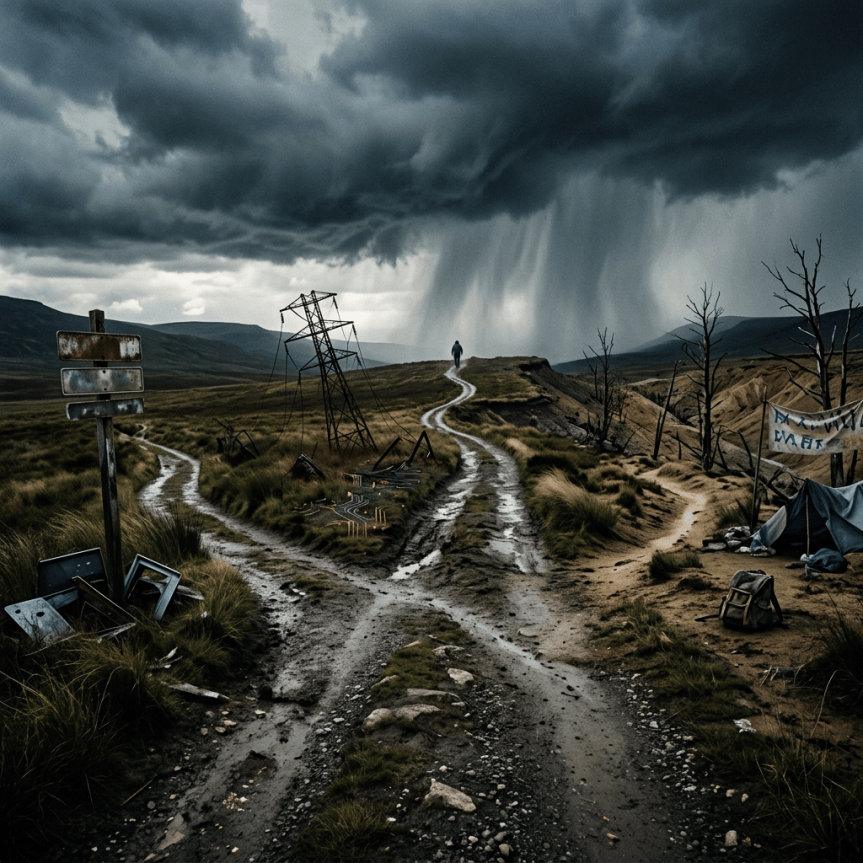
Why These Challenges Matter More Than Any Single Crisis
One of the biggest misunderstandings about the future is the belief that debt, AI, climate change, biodiversity loss, migration, war, and inflation are separate issues. They are not. They are interconnected systems that can reinforce each other, creating a much larger challenge than any one problem alone. As your original article notes, these risks form a “polycrisis” where one pressure amplifies another.
The importance of these challenges lies in their ability to undermine the foundations of modern civilisation:
- Economic stability
- Government legitimacy
- Social cohesion
- Environmental health
- Food and energy security
- Individual wellbeing
If governments become overwhelmed by debt while simultaneously facing climate disasters, AI-driven labour disruption, ageing populations and geopolitical instability, their ability to respond effectively may become constrained. This is why many analysts argue that resilience is becoming as important as growth.
Government Debt and Fiscal Limits
Modern societies depend upon governments to provide healthcare, welfare, education, infrastructure, emergency services and national security.
If debt continues rising faster than economic growth, governments face increasingly difficult choices:
- Raise taxes.
- Cut public services.
- Borrow more money.
- Increase inflation through monetary expansion.
None of these options are politically easy.
The real concern is not debt alone but whether future economic growth can support those obligations. If tax revenues shrink because of slower growth or technological disruption, the burden becomes even harder to manage.
AI and the Future of Work
Artificial intelligence may deliver extraordinary productivity gains, but it also challenges traditional economic assumptions.
For centuries, governments have relied upon employment as the primary mechanism for distributing wealth and collecting taxes.
If AI performs increasing amounts of cognitive work, society must answer difficult questions:
- Who owns AI-generated wealth?
- How are displaced workers supported?
- How do governments collect revenues?
- How do people find meaning and purpose beyond employment?
These questions could become some of the defining policy debates of the twenty-first century.
Climate Change and Biodiversity
Climate and biodiversity are often treated as environmental concerns, but they are fundamentally economic concerns.
Nature provides services worth trillions of pounds annually through:
- Pollination
- Water purification
- Soil formation
- Climate regulation
- Flood management
When these systems degrade, the costs do not disappear. They are transferred to businesses, taxpayers and consumers.
A world with declining biodiversity is generally a world with higher costs, lower resilience and greater instability.
The Benefits of Crisis
While crisis sounds entirely negative, history shows that major disruptions often create opportunities for renewal and transformation.
This does not mean suffering is desirable. Rather, crises expose weaknesses that societies have ignored for years.
1. Crisis Forces Innovation
Many of humanity’s greatest advances emerged from difficult periods.
Economic pressures can accelerate:
- Renewable energy deployment.
- Circular economies.
- Local manufacturing.
- Resource efficiency.
- Technological innovation.
Necessity often drives creativity.
A future marked by resource constraints may encourage societies to become more efficient, less wasteful and more sustainable.
2. Crisis Reveals What Truly Matters
Periods of economic uncertainty often shift attention away from endless consumption towards more meaningful measures of prosperity.
People may increasingly value:
- Family.
- Community.
- Health.
- Nature.
- Skills.
- Local resilience.
A crisis can expose the difference between wealth and wellbeing.
3. Crisis Encourages Community Resilience
Periods of hardship frequently strengthen local networks.
Mutual aid groups, community energy projects, local food systems and cooperative enterprises often emerge when traditional systems struggle.
Your article correctly highlights the importance of mutual aid networks, local food security and practical skills development. These approaches not only prepare communities for shocks but also create stronger social bonds.
4. Crisis Accelerates Economic Reform
Many current economic systems were designed for a twentieth-century world.
Future crises may force governments to consider reforms such as:
- New taxation models.
- Wealth taxes.
- Land value taxes.
- Universal basic income.
- AI dividend schemes.
- Circular economic policies.
Ideas that seem politically impossible today can become mainstream during periods of disruption.
5. Crisis Creates Ecological Restoration Opportunities
Environmental degradation often occurs because societies focus on short-term growth.
As the costs become impossible to ignore, governments, businesses and communities may shift towards:
- Rewilding.
- Regenerative agriculture.
- Nature restoration.
- Ecosystem protection.
- Community-owned renewable energy.
The result could be healthier landscapes and greater ecological resilience than exists today.
6. Crisis Can Lead to a New Economic Model
Perhaps the greatest opportunity is the possibility of moving beyond an economic system that measures success almost entirely through GDP growth.
A future economic model might place greater emphasis on:
- Human wellbeing.
- Ecological health.
- Community strength.
- Social equality.
- Long-term resilience.
The transition would be challenging, but crises often provide the political momentum required for transformational change.
What we build after the storm and why?
The real question is not whether challenges are coming. Every generation faces transformative pressures. The question is whether we use those pressures to build something better.
The debt burden, AI disruption, climate instability and biodiversity loss are warnings that current systems may be reaching their limits. Yet they also provide an opportunity to redesign our economies around resilience, sustainability and shared prosperity.
History suggests that great crises often become turning points. The Industrial Revolution emerged from upheaval. Modern welfare states emerged from depression and war. Environmental protections emerged from ecological damage.
The coming polycrisis may ultimately force humanity to confront a simple truth: infinite growth on a finite planet is impossible, but infinite innovation, cooperation and adaptation are not.
The greatest benefit of a crisis is that it forces society to choose what kind of future it truly wants to build.


