
Most people know the difference between right and wrong.
A child understands fairness before they understand economics. A neighbour knows that kindness is better than cruelty. Most of us can recognise honesty, compassion and justice when we encounter them. The right thing is often surprisingly easy to understand.
Yet if recognising the right thing were enough, history would have been a far gentler place.
The central moral question facing humanity is not whether we can recognise what is good.
It is why we so often fail to live buy it.
Perhaps the greatest philosophical mystery is not evil itself, but the vast distance that exists between knowing what is right and finding the courage to act on it.
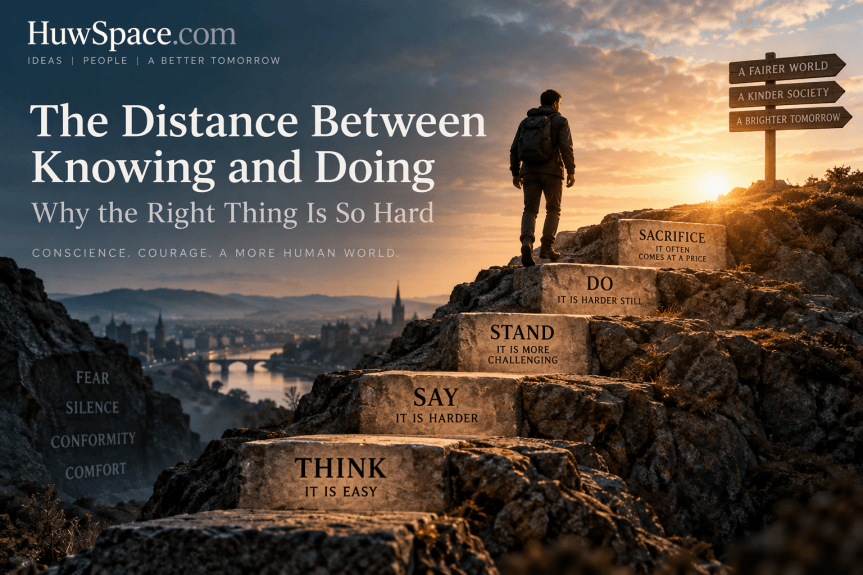
Human history suggests there are several stages in this journey.
Each stage becomes progressively more difficult.
The Great Moral Distance
The first step is easy.
To think the right thing requires very little courage.
Thought is private.
No authority can hear our thoughts. No crowd can mock them. No institution can punish them. We can agree with our conscience in complete safety.
Many people quietly recognise injustice.
Many people privately acknowledge a lie.
Many people know when cruelty is occurring.
The right thing is often present in the mind long before it appears in the world.
The second step is harder.
To say the right thing creates risk.
The moment a thought becomes speech it leaves the sanctuary of the mind and enters the judgement of others. Friends may disagree. Colleagues may become uncomfortable. Communities may react defensively.
A private belief suddenly acquires consequences.
Many truths remain unspoken because people instinctively understand that speaking changes everything.
The third step is harder still.
To stand for the right thing requires endurance.
A single statement may attract criticism.
A sustained commitment invites opposition.
Many people are willing to express a principle once.
Far fewer are willing to keep defending it when there is a cost attached.
The fourth step is the most difficult.
To do the right thing means accepting consequences.
At this point morality ceases to be an intellectual exercise.
It becomes reality.
The right action may require sacrifice.
It may cost popularity.
It may cost position.
It may cost wealth.
It may cost relationships.
In some places and at some times it may cost liberty itself.
History reveals a sobering truth.
The punishment is rarely for thinking.
The punishment often begins when people speak.
The punishment intensifies when they act.
This pattern appears again and again throughout human civilisation.
Socrates was not condemned for having thoughts. He was condemned because he expressed them publicly.
Jesus was not crucified for private beliefs. He was executed because his teachings challenged existing structures of power and authority.
The same pattern can be found among reformers, abolitionists, suffragettes, civil rights activists, journalists, whistleblowers and dissidents across the centuries.
Ideas become dangerous when they leave the mind.
Conscience becomes threatening when it becomes action.
Perhaps this explains why fear remains one of the most powerful forces in human affairs.
Humanity remembers.
Whether consciously or unconsciously, we inherit the stories of those who paid a price for principle.
We remember prisons.
We remember exile.
We remember reputations destroyed.
We remember livelihoods lost.
We remember crosses.
We remember graves.
The memory of these sacrifices passes from generation to generation.
It whispers a warning to every human heart:
Remain silent.
Stay safe.
Avoid conflict.
Do not stand alone.
Seen from this perspective, history becomes easier to understand.
The real wonder is not that so many people remain silent.
The real wonder is that some do not.
Some individuals reach a point where remaining silent feels more painful than speaking.
Some conclude that comfort purchased at the price of conscience is no comfort at all.
For these people, truth becomes more important than approval.
Justice becomes more important than safety.
Conscience becomes louder than fear.
Society often celebrates these people after the danger has passed.
We name streets after them.
We build statues in their memory.
We quote their words.
Yet while they are alive they are frequently criticised, mocked, excluded or attacked.
Yesterday’s troublemakers become today’s heroes.
Yesterday’s radicals become today’s reformers.
Yesterday’s minority opinions become today’s common sense.
This is one of history’s great ironies.
The very people a society honours in hindsight are often the people it resisted in the present.
Every freedom we possess today was once defended by somebody who stood in a minority.
Every social reform was once unpopular.
Every moral advance began as an inconvenience to somebody.
This is why courage occupies such a special place among the virtues.
Courage is not simply bravery.
Courage is the willingness to carry the burden of conscience.
It is the decision to continue when truth becomes costly.
The heroes of history were not necessarily wiser than everybody else.
Often they simply refused to betray what they already knew.
They thought the right thing.
They said the right thing.
They stood for the right thing.
They did the right thing.
And for many, the price was heavy.
Some lost careers.
Some lost freedom.
Some lost families.
Some lost their lives.
The benefits of their sacrifice were frequently enjoyed not by themselves but by future generations they would never meet.
Perhaps that is the deepest lesson history offers.
Human civilisation advances not merely through knowledge, intelligence or innovation.
It advances because a minority of individuals are willing to carry the burden that conscience places upon them.
The ultimate challenge facing each of us is therefore not whether we know what is right.
Most of us already do.
The real question is far more uncomfortable.
Will we still recognise it as right when it begins to cost us something? but if morality has a currency of sorts then if there is a cost to us to do something there is also the cost of doing nothing.
Conclusion: The Price of Action and the Price of Silence
The right thing may be difficult to do.
It may be uncomfortable.
It may be costly.
At times it may even be dangerous.
Throughout history, countless individuals have paid a heavy price for following their conscience. Some lost positions of influence. Some lost livelihoods. Some lost freedom. Some lost their lives.
The burdens carried by these souls were often profound.
Yet history invites us to consider a second question.
What is the price of doing nothing?
We often speak of the cost of action.
Far less often do we speak of the cost of silence.
Yet silence also has consequences.
Indifference has consequences.
Looking away has consequences.
When injustice is ignored, injustice grows.
When lies go unchallenged, lies spread.
When good people remain silent, conscience withdraws from public life and fear takes its place.
Perhaps there exists something we might call a moral currency.
Every decision is made within it.
To act may require us to pay a price.
But refusing to act also creates a debt.
The difference is that the cost of action is usually paid by the individual, while the cost of inaction is often paid by society.
The whistleblower risks a career.
The dissident risks imprisonment.
The reformer risks ridicule.
These are visible costs.
But what of the unseen costs?
What is the cost when corruption remains hidden?
What is the cost when injustice becomes normal?
What is the cost when prejudice is left unchallenged?
What is the cost when truth is surrendered for comfort?
History suggests these costs can become enormous.
The lesson is not that every protest is right.
Nor is it that every dissenter is wise.
The lesson is something far more universal.
Every human being will eventually face moments in which conscience presents a choice.
Not between comfort and discomfort.
Not between safety and danger.
But between two different prices.
The price of acting.
And the price of remaining silent.
We cannot avoid payment altogether.
The moral question might be for an individual at a moment in time simply which price are they willing to bear.
Perhaps this is why the journey from thought to action is so important.
To think the right thing is easy.
To say the right thing is harder.
To stand for the right thing is harder still.
To do the right thing may require sacrifice.
Yet beyond all these challenges lies one final question, perhaps the most important question of all:
What will be the cost if we choose to do nothing?
For every generation, for every society and for every individual, that is ultimately the choice.
That is the burden.
That is the responsibility.
And there is always of course a price to pay.


