
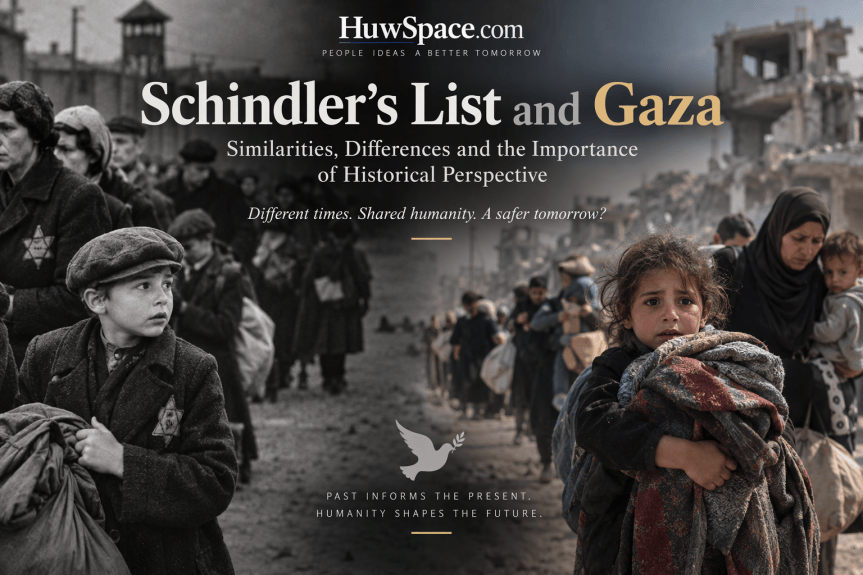
How should we compare human suffering across different periods of history, and where should we draw the line?
Images emerging from Gaza since October 2023 have prompted many people to look to history for comparison. Among the most controversial parallels drawn by some commentators is between the experiences of Palestinians in Gaza and the Jewish victims portrayed in Steven Spielberg’s acclaimed film Schindler’s List.
Such comparisons are emotionally charged and fiercely debated. For some, they highlight universal lessons about displacement, civilian suffering and the dangers of dehumanisation. For others, they risk misunderstanding or diminishing the unique horror of the Holocaust.
The challenge is to examine these arguments honestly while respecting both historical truth and contemporary human suffering.
Why Some People Draw Parallels
Those who draw parallels are usually not claiming that Gaza and the Holocaust are identical events. Instead, they point to experiences that appear similar from a humanitarian perspective.
Forced Displacement
One of the most moving aspects of Schindler’s List is the depiction of Jewish families being driven from their homes, often with little more than they could carry.
Similarly, many Palestinians in Gaza have experienced repeated displacement during the conflict, moving between shelters, encampments and temporary refuges. According to the United Nations Office for the Coordination of Humanitarian Affairs (OCHA), large numbers of Gaza’s residents have been displaced multiple times during the war.
Source: UN OCHA – Occupied Palestinian Territory
Civilian Vulnerability
Spielberg’s film portrays ordinary civilians trapped within forces beyond their control. Children, elderly people and families become victims of political and military decisions made by others.
Human rights organisations including Amnesty International and Human Rights Watch have raised concerns regarding the protection of civilians in Gaza, documenting civilian casualties and the destruction of civilian infrastructure.
Sources:
- Amnesty International: Israel and Occupied Palestinian Territory
- Human Rights Watch: Israel and Palestine
Restrictions on Movement
The Kraków Ghetto depicted in Schindler’s List existed under severe restrictions on movement and access to resources.
Critics of Israeli policy have pointed to Gaza’s long-standing border restrictions and blockade as creating conditions in which daily life is heavily constrained. Humanitarian agencies have repeatedly expressed concern regarding access to food, medicine and humanitarian supplies.
Source: United Nations Relief and Works Agency (UNRWA)
Dehumanisation
Many scholars argue that mass atrocities become possible only when populations are viewed as less than fully human.
Some commentators argue that language used by extremists on all sides of the Israeli-Palestinian conflict demonstrates how easily people can be reduced to labels rather than recognised as individuals deserving dignity and protection.
This is perhaps the most powerful lesson many people take from Schindler’s List: that the loss of empathy often precedes the loss of human rights.
Why Many Historians Reject Direct Comparisons
Despite recognising civilian suffering in Gaza, many Holocaust scholars strongly caution against drawing direct equivalence between the Holocaust and the current conflict.
The Holocaust Was a Programme of Extermination
The Holocaust was a state-led project by Nazi Germany aimed at the systematic elimination of Jewish people across Europe.
The United States Holocaust Memorial Museum describes it as the persecution and murder of six million Jews by the Nazi regime and its collaborators.
Source: United States Holocaust Memorial Museum – Introduction to the Holocaust
The Holocaust involved death camps, gas chambers, forced labour systems and an explicit racial ideology dedicated to the destruction of an entire people.
Different Historical Contexts
Jewish victims in Nazi-occupied Europe were targeted because they were Jews.
The Gaza conflict exists within a very different context involving territorial disputes, competing national movements, military operations and the role of Hamas, which carried out the attacks on Israel on 7 October 2023 and continues to be engaged in armed conflict with Israel.
Many historians argue that these distinctions are essential and should not be overlooked.
Distinct Methods and Objectives
The Holocaust’s machinery of extermination was designed specifically for mass murder.
The suffering seen in Gaza arises from warfare, bombardment, siege conditions, displacement and the collapse of civilian infrastructure.
While the humanitarian consequences may be devastating, historians argue that the objectives, methods and historical circumstances differ significantly.
Why the Comparison Remains Controversial
For many Jewish people, comparisons between Israel and Nazi Germany can feel deeply painful because they appear to place the descendants of Holocaust survivors in the role of Holocaust perpetrators.
The International Holocaust Remembrance Alliance (IHRA) notes that some comparisons between contemporary Israeli policy and Nazi policy may constitute antisemitism depending on context and intent.
Source: IHRA Working Definition of Antisemitism
Conversely, many Palestinian advocates argue that historical comparisons serve as warnings rather than accusations. They contend that the promise of “Never Again” should apply universally to all peoples facing severe humanitarian crises.
International Law and Current Debates
Legal arguments regarding Gaza continue to be examined internationally.
The International Court of Justice (ICJ) is currently hearing proceedings relating to allegations under the Genocide Convention. The Court has issued provisional measures but has not reached a final judgment on whether genocide has occurred.
Source: International Court of Justice – South Africa v Israel
As a result, journalists, historians and commentators should exercise caution when making definitive legal claims.
A HuwSpace Perspective
History does not serve us well when it becomes a weapon. It serves us best when it becomes a teacher.
The Holocaust remains one of the most meticulously documented and uniquely horrific atrocities in human history. Its ideological commitment to the elimination of a people places it in a category of its own.
Yet acknowledging that uniqueness should never require indifference to the suffering of civilians elsewhere.
There are reasonable arguments that some humanitarian experiences shown in Schindler’s List—displacement, fear, family separation, dependence on aid and civilian vulnerability—can help people empathise with those suffering in Gaza today.
There are equally reasonable arguments that direct comparisons between the Holocaust and the Gaza conflict overlook profound historical differences and risk distorting our understanding of both.
Perhaps the most important lesson is not that the two situations are the same.
It is that every civilian life matters.
The strength of Schindler’s List lies not in teaching us which historical events are identical, but in reminding us what can happen when human beings stop seeing one another as human.
That lesson remains as relevant today as it was when the film first appeared in 1993.
Further Reading
- United States Holocaust Memorial Museum: https://encyclopedia.ushmm.org
- Yad Vashem – The World Holocaust Remembrance Center: https://www.yadvashem.org
- United Nations OCHA: https://www.ochaopt.org
- UNRWA: https://www.unrwa.org
- International Court of Justice: https://www.icj-cij.org
- Amnesty International: https://www.amnesty.org
- Human Rights Watch: https://www.hrw.org


