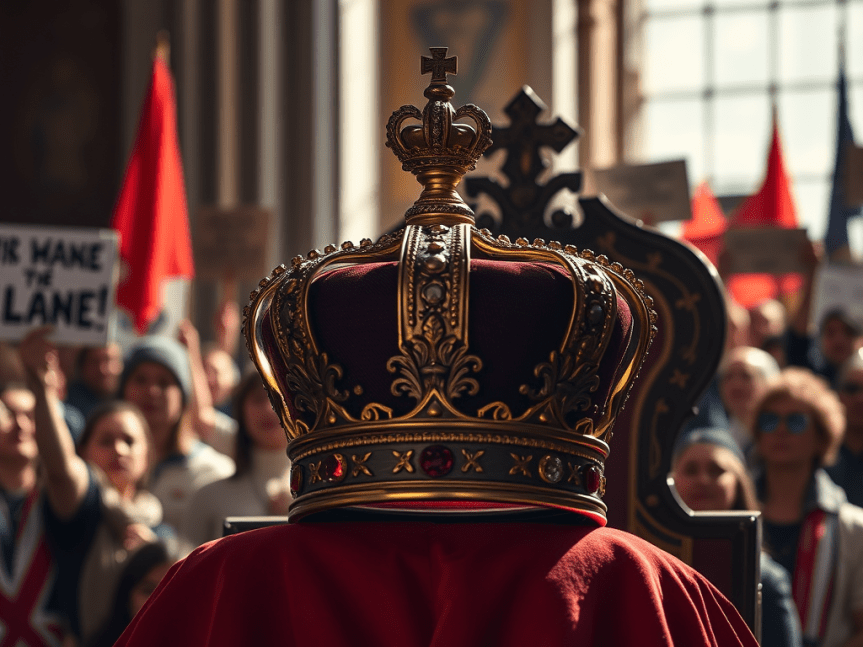
Many a revolution and civil war has played out across the world in many a country including the UK to sever the head of a monarch from the political control of a country. It seems bizarre in this day and age that Britain has a monarch as the head of it’s state, political and religious institutions. But what is even more bizarre is the strength of will at the heart of the establishment to maintain the status quo and make no change to this set of institutions, state of affairs or even review or to ensure transparency concerning where money goes to the monarch and how or why it is then spent.
For me this is not an argument about whether a King or Queen are good people or not but whether they have the right to be born into the role they play and I strongly believe that there should be no birth right to any position in our state let alone that of the head of state.
Arguments against supporting monarchies in democratic societies generally center on principles of equality, accountability, and the desire for a modern, meritocratic state. Critics argue that inherited power is fundamentally incompatible with the democratic ideal that all citizens are equal and that leaders should be chosen by the people.
- Lack of Democratic Accountability
A core tenet of democracy is that leaders must be answerable to the people they serve.
No Choice or Removal: Unlike elected officials, monarchs cannot be held to account or removed at the ballot box by the public.
Hereditary Risk: Relying on inheritance means there is no selection process to ensure the leader is capable; a nation risks being stuck with an incompetent, “petty,” or “vindictive” individual for decades.
2. Incompatibility with Popular Sovereignty
Democracy is rooted in the idea that power belongs to the people, not a specific family.
Anachronism: Critics view monarchy as a vestige of a feudal past that has no place in a modern world where legitimacy should derive from the consent of the governed.
Secrecy and Lobbying: In some systems, monarchies are exempt from transparency laws (like Freedom of Information requests), allowing for “lobbying by stealth” for private business interests.
3. Economic and Social Costs
Opponents often point to the tangible burdens of maintaining a royal institution.
Taxpayer Expense: Critics argue that the significant funds spent on the “extravagant lifestyle” of a royal family—including security, travel, and palace maintenance—could be better used for public services.
Colonial Legacy: For former colonies, retaining a distant monarch as a head of state can be seen as an obstacle to fully reconciling with their history and achieving true national independence.
4. Institutional Resilience vs. Democratic Values
While some argue that constitutional monarchies provide stability, critics contend:
Borrowed Time: Monarchies in democratic countries are often described as “operating on borrowed time,” requiring manufactured goodwill to survive.
Fragile Neutrality: A monarch’s perceived neutrality is easily shattered if they attempt to intervene in political matters, leading to constitutional crises.
Will the UK always have a monarchy?
Whether the UK will always have a monarchy is uncertain, as it is not guaranteed by law and relies on public support, which has shown a long-term decline. While it remains popular as a symbol of unity and tradition, support dropped to a record low of 54% in 2023, with around 25% favoring abolition.
Key Factors Regarding the Future of the Monarchy:
Public Opinion & Trends: While a majority still support the institution, backing has fallen from 76% in 2012 to 54% in 2023. A growing minority, now around 25%, supports a republic, marking a 10% increase in just five years.
Constitutional Pathway: There is no legal barrier to abolition; it could be achieved through a parliamentary act and a referendum, creating a new, elected head of state.
Arguments for Removal: Critics argue the institution is incompatible with modern democratic values, lacks transparency, and that its wealth (e.g., the Duchy estates) should belong to the public.
Arguments for Retention: Proponents highlight the monarch’s role in providing political stability, acting as a non-partisan head of state, and contributing to tourism and international soft power.
Future Adaptability: The monarchy’s survival has relied on its ability to adapt to changing times, a strategy that future monarchs like Prince William will likely need to continue to maintain support.
The monarchy’s future depends on the “oxygen of public support” and its ability to remain relevant to future generations, making its permanence not guaranteed.

Removing the power base of a born and bred King or Queen from the head of the UK will not be easy or happen overnight but it does feel like a form of constitutional madness to still have a monarch today as the head of a democratic society and is very much one that has been in place for so long it is sadly perceived to be a normal state of affairs.

 Welcome to Huwspace
You must be logged in to post a comment.