
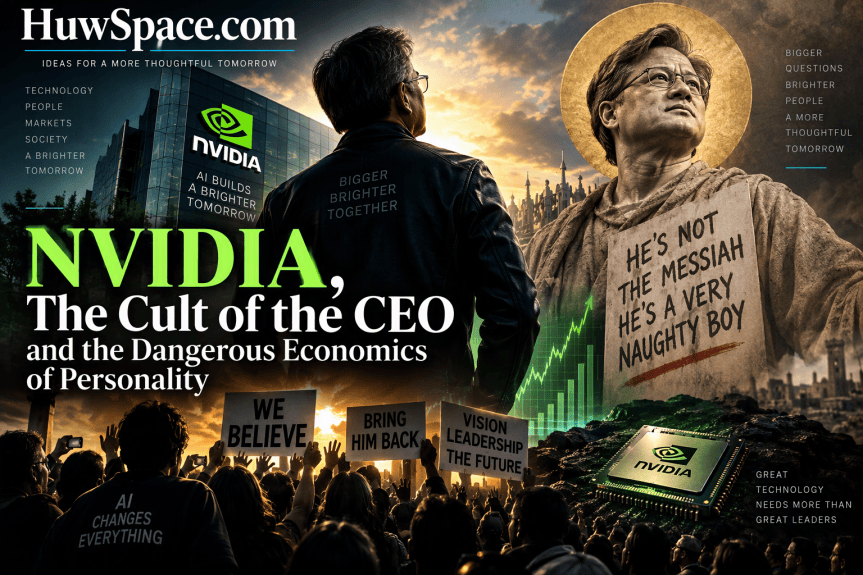
Standfirst: The turmoil surrounding NVIDIA’s leadership is about more than one company or one executive. It exposes a growing weakness in modern markets: investors increasingly place their faith not in businesses, but in personalities. History suggests that can be a dangerous habit.
By Huw Edwards | HuwSpace.com
The AI revolution is supposed to be about technology.
Algorithms.
Data centres.
Semiconductors.
Yet one of the biggest stories in the technology sector this month has centred on a single individual: Jensen Huang, the co-founder and former chief executive of NVIDIA. Following his resignation, investor concern was so intense that more than 100,000 people reportedly signed a petition calling for his return, while major shareholders urged the board to keep that possibility open.
That alone should give investors pause for thought.
Because if the departure of one individual creates that much anxiety, what exactly are investors buying?
A company?
Or a personality?
The Messiah Problem
There is an old joke from Monty Python’s Life of Brian.
The crowd declares: “He’s the Messiah!”
The response comes back: “He’s not the Messiah. He’s a very naughty boy.”
The joke works because humans have a habit of elevating ordinary people into something more than human. We turn leaders into symbols. We attribute success to them alone. We convince ourselves that they possess unique qualities that cannot be replaced.
Markets are no different.
Investors often claim to be rational. They talk about earnings, cash flow, margins and growth.
Yet the reaction to leadership changes frequently reveals something more emotional at work.
At some point, a successful chief executive stops being viewed as a manager and becomes a prophet of future prosperity.
The danger is that nobody can live up to that status forever.
The Cult of the Visionary
Technology firms seem particularly vulnerable.
Apple had Steve Jobs.
Tesla has Elon Musk.
OpenAI has Sam Altman.
NVIDIA has Jensen Huang.
These individuals undoubtedly played critical roles in building extraordinary organisations.
But there is a difference between recognising someone’s contribution and convincing yourself that the company cannot function without them.
The moment investors start believing an executive is irreplaceable, they stop valuing the institution and start valuing the individual.
That is a dangerous shift.
Strong companies should outlive their founders.
Strong businesses should survive leadership changes.
Strong institutions should be greater than any one person.
If they are not, investors should perhaps be asking harder questions.
The AI Sector’s Personality Bubble
The AI boom may have created more than a technology bubble.
It may have created a personality bubble.
Artificial intelligence remains one of the most transformative technologies of our age. The underlying opportunity is real.
Yet many AI-related valuations appear increasingly tied to faith in a handful of high-profile figures.
Investors follow conference appearances.
They scrutinise interviews.
They react to social media posts.
Entire sectors now seem capable of moving on the words of a few celebrity executives.
That is not a sign of rational pricing.
It is a sign of concentrated belief.
And belief can be fragile.
Profits Versus Personality
The uncomfortable truth is that profits and personality are not the same thing.
A charismatic chief executive can inspire confidence.
They can attract talent.
They can articulate a compelling vision.
But they cannot suspend economic reality.
A share price supported by earnings is one thing.
A share price supported by faith in an individual is something else entirely.
The history of business is littered with examples of celebrated leaders who appeared infallible until suddenly they were not.
Some failed through hubris.
Some through scandal.
Some simply discovered that expectations had become impossible to satisfy.
The lesson is always the same.
When investors start believing that one person is responsible for all success, they become blind to risk.
The Real Value of Leadership
This is not an argument against leadership.
Leadership matters enormously.
Vision matters.
Trust matters.
What matters less is the fantasy that one person alone creates corporate success.
NVIDIA’s achievements were not built by one executive.
They were built by thousands of engineers, researchers, designers, manufacturers and employees over decades.
The same is true of nearly every successful company.
Investors sometimes forget that because stories are easier to understand than systems.
People are easier to celebrate than institutions.
Heroes are easier to believe in than organisations.
Conclusion
The reaction to Jensen Huang‘s departure has revealed something fascinating about the modern market. Investors claim to be buying the future of artificial intelligence. Yet their behaviour suggests they are often buying something much older.
Faith.
Faith in leaders.
Faith in visionaries.
Faith in the idea that one exceptional person can carry an entire company on their shoulders.
History suggests caution.
The most valuable companies are not those led by messiahs.
They are the ones that can thrive after the messiah has gone.
Because eventually every leader leaves.
The real test of a company is whether the business remains standing when the cult of personality walks out of the door.
Sources
Yahoo Finance (15 November 2026)
Over 100,000 Want Jensen Huang Back. Nvidia Stock’s Real Test Comes Tuesday
Read article
USA Today (17 November 2026)
Former Nvidia CEO Jensen Huang Speaks Out After Resignation
Read article
Market Data
- Yahoo Finance, NVIDIA Historical Share Price Data
https://uk.finance.yahoo.com/quote/NVDA/history/ - Stock Analysis, NVIDIA Financial Statistics and Valuation Metrics
https://stockanalysis.com/stocks/nvda/ - Nasdaq, NVIDIA Historical Market Data
https://www.nasdaq.com/market-activity/stocks/nvda/historical/
This article reflects the author’s analysis and commentary on publicly available information and should not be considered financial or investment advice.


