
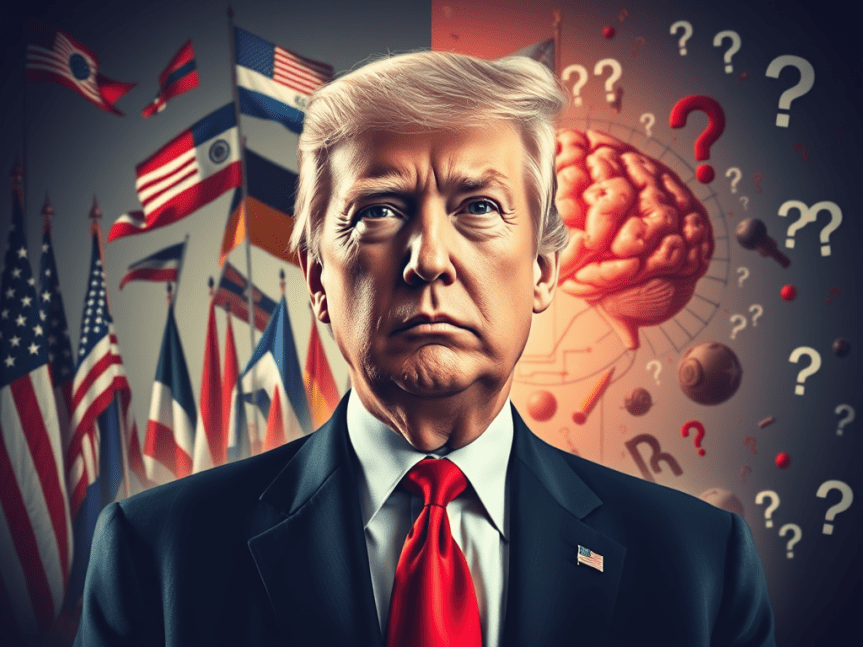
President Trump is described as “delusional” by mental health professionals, political commentators, and world leaders due to his persistent assertion of claims that directly contradict documented facts. These descriptions often center on several key behaviors:
Clinical and Psychological Perspectives
- Fixed False Beliefs: Psychiatrists define a delusion as a “fixed false belief” that is resistant to reason or confrontation with fact. Experts have cited his insistence on “stolen” elections and exaggerated crowd sizes as fulfilling this criteria.
- Narcissistic Personality: Many specialists argue his perceived delusions are rooted in Malignant Narcissism or Narcissistic Personality Disorder, which can lead to a “delusional detachment from reality” to protect an inflated self-image or “personal myth of greatness”.
- The Gospel of Positive Thinking: Some analysts link his behavior to his lifelong adherence to Norman Vincent Peale’s “Power of Positive Thinking,” where reality is shaped by one’s own mental attitude, leading to a refusal to acknowledge negative outcomes.
Recent Examples and Actions (2024-2025)
- Economic Claims: Critics describe his 2025 assertions that tariffs “magically” bring in billions from foreign countries—rather than taxing domestic consumers—as economically “nuts” and detached from reality.
- Polling Discrepancies: In late 2025, Trump was described as delusional for claiming he had the “highest poll numbers” of his career on Truth Social, despite concurrent data from the Associated Press and Fox News showing some of his worst approval ratings.
- Foreign Policy Assertions: Observers pointed to “delusional fantasies” in his 2025 claims regarding foreign leaders, such as incorrectly stating he ended a war between Azerbaijan and Albania (two countries not at war) and suggesting he could “own” or “take over” the Gaza Strip for real estate development.
- Annexation of Canada: His public discussion in 2025 about Canada potentially becoming the “51st state” was cited as an example of a belief system that ignores the reality of sovereign nations and public opinion.
Debates and Counterpoints
- Political Strategy vs. Mental Illness: Some observers argue he is “crazy like a fox,” using conspiracy theories and falsehoods as calculated tools for political success rather than out of a true clinical delusion.
- The Goldwater Rule: The American Psychiatric Association’s “Goldwater Rule” prohibits members from diagnosing public figures without a personal examination, causing some professionals to push back against colleagues who label the president “delusional” publicly.
- “Trump Derangement Syndrome”: Supporters often use this term to argue that it is actually his critics who are delusional, reacting irrationally to his unconventional but effective political style.

 Welcome to Huwspace
Love that song, and it’s a perfect fit for what we’re seeing with Trump’s physical, mental, and moral decay. Cheers
LikeLike