
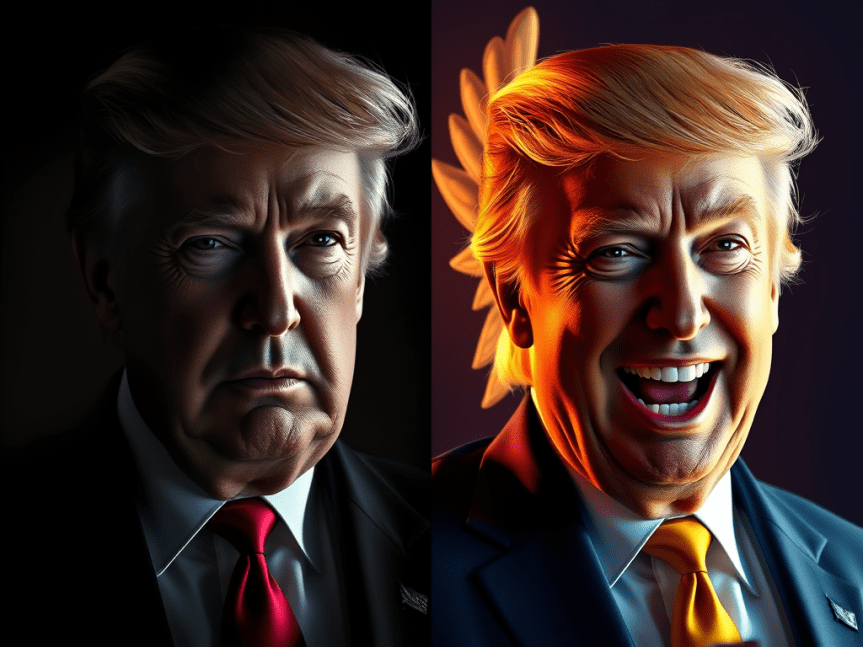
Whether Donald Trump is “evil” is a matter of intense public debate and subjective judgment, with no consensus. The term is used by various critics, supporters, and observers to describe his character, policies, and political impact from widely differing perspectives.
Arguments for Characterizing Him as evil
Critics and some public figures often use the term “evil” to describe Trump based on his actions and rhetoric:
- Moral and Ethical Critique: Figures like actor Robert De Niro have explicitly called him “evil,” citing a lack of morals, ethics, or regard for others.
- Impact of Policies: Some commentators argue that his policies, such as certain immigration measures or his handling of the COVID-19 pandemic, have caused significant suffering and death, which they categorize as a form of “multidimensional evil”.
- Political Rhetoric: His use of language to demonise domestic political opponents—labelling them as “evil”—is seen by some as a dangerous shift in American political discourse.
- Cultural Symbolism: In popular culture and media, Trump has been frequently depicted or used as a template for villainous characters, representing archetypes of greed and cynicism.
Counter-Perspectives and Alternative Labels
Other observers reject the “evil” label, offering different interpretations:
- Incompetence vs. Malice: Some critics argue he is not evil but rather a “chaotic fool” or “buffoon” whose detrimental impacts stem from ego and incompetence rather than calculated malevolence.
- “Necessary Evil”: Some supporters or pragmatic observers have characterized him as a “necessary evil”—a disruptive force required to challenge established political systems.
- Psychological Framing: Many analysts prefer clinical or psychological terms, such as “narcissistic” or “pathological,” to describe his behaviour rather than moralistic terms like “evil”.
Perception and Bias
Research suggests that whether an individual perceives Trump as “devil or messiah” is often influenced by their own pre-existing biases or political echo chamber and how they weigh his public persona as a successful businessman against his controversial actions as a political leader.
Sinner or saint in the time of political echo chambers/
Maybe in a time of political echo chambers where environments are often created by social media algorithms and selective exposure, where individuals only encounter information, opinions, and beliefs that reflect and reinforce their own. These insular spaces, sometimes termed “neotribalism,” intensify political polarization, normalize extreme views, and shield users from opposing perspectives. such a time is the perfect time to create a sinner or a saint in Donald Trump. We don’t want to see the good in what we perceive to be bad and alternatively those that see only the good in what he does are ignorant to the bad.
But also on the other hand if Donald Trump himself only chooses to listen and follow his own political echo chambers perspective and train of thought, then what will he loose out on or what damage will be done or has or is already being done by ignoring a more overarching or balanced set of views and perspectives on politics and the globe. Presidents can now be hoodwinked just as easily as people can by their own political echo chambers.
Final a religious perspective to Trumps entourage
In Matthew 23:3, Jesus tells his followers to obey the teachings of the scribes and Pharisees, but not to follow their actions, stating: “for they talk but do not do”. This is a warning against hypocrisy, specifically criticizing religious leaders who preach the law but do not practice it themselves.
Key details regarding this, and similar phrasing:
- Context: Jesus was calling out hypocritical leaders who “tie up heavy, cumbersome loads” (strict religious rules) but are unwilling to lift a finger to help.
- Meaning: This is a command to follow the authorized, sound doctrine (“what they say”), but avoid copying the behaviour of those who fail to live up to it (“what they do”).

 Welcome to Huwspace