
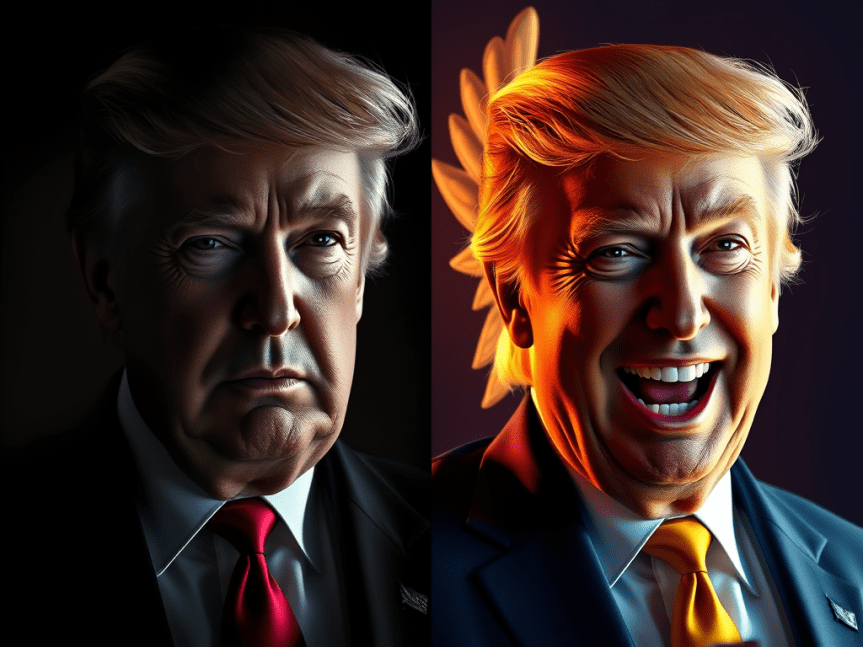
Is Donald Trump a ‘Saint’ or a ‘Sinner’ in the time of political echo chambers?

Whether Donald Trump is “evil” is a matter of intense public debate and subjective judgment, with no consensus. The term is used by various critics, supporters, and observers to describe his character, policies, and political impact from widely differing perspectives.

Arguments for Characterizing Him as evil

Critics and some public figures often use the term “evil” to describe Trump based on his actions and rhetoric:

  • Moral and Ethical Critique: Figures like actor Robert De Niro have explicitly called him “evil,” citing a lack of morals, ethics, or regard for others.
  • Impact of Policies: Some commentators argue that his policies, such as certain immigration measures or his handling of the COVID-19 pandemic, have caused significant suffering and death, which they categorize as a form of “multidimensional evil”.
  • Political Rhetoric: His use of language to demonise domestic political opponents—labelling them as “evil”—is seen by some as a dangerous shift in American political discourse.
  • Cultural Symbolism: In popular culture and media, Trump has been frequently depicted or used as a template for villainous characters, representing archetypes of greed and cynicism. 

Counter-Perspectives and Alternative Labels

Other observers reject the “evil” label, offering different interpretations:

  • Incompetence vs. Malice: Some critics argue he is not evil but rather a “chaotic fool” or “buffoon” whose detrimental impacts stem from ego and incompetence rather than calculated malevolence.
  • “Necessary Evil”: Some supporters or pragmatic observers have characterized him as a “necessary evil”—a disruptive force required to challenge established political systems.
  • Psychological Framing: Many analysts prefer clinical or psychological terms, such as “narcissistic” or “pathological,” to describe his behaviour rather than moralistic terms like “evil”.

Perception and Bias

Research suggests that whether an individual perceives Trump as “devil or messiah” is often influenced by their own pre-existing biases or political echo chamber and how they weigh his public persona as a successful businessman against his controversial actions as a political leader.

Sinner or saint in the time of political echo chambers/

Maybe in a time of political echo chambers where environments are often created by social media algorithms and selective exposure, where individuals only encounter information, opinions, and beliefs that reflect and reinforce their own. These insular spaces, sometimes termed “neotribalism,” intensify political polarization, normalize extreme views, and shield users from opposing perspectives. such a time is the perfect time to create a sinner or a saint in Donald Trump. We don’t want to see the good in what we perceive to be bad and alternatively those that see only the good in what he does are ignorant to the bad.

But also on the other hand if Donald Trump himself only chooses to listen and follow his own political echo chambers perspective and train of thought, then what will he loose out on or what damage will be done or has or is already being done by ignoring a more overarching or balanced set of views and perspectives on politics and the globe. Presidents can now be hoodwinked just as easily as people can by their own political echo chambers.

Final a religious perspective to Trumps entourage

Pastors pray over Trump in the Oval Office

In Matthew 23:3, Jesus tells his followers to obey the teachings of the scribes and Pharisees, but not to follow their actions, stating: “for they talk but do not do”. This is a warning against hypocrisy, specifically criticizing religious leaders who preach the law but do not practice it themselves. 

Key details regarding this, and similar phrasing:

  • Context: Jesus was calling out hypocritical leaders who “tie up heavy, cumbersome loads” (strict religious rules) but are unwilling to lift a finger to help.
  • Meaning: This is a command to follow the authorized, sound doctrine (“what they say”), but avoid copying the behaviour of those who fail to live up to it (“what they do”).


The poor will always have you

The phrase, “The poor will always have you,” is an inversion of a well-known quote from the New Testament of the Bible, which in modern translations generally reads, “The poor you will always have with you“. 

This statement is recorded in the Gospels of Matthew (26:11), Mark (14:7), and John (12:8), and is part of Jesus’ response to his disciples when they object to a woman anointing him with expensive perfume that could have been sold to help the poor. 

Origin and Context

Jesus’ statement is a direct allusion to Deuteronomy 15:11 in the Old Testament, which states, “For there will never cease to be poor in the land; that is why I am commanding you to open wide your hand to your brother and to the poor and needy in your land”. 

Meaning and Interpretation

When Jesus said this, he was not dismissing the plight of the poor or suggesting that poverty is an unchangeable fate to be ignored. Instead, the original context highlights several points: 

  • A Call to Action: By referencing Deuteronomy, Jesus was reminding his followers of their ongoing, God-given responsibility to be open-handed and generous toward the poor.
  • Prioritizing Worship: The statement served as a defense of the woman’s act of worship. Jesus emphasized that while the disciples would always have opportunities to help the poor, the unique, physical opportunity to honor him before his imminent death and burial was fleeting.
  • Critique of Motives: In John’s Gospel, the objection came from Judas Iscariot, who was a thief and did not genuinely care for the poor, adding a layer of rebuke to those who use concern for the needy as a mask for their own self-righteousness or misplaced priorities. 

In summary, the phrase is a reminder of the perpetual existence of poverty in a fallen world and a constant call for believers to show ongoing compassion and generosity, but it also establishes the importance of wholehearted devotion and worship of Christ.

I am not normally one for looking to biblical texts for inspiration but this just struck a cord with me this morning. Although I am employed (happyish in my work) receive enough pay to keep a roof over my head and to try to save money for rainy days and buy goods and services that I think I need in my life, there is very little leftover to do anything else with after that.

Not that I need more money for myself but there is also a complete lack of employment opportunities to move up any form of career ladder nowadays across Britain, even if I made the time and effort to apply for other jobs. Unlike in my youth, administration manager roles or project support staff roles roles just no longer exist in a way like they used to. I know people with a desire to work that are finding it extremely difficult to step into employment now and have never witnessed an employment market as difficult and competitive as the one that exists today.

There are ways and means of getting into work and you must go the extra mile if unemployed every time to prove your worth to potential employers. I have always looked to work in a place of my choice doing something that interests me as a volunteer when out of work and that has always proved so far to be an excellent stepping stone to employed work and also a huge motivator to get out of bed and rewarding me with enjoyment and self respect.

I had up until recently been contributing small amounts or money each month to the Green Party and also a charity called International Rescue. I stopped those payments recently and it has to some extent been playing on my mind. How can someone like me help people those with less than what I have.

I would like to think there are many ways I can continue to help others. Such as how I vote, what I advocate for in the political system. What I say on my blog, what I believe in and live by. Helping a friend with less cash than me with a drink on a night out or making sure they have enough money to safely get a taxi home or other little things like that are small wins that help the people that I respect and want to support.

Poverty has felt like a real life possibility for me at times one which could if I am unlucky enough or we are all propelled into some cataclysm come back top haunt me. I was homeless (for a very short time myself once, which lead to me having the home that I have now lived in for over 15 years provided by a housing association which I now also work voluntarily for on a scrutiny panel to help improve the housing association for others, they have helped me so I am helping them now. I have always found in life that when I can not afford to give to a charity or good cause financially I can always make up for by giving my time and effort instead.

I have also been on benefits in the past when out of work or unwell with which without which I could have had nothing although saying that I have always had the love and support of my parents. They will not always be around to help me though which does make me focus my mind on ensuring I am there to stand on my own two feet on my own. To think of safety nets is not just theoretical for me but absolutely vital in order to have gone from where I was to where I am today.

To pay my way in life and hold my own not relying on anyone now financially but myself is a huge achievement to me. Though some might see holding your own and paying your way as perhaps a form of failure to me it is a genuine success. Well it must be some kind of religious quotes day for me so I will bail out with another interesting quote from the bible. “Blessed are the poor in spirit, for theirs is the kingdom of heaven”.

JAMES – Sit Down (Original Rough Trade Version Music Video)

Understanding Miracles and Their Implications

So how did it come to me blogging about this – well with a considerable amount of thoughtful scepticism. I started thinking about who decides what is a miracle in today’s world and what does that say about all miracles and whether they have happened or not and whether that matters anyway!

Simply put mainly according to AI’s interpretation on this issue (who would have believed a few years ago that AI would be attempting to teach a human on the divinity of a miracle, but here we are) a miracle is an extraordinary and welcome event that is not explicable (meaning capable of being explained) or understood by natural or scientific laws and is therefore attributed to a divine agency.

A miracle is generally understood as an extraordinary event that is attributed to supernatural forces or divine intervention, often defying natural or scientific laws. 

It’s also used more broadly to describe any amazing or wonderful event, regardless of whether it has supernatural connotations. 

Here’s a more detailed breakdown:

1. Supernatural/Divine Interpretation:

Many religions associate miracles with the actions of a deity or other supernatural being. 

These events are often seen as signs of God’s power or intervention in human affairs. 

Examples include healing the sick, raising the dead, or performing other feats beyond natural capabilities. 

2. Broader Usage:

In everyday language, “miracle” can refer to any highly improbable but positive event, like surviving a disaster or experiencing a stroke of good luck. 

This usage emphasizes the unexpected and beneficial nature of the event. 

For example, “a miracle of modern engineering” might describe a complex structure that was incredibly difficult to build. 

3. Key Characteristics:

Unexplained or inexplicable: Miracles are often events that cannot be readily explained by natural or scientific laws.

Extraordinary or wonderful: They are events that stand out as exceptional and remarkable.

Potentially supernatural: In many cases, miracles are associated with supernatural agency, but this is not always the case in broader usage. 

So for now where my ponderings have led me to consider whether divine miracles occur on daily basis and are real events or a thing of fiction. It’s fascinating that god requires no proof and yet a miracle is the greatest proof or all of god exists.

To me the greatest miracle of all is the miracle of life and followed by the existence of all and the wonder and beauty of all living things especial humans and other conscious beings. This is truly wondrous miracle of existence and also clear proof of a divine being at work for me – what it does not tell me though in any way, shape or form whatsoever is whether that divine being is a Buddhist, Muslim, Jew or Christian.

Religious labels and the divine have for most of my life been lost on me and therefore if one religion tells me something is not a sin and another tells me it is then how do I or anyone know else know which is the most appropriate interpretation to take? Or for that matter if one religions says that something is a miracle and another religion says no it never happened then who is the divine messenger of god and who is not? I expect it boils back down to individual belief and perceptions of those rules and regulations for certain beliefs, faiths and/or religions to be perceived and believed to be right or wrong, true or false.