

Jesus, Justice and the Left: Can Christians Back Socialism?

Many Christians are comfortable with personal charity but become uncomfortable when the discussion turns to taxation, welfare, regulation or wealth redistribution.

Yet the Bible contains repeated warnings not merely about individual sin but about unjust systems. The prophets Amos, Isaiah and Micah condemned rulers, elites and economic arrangements that crushed the poor. Their criticism was political as well as spiritual.

Jesus himself spoke far more about wealth and poverty than many modern Christians realise:

“Whatever you did for one of the least of these brothers and sisters of mine, you did for me.”

  • Matthew 25:40

The challenge is obvious. If society knowingly permits avoidable poverty, suffering or exclusion, are Christians fulfilling their obligations simply by donating to charity, or do they have a duty to change the structures creating those problems?

Democratic Socialism as Applied Christianity?

Democratic socialism argues that economic life should be organised around human wellbeing rather than the accumulation of private wealth alone.

Many Christians see echoes of Gospel values in this idea:

  • Healthcare based on need rather than ability to pay.
  • Fair wages and dignified working conditions.
  • Housing as a human necessity.
  • Collective responsibility for the vulnerable.
  • Constraints on excessive concentrations of wealth and power.

None of these ideas require the abolition of markets or private property. Rather, they attempt to place moral limits around them.

In that sense, democratic socialism can be viewed not as a replacement for Christianity but as one political expression of Christian ethics.

The Conservative Christian Challenge

The strongest objection is not that Christians should ignore suffering.

Instead, conservative Christians argue that Christian virtue loses something when it is enforced through the state. A gift given freely reflects love; taxation is compulsory.

This is a serious argument, but it raises another question:

If voluntary charity alone were sufficient, why has poverty remained so persistent throughout history?

Hospitals, public education, sanitation, worker protections and social security systems were not created solely through individual acts of kindness. They emerged because societies collectively decided that certain forms of suffering were unacceptable.

A Reflection

Perhaps the more interesting question is not whether Christianity demands socialism, but whether Christianity can remain purely private.

A faith centred on loving one’s neighbour cannot avoid confronting politics for long. Politics determines whether children go hungry, whether elderly people receive care, whether workers can live with dignity and whether opportunity is available only to the fortunate few.

Christians may legitimately disagree about the mechanisms. Some will favour markets with safeguards. Others will favour democratic socialism. Still others will advocate community-led solutions.

What becomes harder to defend is the notion that faith has nothing to say about economic injustice at all.

If Christ repeatedly stood alongside the poor, the marginalised and the powerless, then Christians must ask themselves a difficult question:

Not whether they should help their fellow human beings, but whether they are willing to support the changes necessary to prevent that suffering from arising in the first place.

For many believers, that journey leads naturally toward democratic socialism. For others, it does not.

But it is a question that Christianity cannot easily ignore.

Christianity does not automatically produce a single political ideology. Christians can disagree about markets, taxation, welfare and the size of the state. Yet it is difficult to read the teachings of Jesus and conclude that society should be organised without regard for justice, equality of human worth and concern for the vulnerable.

The Gospel may not explicitly demand democratic socialism, but it does seem to demand something that troubles both the political left and right: a society in which power serves people rather than people serving power.

If every human being possesses equal value before God, then social justice and democratic participation become more than political preferences. They become expressions of a deeper spiritual truth about human dignity itself.

Seth Lakeman – Poor Man’s Heaven

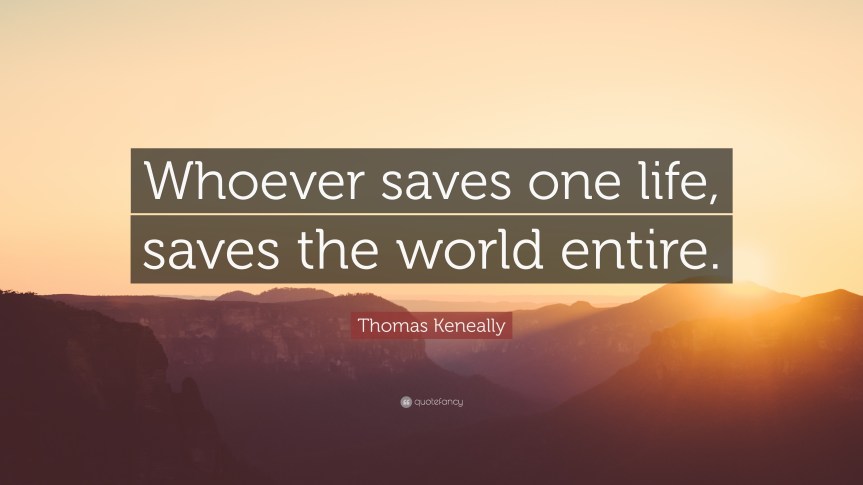
Whoever Saves One Life, Saves the World Entire

The above clip from Schindler’s List is an emotional clip refer to Oscar Schindler leaving the camp where he had saved so many Jewish people’s lives from and him becoming emotional about what he had or had not achieved in his time there.

We often judge our impact by the scale of what we can achieve. We look at poverty, war, loneliness, addiction, illness, or injustice and feel overwhelmed by the vastness of the challenge. Yet history, faith, and human experience repeatedly remind us that changing one life can alter far more than we ever realise.

The ancient phrase,“Whoever saves one life, saves the world entire,” expresses a profound truth about human existence. Originating in Jewish tradition and echoed within Islamic teaching, the maxim teaches that the value of a single life cannot be measured merely by numbers. Every person carries within them an entire world of relationships, experiences, dreams, memories, and future possibilities.

Most of us, however, will never rescue hundreds of people from danger. We will never be remembered alongside figures such as Oskar Schindler, whose actions during one of history’s darkest periods helped save more than a thousand lives. Yet perhaps this is not the point.

The phrase challenges us to think differently about significance.

The Lives We Never Know We Touched

Human influence rarely arrives with an announcement.

A kind word offered during someone’s darkest week. A mentor who spends an extra hour helping a struggling student. A neighbour who notices when someone has become isolated. A friend who answers a late-night phone call. A teacher who sees potential in a child before anyone else does.

In the moment, these actions can seem small.

Yet we rarely witness the full consequences of what we do.

The person encouraged today may go on to raise a family, create a business, discover a medical breakthrough, volunteer in their community, or simply offer the same kindness to countless others. The act that appeared insignificant may become a turning point from which an entirely different future unfolds.

Like ripples spreading across a pond, the effects continue long after the original action has been forgotten.

The Mathematics of Human Potential

We often measure success through visible outcomes. How many people were helped? How many problems were solved? How much change was created?

But human lives do not follow simple arithmetic.

Consider a single individual facing a crisis. Supporting them may help one person. Yet it may also preserve a relationship, strengthen a family, protect future opportunities, and influence generations that do not yet exist.

Every person exists within a network of connections. Change one life and you may unknowingly alter dozens more.

This is why the ancient teaching remains so powerful. It recognises that every life is not merely an individual existence but the centre of an entire web of human relationships.

Saving a life does not simply save one person.

It saves all the futures connected to them.

The Burden of Wanting to Save Everyone

Many people who care deeply about the world carry a hidden frustration.

They look at climate change, conflict, poverty, political instability, biodiversity loss, social division, or economic uncertainty and feel paralysed by the scale of the challenge.

The problems appear too large.

The resources appear too small.

Our individual contribution feels insignificant.

Yet this is where the wisdom of the phrase offers something liberating.

It does not ask us to save everyone.

It asks us to recognise the value of saving anyone.

The reality is that none of us can solve every problem. No one person can end all suffering or fix every injustice. But each of us has opportunities to affect the lives immediately around us.

The neighbour.

The colleague.

The friend.

The stranger.

The person quietly struggling while everyone else carries on.

History is not only shaped by grand movements and famous individuals. It is also shaped by countless ordinary acts that never make headlines.

The Invisible Legacy

One of the remarkable truths about life is that we seldom know our own impact.

Many people who have changed lives never discover it.

A teacher may never learn that their encouragement prevented a student from giving up.

A doctor may never see the generations that exist because one patient survived.

A volunteer may never hear that a conversation changed someone’s direction entirely.

Even parents often do not fully appreciate how their values echo through future generations.

We live surrounded by invisible legacies.

Perhaps somewhere today, a person is alive, hopeful, employed, loved, or thriving because of a small action from someone else years ago.

That chain of influence stretches endlessly backwards and forwards through time.

Why This Matters Today

Modern society often celebrates scale.

Followers. Views. Reach. Influence. Growth.

The assumption is that more people reached means greater value created.

Yet the teaching “Whoever saves one life, saves the world entire” presents a different standard.

Value is not determined by numbers alone.

A conversation with one person can matter more than a message delivered to millions.

A single act of compassion can have consequences greater than any algorithm can measure.

The world changes not only through large institutions and governments, but through human beings choosing to care about one another.

Saving the World, One Person at a Time

Perhaps the greatest lesson within this ancient phrase is not that one life represents an entire world.

It is that we are rarely in a position to know which life matters most.

The stranger we help today may affect the lives of hundreds tomorrow.

The child we encourage might grow into the leader, scientist, artist, carer, or innovator who changes countless lives.

Or perhaps they simply become a kinder person who passes that kindness forward.

That alone is enough.

We live in a world where the scale of our challenges can seem overwhelming. It is easy to become discouraged by everything we cannot do.

But there remains immense power in what we can do.

We may never save everyone.

We may never even know when we have saved someone.

Yet every act of compassion, encouragement, protection, understanding, or support carries with it the possibility of changing an entire future.

And because the future branches out infinitely through every human life, we may discover that the ancient wisdom was right all along.

Sometimes, when we save one life, we really do save the world entire. ✨

The poor will always have you

The phrase, “The poor will always have you,” is an inversion of a well-known quote from the New Testament of the Bible, which in modern translations generally reads, “The poor you will always have with you“. 

This statement is recorded in the Gospels of Matthew (26:11), Mark (14:7), and John (12:8), and is part of Jesus’ response to his disciples when they object to a woman anointing him with expensive perfume that could have been sold to help the poor. 

Origin and Context

Jesus’ statement is a direct allusion to Deuteronomy 15:11 in the Old Testament, which states, “For there will never cease to be poor in the land; that is why I am commanding you to open wide your hand to your brother and to the poor and needy in your land”. 

Meaning and Interpretation

When Jesus said this, he was not dismissing the plight of the poor or suggesting that poverty is an unchangeable fate to be ignored. Instead, the original context highlights several points: 

  • A Call to Action: By referencing Deuteronomy, Jesus was reminding his followers of their ongoing, God-given responsibility to be open-handed and generous toward the poor.
  • Prioritizing Worship: The statement served as a defense of the woman’s act of worship. Jesus emphasized that while the disciples would always have opportunities to help the poor, the unique, physical opportunity to honor him before his imminent death and burial was fleeting.
  • Critique of Motives: In John’s Gospel, the objection came from Judas Iscariot, who was a thief and did not genuinely care for the poor, adding a layer of rebuke to those who use concern for the needy as a mask for their own self-righteousness or misplaced priorities. 

In summary, the phrase is a reminder of the perpetual existence of poverty in a fallen world and a constant call for believers to show ongoing compassion and generosity, but it also establishes the importance of wholehearted devotion and worship of Christ.

I am not normally one for looking to biblical texts for inspiration but this just struck a cord with me this morning. Although I am employed (happyish in my work) receive enough pay to keep a roof over my head and to try to save money for rainy days and buy goods and services that I think I need in my life, there is very little leftover to do anything else with after that.

Not that I need more money for myself but there is also a complete lack of employment opportunities to move up any form of career ladder nowadays across Britain, even if I made the time and effort to apply for other jobs. Unlike in my youth, administration manager roles or project support staff roles roles just no longer exist in a way like they used to. I know people with a desire to work that are finding it extremely difficult to step into employment now and have never witnessed an employment market as difficult and competitive as the one that exists today.

There are ways and means of getting into work and you must go the extra mile if unemployed every time to prove your worth to potential employers. I have always looked to work in a place of my choice doing something that interests me as a volunteer when out of work and that has always proved so far to be an excellent stepping stone to employed work and also a huge motivator to get out of bed and rewarding me with enjoyment and self respect.

I had up until recently been contributing small amounts or money each month to the Green Party and also a charity called International Rescue. I stopped those payments recently and it has to some extent been playing on my mind. How can someone like me help people those with less than what I have.

I would like to think there are many ways I can continue to help others. Such as how I vote, what I advocate for in the political system. What I say on my blog, what I believe in and live by. Helping a friend with less cash than me with a drink on a night out or making sure they have enough money to safely get a taxi home or other little things like that are small wins that help the people that I respect and want to support.

Poverty has felt like a real life possibility for me at times one which could if I am unlucky enough or we are all propelled into some cataclysm come back top haunt me. I was homeless (for a very short time myself once, which lead to me having the home that I have now lived in for over 15 years provided by a housing association which I now also work voluntarily for on a scrutiny panel to help improve the housing association for others, they have helped me so I am helping them now. I have always found in life that when I can not afford to give to a charity or good cause financially I can always make up for by giving my time and effort instead.

I have also been on benefits in the past when out of work or unwell with which without which I could have had nothing although saying that I have always had the love and support of my parents. They will not always be around to help me though which does make me focus my mind on ensuring I am there to stand on my own two feet on my own. To think of safety nets is not just theoretical for me but absolutely vital in order to have gone from where I was to where I am today.

To pay my way in life and hold my own not relying on anyone now financially but myself is a huge achievement to me. Though some might see holding your own and paying your way as perhaps a form of failure to me it is a genuine success. Well it must be some kind of religious quotes day for me so I will bail out with another interesting quote from the bible. “Blessed are the poor in spirit, for theirs is the kingdom of heaven”.

JAMES – Sit Down (Original Rough Trade Version Music Video)

My God, my God, why have You forsaken Me?

The bible teaches us that during the Crucifixion of Jesus on the ninth hour he cried with a loud voice, saying, Eloi, Eloi, lama sabachthani? This is, translated as, My God, my God, why hast thou forsaken me? Such a sad statement to have in the bible and a true reflection of the grief and sadness of the situation unfolding on the cross in real-time for Jesus still echoing down the years of history to all.

Many Christians believe that what happens is all part of God’s plan and choice, and that all our souls are heading towards Gods destination of choice for us, the good the bad and the ugly.  

I hope and pray this is true but I am not sure I have the conviction of faith to believe it to be so all the time. When you witness or experience bad things happening to yourself or good people that you love and know, it scares or bruises your soul and sometimes the closer to home that it happens then the deeper the scar cuts. My believe in the presence and existence of God does not deminish but having faith in how his will is conducted is a challenge at times.

I believe God is all powerful and has unconditional love, “the highest form of love, charity” and “the love of God for man”. I try my best to work in service of god throughout my life living as a good person, but know I am just one man and in all honesty though my actions attempt to do right by God, and sometimes I fail but not all times.

But my ability to have faith in his plan is in all honesty my greatest weakness. I get paranoid and fear that evil could theoretically overcome humans on this planet and for that I try to speak out against evil and wrong doing even more so because of this.

I am no great fighter my greatest weapons are in words and deeds that matter to others and myself. I am not trained in the use of a gun or my fists. Though if I am alive and well enough and a global war was declared which my country was involved within I would seek to take my place however I could best serve.

As far as the future is concerned, God will be alright whatever happens and he will be happy and content with his plan no matter how it unfolds for me or those that I love on this earth. I just hope he does not forsake us and the places we love as bad things continue to happen to good people across the globe.  

I try to speak truth to power which is a gift and curse that I have and at difficult times like that we are living through now it is one of the things that I aspire to continue to do.

Seal – Don’t Cry