
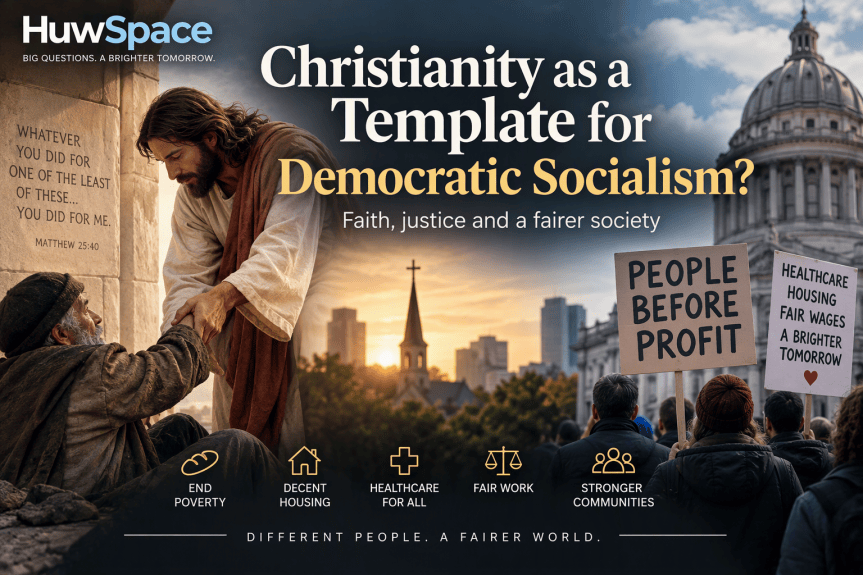
Many Christians are comfortable with personal charity but become uncomfortable when the discussion turns to taxation, welfare, regulation or wealth redistribution.
Yet the Bible contains repeated warnings not merely about individual sin but about unjust systems. The prophets Amos, Isaiah and Micah condemned rulers, elites and economic arrangements that crushed the poor. Their criticism was political as well as spiritual.
Jesus himself spoke far more about wealth and poverty than many modern Christians realise:
“Whatever you did for one of the least of these brothers and sisters of mine, you did for me.”
- Matthew 25:40
The challenge is obvious. If society knowingly permits avoidable poverty, suffering or exclusion, are Christians fulfilling their obligations simply by donating to charity, or do they have a duty to change the structures creating those problems?
Democratic Socialism as Applied Christianity?
Democratic socialism argues that economic life should be organised around human wellbeing rather than the accumulation of private wealth alone.
Many Christians see echoes of Gospel values in this idea:
- Healthcare based on need rather than ability to pay.
- Fair wages and dignified working conditions.
- Housing as a human necessity.
- Collective responsibility for the vulnerable.
- Constraints on excessive concentrations of wealth and power.
None of these ideas require the abolition of markets or private property. Rather, they attempt to place moral limits around them.
In that sense, democratic socialism can be viewed not as a replacement for Christianity but as one political expression of Christian ethics.
The Conservative Christian Challenge
The strongest objection is not that Christians should ignore suffering.
Instead, conservative Christians argue that Christian virtue loses something when it is enforced through the state. A gift given freely reflects love; taxation is compulsory.
This is a serious argument, but it raises another question:
If voluntary charity alone were sufficient, why has poverty remained so persistent throughout history?
Hospitals, public education, sanitation, worker protections and social security systems were not created solely through individual acts of kindness. They emerged because societies collectively decided that certain forms of suffering were unacceptable.
A Reflection
Perhaps the more interesting question is not whether Christianity demands socialism, but whether Christianity can remain purely private.
A faith centred on loving one’s neighbour cannot avoid confronting politics for long. Politics determines whether children go hungry, whether elderly people receive care, whether workers can live with dignity and whether opportunity is available only to the fortunate few.
Christians may legitimately disagree about the mechanisms. Some will favour markets with safeguards. Others will favour democratic socialism. Still others will advocate community-led solutions.
What becomes harder to defend is the notion that faith has nothing to say about economic injustice at all.
If Christ repeatedly stood alongside the poor, the marginalised and the powerless, then Christians must ask themselves a difficult question:
Not whether they should help their fellow human beings, but whether they are willing to support the changes necessary to prevent that suffering from arising in the first place.
For many believers, that journey leads naturally toward democratic socialism. For others, it does not.
But it is a question that Christianity cannot easily ignore.
Christianity does not automatically produce a single political ideology. Christians can disagree about markets, taxation, welfare and the size of the state. Yet it is difficult to read the teachings of Jesus and conclude that society should be organised without regard for justice, equality of human worth and concern for the vulnerable.
The Gospel may not explicitly demand democratic socialism, but it does seem to demand something that troubles both the political left and right: a society in which power serves people rather than people serving power.
If every human being possesses equal value before God, then social justice and democratic participation become more than political preferences. They become expressions of a deeper spiritual truth about human dignity itself.


