
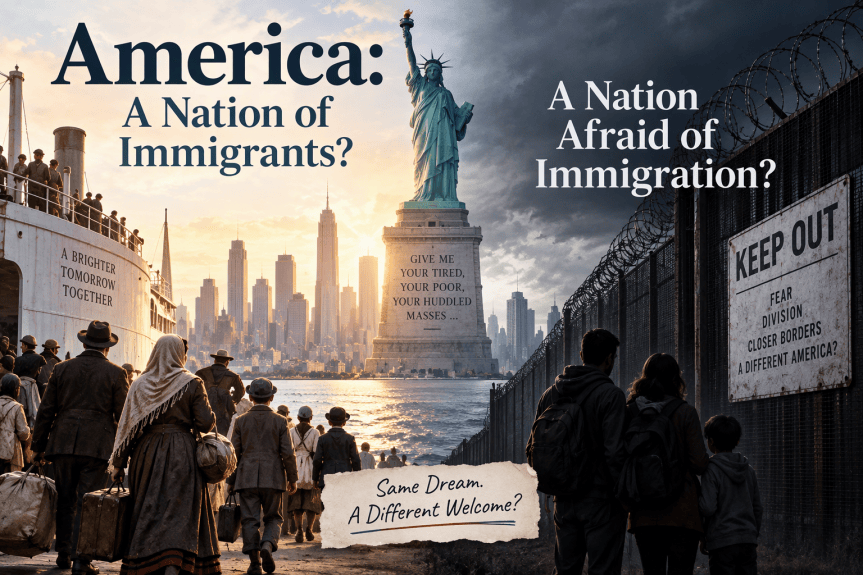
The Hopes, Fears and Contradictions of the American Dream
By Huw Edwards
“Give me your tired, your poor, your huddled masses yearning to breathe free.”
For generations, the United States has presented itself as a beacon of opportunity. From the Statue of Liberty to Hollywood, from Silicon Valley to the open highways of the American West, the national story has often been one of newcomers arriving with hope and determination.
Yet alongside that story lies another.
Almost every major wave of immigration has been accompanied by fears of cultural change, economic competition, crime, political instability or threats to national identity. Americans are not unique in this regard. Throughout history, societies have often viewed newcomers with suspicion. What makes the United States remarkable is that this anxiety repeatedly emerges within a nation built almost entirely through migration.
A Country Built By Successive Waves Of Immigration
The phrase “nation of immigrants” is not simply political rhetoric.
With the exception of Native Americans and the descendants of enslaved people brought by force, most Americans can trace their ancestry to people who arrived seeking opportunity, safety or a better future. Europeans fleeing poverty, Jews escaping persecution, Asians pursuing opportunity, refugees escaping conflict and Latin American migrants seeking work have all contributed to building modern America.
Yet many groups now considered fully American were once viewed as outsiders.
Irish immigrants were accused of undermining social order.
Italian immigrants were portrayed as criminals.
Chinese migrants faced exclusionary laws.
Jewish refugees encountered quotas and suspicion.
Each generation seems to identify a new group that supposedly cannot integrate.
History repeatedly demonstrates otherwise.
The Reality Is More Complicated Than Politics Suggests
Immigration debates are frequently framed as a battle between compassion and security.
Reality is far more complicated.
Historical evidence suggests that not all immigrants remained permanently in the United States. Significant numbers returned home voluntarily after earning money or supporting families. Others left because they could not establish successful lives in America or because policy changes made remaining difficult. Estimates suggest that between one-fifth and one-third of immigrants who arrived since the early twentieth century ultimately departed rather than permanently settle.
The commonly used image of immigration as a one-way permanent movement often fails to reflect historical reality.
Migration has frequently been temporary, circular and shaped by economic circumstances.
Are Americans Being Taught To Fear Immigrants?
This is where the debate becomes politically charged.
Some commentators argue that politicians, media organisations and wealthy public figures deliberately amplify fears about immigration because fear is politically useful.
Others argue that public concerns arise from genuine pressures relating to housing, wages, infrastructure, social cohesion and border management.
The truth is likely to contain elements of both.
Political messaging undeniably influences public opinion. At the same time, dismissing all concerns about immigration as prejudice risks ignoring legitimate questions about how modern states manage migration effectively.
The challenge facing any democracy is distinguishing between evidence-based concerns and narratives designed primarily to provoke fear.
The Elon Musk Contradiction
One of the more interesting figures within the modern immigration debate is Elon Musk.
Musk was born in South Africa and later became a United States citizen after immigrating legally.
Critics point to an apparent contradiction between his immigrant background and support for stronger border controls.
Supporters argue there is no contradiction at all, maintaining that legal immigration and irregular migration are separate issues.
Whatever position readers take, Musk highlights an important reality.
Immigrants are not a single political group. They hold diverse opinions about economics, national identity, border policy and social change. The assumption that immigrants automatically support unrestricted immigration is not supported by evidence.
Why Some Immigrants Support Restrictions
One of the most uncomfortable observations throughout history is that groups who once faced discrimination can subsequently become sceptical of newer arrivals.
This is not usually driven by hatred.
More often it reflects concerns about competition, assimilation, social acceptance or fairness.
Individuals who spent years navigating legal immigration pathways may naturally question why others should follow different routes.
This dynamic has appeared repeatedly throughout American history and reveals something broader about human nature.
People often become protective of opportunities they fought hard to obtain.
Success Story Or Invasion?
Language matters.
Those favouring immigration tend to describe people as workers, families, asylum seekers and future citizens.
Those favouring stricter controls often describe large-scale migration as an uncontrolled influx, crisis or invasion.
Both frames shape public perceptions long before facts are examined.
The reality is that immigration has delivered enormous economic, cultural and scientific benefits to the United States. Many of America’s most successful businesses were founded by immigrants or their children.
At the same time, governments do have a responsibility to maintain confidence in borders, enforce laws and manage migration at levels communities can successfully absorb.
Ignoring either reality weakens the debate.
The Fear Experienced By Immigrants
Lost within many political arguments is the fact that immigrants themselves often live with significant uncertainty.
Fear of detention.
Fear of deportation.
Fear of family separation.
Fear that changing laws may suddenly alter years of planning and sacrifice.
While some Americans worry about immigration, many immigrants worry about America.
Understanding both perspectives may be essential if meaningful solutions are ever to be found.
What One Hundred Years Of History Suggests
The immigration debate often swings between extremes.
Some claim immigration is the solution to economic problems.
Others suggest it is the cause of economic problems.
History supports neither position.
Immigration has consistently provided labour, innovation and entrepreneurship that contributed significantly to American growth. It has also periodically generated social tensions, political conflict and policy challenges.
The challenge is not deciding whether immigration is good or bad.
The challenge is managing it in a way that balances opportunity, compassion, security and public trust.
Conclusion: Remembering The Stranger At The Gate
America remains one of history’s greatest immigrant success stories.
It is also a country that repeatedly fears the people who most resemble its own ancestors.
That contradiction may never completely disappear.
What history teaches, however, is that today’s outsiders often become tomorrow’s neighbours, colleagues, business owners and citizens.
The real question is not whether America should abandon its borders or abandon its identity as a nation of immigrants.
The real question is whether it can remember its own history.
Every American family that arrived from elsewhere was once viewed as foreign.
Every established community was once the newcomer.
Every generation faces the choice between fear and confidence.
Perhaps the future of the American dream depends upon choosing confidence more often than fear.
Sources & Further Reading
Immigration History & Assimilation
- Stanford Institute for Economic Policy Research, What History Tells Us About the Assimilation of Immigrants: https://siepr.stanford.edu/publications/policy-brief/what-history-tells-us-about-assimilation-immigrants
- Library of Congress, Immigration to the United States: https://www.loc.gov/classroom-materials/united-states-history-primary-source-timeline/
Immigration Statistics
- U.S. Census Bureau, Foreign-Born Population: https://www.census.gov/topics/population/foreign-born.html
- Department of Homeland Security, Yearbook of Immigration Statistics: https://ohss.dhs.gov/topics/immigration/yearbook
Historical Immigration Policy
- U.S. House of Representatives History Office, Immigration and Nationality Act of 1965: https://history.house.gov/Historical-Highlights/1951-2000/Immigration-and-Nationality-Act-of-1965/
Return Migration Research
- Stanford University, Returning Home in the Age of Mass Migration: https://news.stanford.edu/stories/2017/09/returning-home-age-mass-migration
Additional Context
- Time Magazine, Why America Still Fears the Other: https://time.com/7280423/immigrants-refugees-america-afraid-of-the-other-essay/


