
Navigating a Future of Debt, AI Disruption, Climate Breakdown and Economic Uncertainty
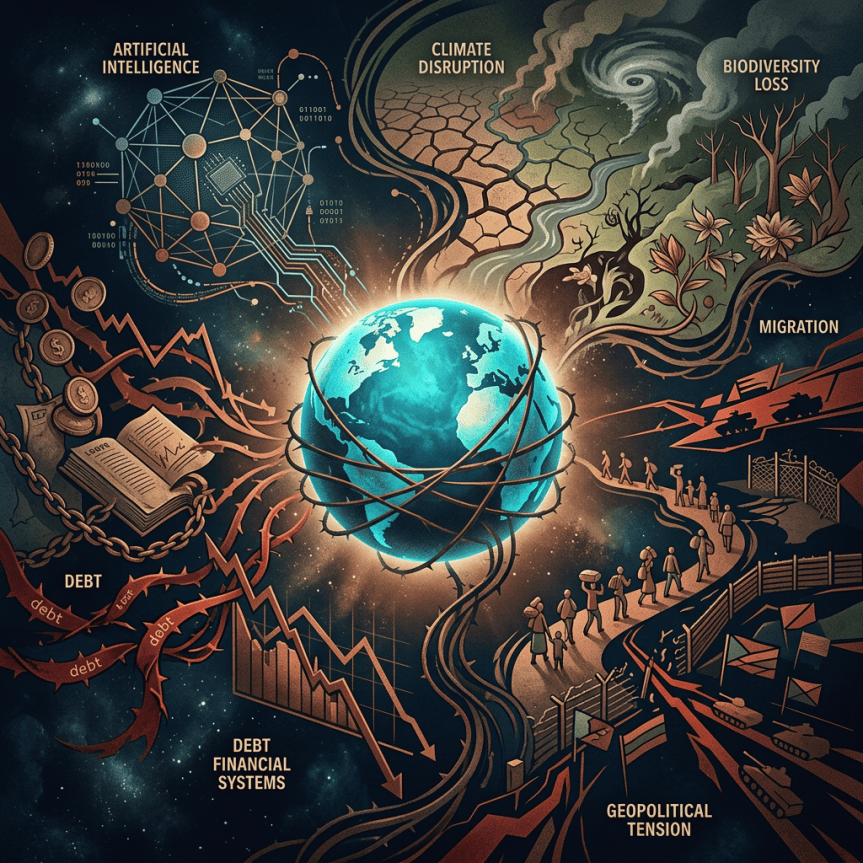
There is a growing sense that the world is entering a period unlike anything experienced in recent decades. Across developed and developing economies, government debt is rising, geopolitical tensions are intensifying, artificial intelligence is reshaping labour markets, climate impacts are accelerating, and biodiversity continues to decline. Rather than existing as separate challenges, these pressures increasingly interact with one another, creating what many analysts describe as a “polycrisis” – a situation where multiple systemic risks amplify each other simultaneously.
The question is not simply whether one crisis will occur. The deeper concern is whether several crises could unfold together, testing governments, economies and communities at the same time.
The Great Debt Dilemma
Governments across the world emerged from financial crises, pandemics and economic shocks with unprecedented levels of debt. While debt itself is not unusual, growing concerns centre on whether governments can continue servicing their obligations if economic growth slows while spending demands continue to rise.
Many advanced economies face a difficult combination of ageing populations, rising healthcare costs, infrastructure demands, military spending commitments and climate adaptation requirements. At the same time, taxation systems struggle to keep pace with changing economic realities.
As AI automates more administrative, analytical and professional roles, governments may face declining income tax receipts from traditional employment. Meanwhile, globalisation and digital commerce enable capital and profits to move across borders more easily than labour, potentially limiting national governments’ ability to expand their tax bases.
This creates a dangerous feedback loop:
- Higher spending requirements.
- Slower economic growth.
- Reduced tax revenues.
- Larger government borrowing.
- Rising debt-servicing costs.
The risk is not necessarily an immediate collapse, but a gradual erosion of governmental capacity and public trust.
AI: Productivity Miracle or Employment Shock?
Artificial intelligence presents one of humanity’s greatest opportunities and one of its greatest uncertainties.
Optimists point to enormous gains in productivity, scientific discovery and healthcare. Pessimists highlight the possibility of large-scale disruption to knowledge work and professional occupations.
Unlike previous technological revolutions, AI does not simply replace manual labour. It increasingly performs functions that were previously considered uniquely human, including writing, analysis, design, administration, coding and decision support.
The danger lies not in AI itself but in the speed of transition. If millions of workers are displaced faster than new industries emerge, societies could face:
- Reduced consumer spending.
- Higher unemployment or underemployment.
- Lower income tax revenues.
- Greater pressure on welfare systems.
- Increased political instability.
The challenge for governments is ensuring that AI-generated wealth benefits society broadly rather than concentrating in a handful of corporations and asset owners.
Climate Change: The Hidden Economic Multiplier
Climate change is often discussed as an environmental issue, but it is increasingly an economic one. Extreme weather events damage infrastructure, reduce agricultural productivity and increase insurance costs.
The climate crisis acts as a threat multiplier, worsening existing vulnerabilities.
Heatwaves reduce productivity. Floods destroy homes and businesses. Droughts raise food prices. Storms disrupt supply chains.
These impacts create inflationary pressures that ripple through economies. As adaptation costs increase, governments find themselves spending more while often collecting less tax revenue from affected regions.
The result is another cycle of rising debt and economic fragility. Climate-related disruptions may become a permanent feature of the global economy rather than occasional emergencies.
Biodiversity Loss: The Overlooked Crisis
While climate change dominates headlines, biodiversity loss may prove equally significant.
Healthy ecosystems provide services that modern economies largely take for granted:
- Pollination of crops.
- Water purification.
- Carbon storage.
- Flood protection.
- Soil fertility.
As species disappear and ecosystems degrade, these natural systems become less resilient.
The economic consequences are often invisible until critical thresholds are crossed. Food production becomes less reliable. Natural disasters cause greater damage. Water systems become more expensive to maintain.
Societies have traditionally treated nature as an infinite asset. Increasing evidence suggests that assumption is no longer sustainable.
Conflict, Migration and Global Fragmentation
The post-Cold War vision of increasing global integration appears increasingly uncertain.
Regional conflicts, competition between major powers and resource scarcity are fragmenting global supply chains. These disruptions can lead to:
- Higher energy prices.
- Increased commodity volatility.
- Reduced international investment.
- Greater military expenditure.
At the same time, climate impacts and conflict may increase migration pressures. Millions of people could be forced to move due to environmental degradation, water scarcity or instability.
Migration itself is not the problem. The challenge emerges when institutions fail to manage integration effectively or when receiving communities feel economically insecure.
Without social cohesion, economic shocks can be transformed into political crises.
Is the Economic Bubble About to Burst?
Many commentators argue that we are approaching the limits of a debt-fuelled economic model. Others point out that similar predictions have emerged repeatedly throughout history and that economies possess remarkable adaptive capacity.
The truth may lie somewhere in between.
Rather than a single catastrophic collapse, the future may involve a prolonged period of:
- Lower growth.
- Higher volatility.
- Recurring financial instability.
- Rising fiscal pressures.
- Political fragmentation.
- Greater environmental stress.
History suggests that societies rarely collapse overnight. More often, they experience periods of adjustment that can last decades.
The critical question is whether governments, businesses and communities can adapt quickly enough.
Building Resilience Instead of Fear
If these risks are real, the most productive response is neither denial nor panic. It is resilience.
Strengthening local economies, reducing dependence on fragile supply chains and investing in practical skills can provide protection against uncertainty. The original document highlights mutual aid networks, local food production, skill diversification and community resilience as practical responses to systemic risks.
Strengthen Communities
Strong communities often weather crises better than isolated individuals.
This may include:
- Community-owned energy projects.
- Local food initiatives.
- Tool-sharing networks.
- Skills exchanges.
- Cooperative enterprises.
When national systems face stress, local relationships become increasingly valuable.
Invest in Human Skills
While AI will automate many tasks, some skills remain difficult to replace:
- Caregiving.
- Healthcare.
- Education.
- Skilled trades.
- Ecological restoration.
- Community leadership.
Developing adaptable capabilities may prove more valuable than specialising exclusively in highly automated sectors.
Restore Nature Locally
Biodiversity restoration does not require waiting for international agreements.
Communities can support:
- Native species planting.
- Urban rewilding.
- Habitat restoration.
- Pollinator corridors.
- Community conservation projects.
Small local actions can create meaningful ecological benefits when multiplied across many communities.
A Choice Between Fragmentation and Renewal
The coming decades will likely be defined by how societies respond to converging pressures from debt, technological disruption, climate change and ecological decline.
The future is not predetermined. Economic systems are human creations, and they can be redesigned. Technologies can be governed. Communities can become more resilient. Nature can recover if given space and protection.
The real danger is not that debt bubbles burst, AI transforms work, or climate impacts intensify. It is the failure to prepare for these realities while time remains.
A more resilient future may require moving beyond an obsession with short-term growth and towards measures of long-term wellbeing, ecological health, community strength and economic security.
The challenges ahead are immense, but history repeatedly demonstrates that societies are capable of remarkable adaptation when they recognise problems early and act collectively.
The question is whether we will do so before the pressures of the polycrisis become overwhelming.


