
The world has never had more awareness of its greatest challenges. Climate change dominates headlines. Biodiversity loss is discussed at global summits. Poverty statistics fill government reports. Billionaires, monarchs, politicians and business leaders regularly speak about creating a better future. Yet despite all this awareness, many of the problems themselves continue to grow.
The uncomfortable question facing humanity is no longer whether people care.
The question is whether caring is enough.
The Age of Awareness
We live in an era where information is abundant.
Scientists have spent decades warning about climate change. Conservationists have highlighted the collapse of wildlife populations. Economists have documented growing inequality. Humanitarian organisations regularly report on hunger, displacement and conflict.
Unlike previous generations, we cannot claim ignorance.
The evidence is visible everywhere.
Wildfires, floods, droughts, rising living costs, growing food insecurity and widening wealth gaps are no longer distant possibilities. They are experiences affecting millions of people today.
On the surface this should give us hope. More people seem aware of these challenges than ever before.
Yet awareness alone has not delivered the transformation many expected.
The Paradox of Modern Leadership
Many of society’s most influential figures genuinely appear concerned.
Environmental initiatives are funded.
Charities receive donations.
International agreements are signed.
Public speeches call for action.
Even institutions often criticised for privilege and wealth, including the Royal Family, have devoted considerable attention to environmental and social issues over recent decades.
The paradox is striking.
If so many powerful people care, why do so many crises continue to worsen?
This is not a question aimed solely at royalty, politicians or billionaires.
It applies to all of us.
Humanity collectively understands the problems better than ever before, yet struggles to respond with sufficient speed and scale.
The Difference Between Care and Impact
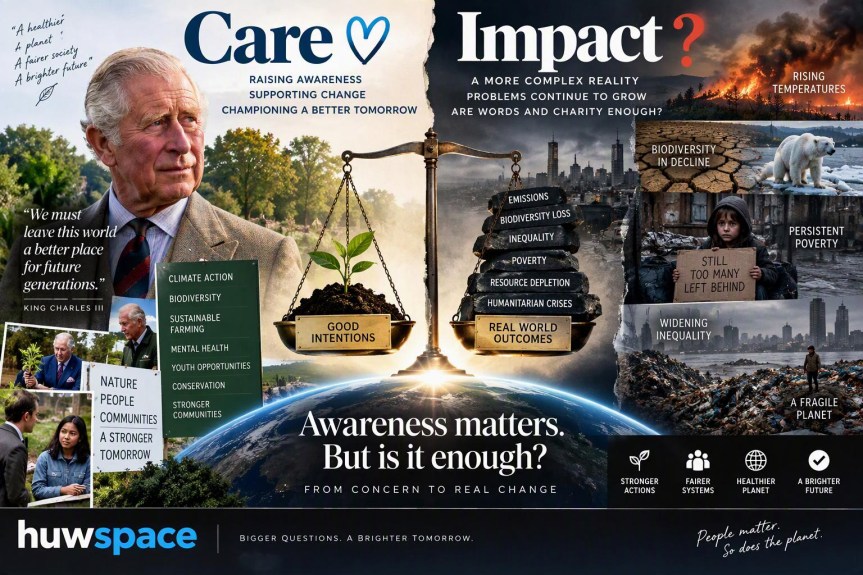
The image accompanying this article highlights a distinction that is rarely discussed.
On one side sits care.
Good intentions.
Awareness.
Concern.
Advocacy.
Education.
Charitable work.
On the other side sits impact.
Carbon emissions.
Biodiversity loss.
Poverty.
Resource depletion.
Social inequality.
Humanitarian crises.
The two are not always connected.
Someone may genuinely care about homelessness while supporting economic structures that make housing unaffordable.
An organisation may promote sustainability while consuming vast amounts of resources.
A government may pledge climate action while approving environmentally damaging projects.
The gap between intention and outcome is often where progress becomes stalled.
Perhaps the Wealthy Are More Human Than We Think
Society often portrays the wealthy as possessing extraordinary foresight.
They are frequently described as visionaries, innovators and strategic thinkers.
Yet history suggests that wealth does not guarantee wisdom.
The wealthy and influential remain susceptible to the same human limitations as everyone else:
- Short-term thinking.
- Confirmation bias.
- Groupthink.
- Fear of change.
- Attachment to existing systems.
- Difficulty imagining large-scale collapse.
The reality may be less sinister and more troubling.
Perhaps many people in positions of influence genuinely care about humanity and the planet.
Perhaps they simply struggle to overcome the same psychological limitations that affect all human beings.
If this is true, then the problem is not merely one of bad individuals making bad decisions.
It is a problem of systems built around human weaknesses.
A System Designed for Growth
Modern economies are remarkably effective at generating wealth.
They are far less effective at recognising ecological boundaries.
Success is often measured through:
- Economic growth.
- Corporate profits.
- Asset appreciation.
- Consumer spending.
Very rarely is success measured by:
- Biodiversity recovery.
- Community resilience.
- Mental wellbeing.
- Long-term ecological stability.
- Intergenerational fairness.
This creates a fundamental contradiction.
A system can generate extraordinary prosperity while simultaneously creating environmental and social damage that is not immediately visible on financial balance sheets.
The result is a world where positive intentions frequently collide with powerful economic incentives.
The Comfort Trap
For affluent societies and wealthy individuals, another challenge exists.
Protection from consequences.
Those with greater resources can often shield themselves from problems for longer.
Rising food prices may be inconvenient rather than devastating.
Water shortages may seem distant.
Environmental degradation may occur far from daily life.
Economic instability may be cushioned by savings, investments and property ownership.
The danger is that genuine concern can exist alongside practical detachment.
People may understand a crisis intellectually without experiencing it directly.
This can create a false sense that gradual change is sufficient when the challenges require far more ambitious action.
Beyond Blame
It is tempting to search for villains.
To blame politicians.
Billionaires.
Corporations.
Royalty.
Previous generations.
While all institutions should be subject to scrutiny, the reality is rarely that simple.
The climate crisis, biodiversity loss and growing inequality emerged from countless decisions made by billions of people operating within systems designed around growth, consumption and competition.
That does not remove responsibility.
It broadens it.
The challenge becomes not identifying a handful of guilty individuals, but understanding how entire societies can care deeply about a problem while continuing to contribute towards it.
From Awareness to Transformation
Awareness remains important.
Without awareness there can be no action.
The mistake is believing awareness alone is enough.
Real change occurs when concern is translated into measurable outcomes.
When policies change.
When incentives change.
When communities change.
When institutions become accountable not merely for what they promise but for what they achieve.
The future will not be shaped by who cares the most.
It will be shaped by who succeeds in turning care into impact.
A Final Thought
Perhaps one of the greatest myths of modern society is that intelligence, wealth or influence automatically produce wisdom.
The evidence suggests otherwise.
The environmental crisis, the cost of living crisis, biodiversity decline and growing inequality have all emerged during a period of unprecedented knowledge, wealth and technological capability.
The problem may not be that humanity lacks awareness.
The problem may be that awareness has become a substitute for action.
Because a healthier planet, a fairer society and a brighter future will not emerge simply because people care about them.
They will emerge only when caring becomes powerful enough to change the systems that shape our world.
People matter. So does the planet.
The challenge facing humanity is no longer learning what is wrong. The challenge is finding and funding the courage, wisdom and collective determination to do enough about it.


