
Published by Huw Edwards
Politics is often presented as a battle of personalities, slogans and culture wars. Yet beneath the noise lies a more fundamental truth. Most voters do not go to the ballot box thinking about political philosophy. They vote according to whether they feel secure, optimistic and heard.
As America heads towards the 2026 midterm elections, polling suggests that many voters are questioning the direction of the country. If current polling is broadly accurate, Democrats appear likely to regain control of the House of Representatives and have a realistic opportunity to capture the Senate as well.
The key question is not simply who is predicted to win, but what those predictions reveal about the mood of the American electorate.
A Midterm Referendum on the State of America
Midterm elections have historically served as a judgement on those currently governing. They provide voters with an opportunity to reward success, express frustration or demand a change of course.
Current polling suggests the latter may be taking place.
Forecasting models and poll aggregators show Democrats holding a significant national advantage. That has led a number of election analysts to project Democratic gains across multiple competitive districts and states.
This is not necessarily evidence of a dramatic ideological realignment. More often, political change emerges when voters become dissatisfied with existing conditions and seek an alternative.
Why Democrats Are Favoured to Win the House
The strongest case for a Democratic victory lies in the House of Representatives.
Several polling averages place Democrats comfortably ahead nationally, while forecasting models project them winning well above the 218 seats required for a majority.
House elections are particularly sensitive to national sentiment. When a party opens up a substantial lead in nationwide polling, competitive districts frequently move in the same direction.
If those polling numbers hold, the House result may not be especially close.
The question is whether polling has accurately measured voter sentiment or whether hidden turnout patterns will once again produce surprises.
The Economy Remains the Hidden Candidate
Political commentators often become obsessed with party strategy, campaign advertisements and candidate personalities.
Voters tend to focus on more practical matters.
Can they afford housing?
Are wages keeping pace with living costs?
Do they feel confident about their family’s future?
Across much of the developed world, rising living costs, housing affordability challenges and economic uncertainty continue to shape public opinion. While headline economic statistics can appear positive, many households judge reality through the weekly shop, mortgage payments, rent costs and household bills.
When citizens feel financially squeezed, governing parties frequently suffer.
The polling trends observed in the United States may therefore reflect more than partisan loyalty. They may represent a broader expression of economic frustration.
The Senate Battle May Decide the Scale of Victory
Although Democrats appear strongly placed in the House, the Senate remains more complicated.
Senate races are fought state by state rather than district by district. Candidate quality, local concerns and regional political cultures can significantly influence outcomes.
However, polling suggests Democrats have become competitive in several races that Republicans would traditionally expect to hold.
Particular attention has focused on states such as Texas and Maine, where Democratic candidates have reportedly performed strongly against Republican opponents.
If Democrats are able to convert those opportunities into victories, control of the Senate could change hands alongside the House.
That possibility explains why many analysts now view the Senate as genuinely competitive rather than comfortably Republican.
Is This a Vote for Democrats or Against Republicans?
One of the most important political questions of the modern era is whether election victories are driven by enthusiasm or frustration.
Many voters no longer support parties with the loyalty seen in previous generations. Instead, they increasingly vote against outcomes, leaders or policies they dislike.
For some Americans, voting Democrat may reflect support for a different political vision. For others, it may simply represent dissatisfaction with Republican leadership and current national conditions.
The distinction matters.
Victories built upon public frustration can be powerful, but they can also prove temporary if underlying problems remain unresolved.
The Polling Problem
No discussion of American elections would be complete without acknowledging the limitations of polling.
Recent election cycles have demonstrated that polls can miss important shifts in voter behaviour. Turnout differences, late campaign developments and methodological challenges continue to create uncertainty.
Polling should therefore be viewed as an indicator, not a guarantee.
Democrats may be favourites, but favourites do not always win.
Election day remains the final test of every political prediction.
The Overall View
If current polling proves accurate, Democrats appear likely to regain control of the House of Representatives and may also secure control of the Senate.
The deeper story, however, concerns public confidence.
Many voters appear to be questioning whether the political and economic systems serving America today are delivering the security, opportunity and stability they expect. The polling suggests frustration may be outweighing satisfaction, and when that happens political change often follows.
Elections are rarely decided by ideology alone.
They are decided by whether people believe tomorrow will be better than today.
At present, the polls suggest millions of Americans are not entirely convinced.
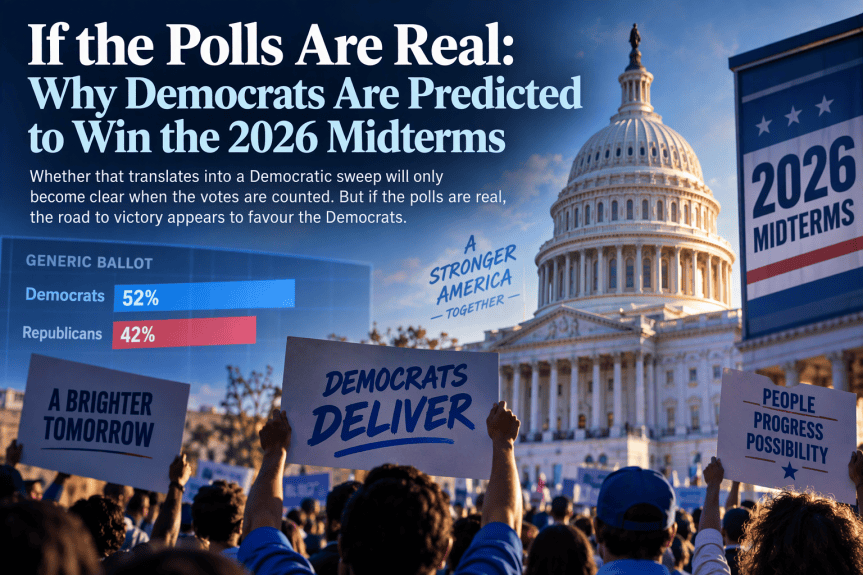
Whether that translates into a Democratic sweep will only become clear when the votes are counted. But if the polls are real, the road to victory appears to favour the Democrats.
Sources
Election Forecasts
Polling and Analysis
- CBS News / YouGov Polling
- The Times – US Midterm Elections Analysis
- The Telegraph – Midterm Election Predictions
Additional Context
Disclaimer: This article is an analysis of polling and forecast data available before the election. Polls are estimates of public opinion and are not a substitute for the certified election result. Forecasts can change significantly in the final days of a campaign and may not accurately predict voter turnout or election outcomes.


