
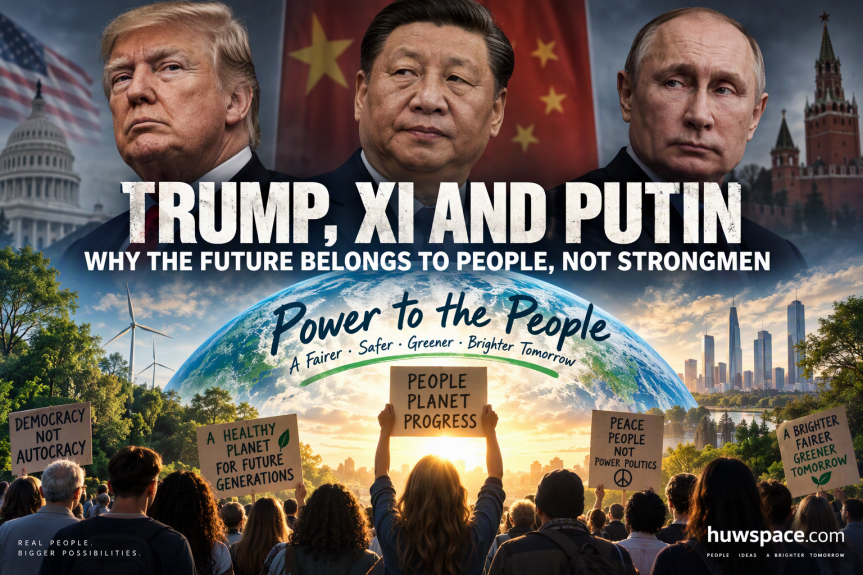
Power to the people, not the powerful
The appeal of a strong leader is understandable.
When people feel ignored, insecure or uncertain about the future, a politician promising order, national renewal and decisive action can become enormously powerful. Donald Trump, Xi Jinping and Vladimir Putin emerged from different societies and political systems, but each has placed national strength at the centre of a compelling political story.
Trump promised to put America first and challenge an establishment that many voters believed had abandoned them. Xi associated his leadership with China’s national rejuvenation and growing international influence. Putin presented himself as the leader who restored Russian pride and authority after the instability that followed the Soviet Union’s collapse.
All three have united substantial parts of their countries behind a vision of national strength.
The danger is that, while strengthening national unity, their competing ambitions risk tearing the wider world apart.
The strongman paradox
Trump, Xi and Putin should not be treated as identical.
Trump operates within an American constitutional democracy containing competitive elections, independent courts and established checks on executive power. Xi leads a one-party state, while Putin presides over a highly centralised Russian political system.
Nevertheless, their leadership styles reveal a common political temptation: concentrating public identity, national purpose and political authority around one dominant figure.
This can be effective. It offers people a clear story about who they are, what has gone wrong and who is to blame. It promises that national decline can be reversed if the country unites behind the leader.
But this form of unity often requires an opponent.
Domestic critics become enemies. Independent journalism becomes disloyal. International relationships are reduced to contests between winners and losers. Compromise is portrayed as weakness, while confrontation becomes evidence of strength.
Nationalism can unite a country, but it can also divide humanity.
A leader who mobilises support through confrontation at home may be tempted to use the same approach abroad. The world then becomes a collection of increasingly assertive states, each pursuing national advantage while shared dangers continue to grow.
Putin and the politics of control
Putin’s supporters credit him with restoring stability and returning Russia to the centre of international affairs. Yet this restoration has been accompanied by a severe concentration of political power.
Freedom House classifies Russia as “Not Free” and describes a political system in which power is concentrated around Putin, genuine opposition is suppressed, elections are manipulated and independent media face extensive restrictions.
Russia’s invasion of Ukraine demonstrates the international consequences of this concentration of authority. On 2 March 2022, the United Nations General Assembly voted by 141 votes to five to demand that Russia end its use of force and withdraw its troops from Ukraine.
Whatever unity Putin has created around Russian identity and power, it has come alongside war, isolation and a confrontation that has destabilised Europe and caused immense human suffering.
That is not strength in the service of humanity. It is power exercised without sufficient accountability for its consequences.
Xi and China’s national rejuvenation
China’s economic transformation is one of the defining developments of modern history. The country has become an economic, technological and geopolitical power capable of shaping the international system.
Xi has placed this rise within a wider narrative of national rejuvenation, discipline and collective purpose.
Yet economic progress does not remove the need for liberty and accountability. Freedom House classifies China as “Not Free” and reports extensive Communist Party control over political expression, the media, online speech and civil society. It also describes Xi as having consolidated personal power to a degree not seen in China for decades.
China has every right to pursue prosperity and an influential place in the world. Its people deserve the benefits of economic development.
But prosperity should not require citizens to surrender their right to question authority. Stability should not depend upon silencing disagreement. National confidence should not become a justification for permanent political control.
Trump and the pressures on democracy
Trump’s rise cannot be explained simply by dismissing his supporters.
Millions of Americans believed that established political institutions had stopped representing them. Trump turned their frustration into a movement built around national restoration, opposition to political elites and the promise of American strength.
That support is real and must be understood.
But democratic leadership requires more than winning elections. It requires respect for constitutional limits, independent institutions, lawful opposition and the principle that political rivals are competitors rather than enemies.
The danger arises when loyalty to a leader becomes more important than loyalty to democratic principles. Attacks on independent journalism, distrust of elections and hostile rhetoric towards opponents can weaken the culture on which democracy depends.
The V-Dem Institute’s Democracy Report 2025 describes a continuing global trend of autocratisation and declining freedom of expression. Its warning is wider than any one politician or country: democratic institutions can deteriorate when societies stop defending them.
Trump may claim to unite Americans around national renewal. Yet a movement that sharpens internal division and treats international cooperation primarily as a test of dominance risks weakening both democracy at home and trust abroad.
A planet that requires cooperation
The central failure of strongman politics is that it offers national answers to planetary problems.
Climate change does not recognise borders.
Pollution does not stop at customs checkpoints.
Pandemics do not require passports.
Artificial intelligence, cyber security, nuclear security and economic instability cannot be managed by one country acting alone.
The atmosphere is shared. The oceans are shared. The consequences of war, environmental destruction and technological disruption are shared.
Humanity therefore needs leaders capable of looking beyond personal authority and short-term national advantage. A politician may strengthen one country temporarily, but no nation can remain secure in a world increasingly defined by conflict, mistrust and environmental decline.
The true test of leadership is no longer simply whether a politician can unite a nation. It is whether that politician can help nations cooperate without sacrificing freedom, dignity or democratic accountability.
Power to the people
Democracy is imperfect because people are imperfect. Its debates can be slow, its compromises frustrating and its institutions vulnerable to complacency.
Yet democracy contains an essential wisdom: no individual should be trusted with unlimited power.
The answer to failing institutions is not blind faith in a strong leader. It is stronger accountability, greater participation, independent journalism, effective courts and citizens prepared to question authority.
Trump, Xi and Putin may each claim success in uniting people around national strength. History will ask a more important question: did their leadership help humanity confront its common challenges, or did it leave the world more divided, suspicious and dangerous?
A leader who unites a country achieves something significant.
A leader who helps unite humanity around peace, freedom and the protection of our shared planet achieves something far greater.
Our future cannot be organised around the ambitions of a few powerful individuals. It must be shaped by informed citizens, accountable institutions and governments that recognise their first duty is to the people.
They may have succeeded in uniting their nations behind them.
The danger is that they risk tearing the world apart.
Power to the people, not the powerful.
Footnotes
1. Freedom House, Russia: Freedom in the World 2025.
2. United Nations General Assembly, Resolution ES-11/1: Aggression Against Ukraine, adopted 2 March 2022.
3. United Nations, General Assembly Overwhelmingly Adopts Resolution Demanding the Russian Federation End Its Use of Force in Ukraine and Withdraw All Troops, 2 March 2022.
4. Freedom House, China: Freedom in the World 2025.
5. V-Dem Institute, Democracy Report 2025: 25 Years of Autocratisation – Democracy Trumped?.


