
By Huw Edwards | HuwSpace.com
Published: 22 November 2026
The Human Cost of Climate Delay
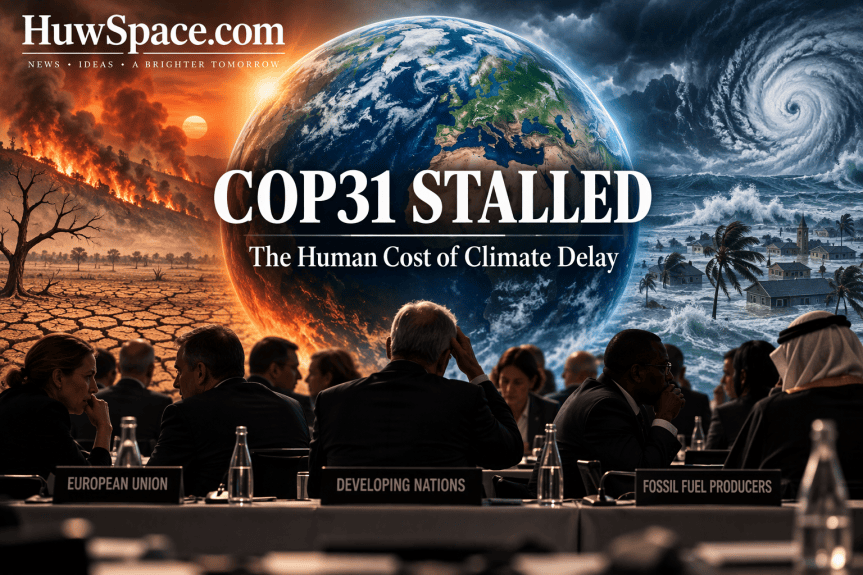
As climate negotiators gathered in Turkey promising renewed action on global warming, the summit instead exposed deep divisions over fossil fuels, climate finance and the pace of change. The atmosphere does not negotiate. Carbon emissions do not wait. Yet once again, politics struggled to keep pace with science.
“The question facing COP31 was simple: can the world agree to move beyond fossil fuels? The answer was anything but.”
A Summit Defined by Division
For two weeks, representatives from almost 200 countries met in Antalya, Turkey, with the aim of strengthening global action against climate change.
Instead, COP31 became dominated by disagreements over the role of fossil fuels in the world’s future energy system.
According to reporting from Reuters, references to moving away from coal, oil and gas were removed from draft negotiating texts after objections from major fossil-fuel-producing countries.
🔗 Source: Reuters, COP31 climate talks spill into overtime as nations quarrel over fossil fuels
For countries already facing rising seas, worsening droughts and increasingly destructive storms, this was not merely a dispute over language.
It was a dispute about survival.
Why Fossil Fuels Became the Sticking Point
At the centre of the negotiations was a single issue.
Should the final agreement explicitly state that the world must transition away from fossil fuels?
A coalition of countries from Europe, Africa, Latin America and the Pacific argued that any credible climate agreement must acknowledge that burning coal, oil and gas remains the primary driver of climate change.
According to UN News, several governments insisted that climate science demanded stronger wording on fossil fuels and increased climate-finance commitments.
🔗 Source: United Nations News, COP31: Countries demand stronger climate deal amid deadlock in Antalya
Others resisted such commitments, citing economic realities, energy security concerns and the practical challenges of rapid transition.
The result was a negotiating process that became increasingly bogged down in disagreement.
A Growing Disconnect Between Politics and Science
Perhaps the most striking aspect of COP31 is how familiar this story has become.
Scientists have spent decades refining our understanding of climate change.
The evidence linking greenhouse gas emissions to rising temperatures is stronger than ever.
Yet the political system remains divided over how quickly change should happen.
The United Nations Environment Programme’s 2026 Emissions Gap Report warned that current policies place the world on a pathway towards approximately 2.8°C of warming this century.
Those findings were summarised ahead of COP31 by the World Economic Forum.
🔗 Source: World Economic Forum, COP31 approaches amid 2.8°C warming warning
The Paris Agreement sought to limit warming to 1.5°C.
The gap between those two figures represents the difference between managing climate risks and facing increasingly severe consequences.
Politics moves at the speed of elections. Climate change moves at the speed of physics.
The Human Cost Nobody Can Fully Calculate
Whenever climate summits fail to deliver stronger action, a difficult question emerges.
How many lives are ultimately affected by delay?
There is no credible scientific estimate for the number of deaths that could result specifically from disagreements at COP31.
Any claim to know that figure would be speculation.
What we do know is that climate change already carries substantial human costs.
The World Health Organization estimates that climate change could contribute to approximately 250,000 additional deaths each year between 2030 and 2050 through heat stress, malaria, diarrhoeal disease and undernutrition.
🔗 Source: World Health Organization, Climate Change and Health
That estimate relates to climate change overall, not specifically to COP31.
But it illustrates the broader reality.
Every delay in reducing emissions increases long-term climate risks.
Every year of inaction adds to the challenge future generations will inherit.
Who Bears the Burden?
The countries most vulnerable to climate change are often among those least responsible for historic emissions.
Small island nations face rising seas.
Many African countries face worsening drought risks.
Communities across Asia face increasingly extreme heat.
Yet these nations frequently lack the financial resources available to wealthier economies.
This is why climate finance became such a contentious issue during the negotiations.
Developing nations argue that those who benefited most from fossil-fuel-driven industrialisation should contribute more towards adaptation and resilience.
COP31 demonstrated just how unresolved that debate remains.
The Real Legacy of COP31
Whether COP31 is ultimately remembered as a temporary setback or a significant missed opportunity remains to be seen.
What is already clear is that the summit exposed profound divisions over fossil fuels at precisely the moment many scientists argue emissions reductions need to accelerate.
The science did not change in Antalya.
The atmosphere did not pause.
Carbon dioxide concentrations did not wait for consensus.
The world left COP31 with the same challenge it arrived with:
How do we reduce emissions quickly enough to avoid the worst consequences of climate change while maintaining economic and political stability?
The answer remains uncertain.
The consequences of getting it wrong are not.
Further Reading
- Reuters: COP31 climate talks spill into overtime as nations quarrel over fossil fuels
- Reuters: COP31 climate deal in the balance after fractious talks
- UN News: Countries demand stronger climate deal amid deadlock in Antalya
- The Guardian: COP31 talks go into overtime as debate rages over lack of fossil fuels
- The Guardian: Climate talks stall as countries mull showdown with Saudi Arabia over fossil fuel phaseout
- World Economic Forum: COP31 approaches amid 2.8°C warming warning
- World Health Organization: Climate Change and Health
Editor’s note: This article discusses the potential consequences of delayed climate action. No scientific body has published a verified estimate for deaths directly attributable to the outcome of COP31 itself.


