
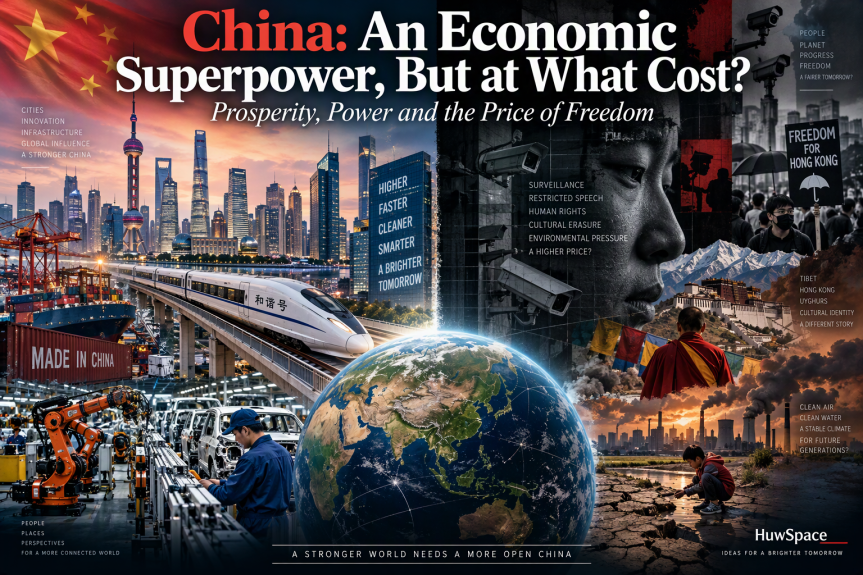
Growth, power and prosperity mean little if they come at the expense of freedom, human dignity and a liveable planet.
The Chinese Century?
Few nations have transformed themselves as dramatically as China.
Within a generation, China has risen from relative economic isolation to become one of the most powerful nations on Earth. Its factories produce much of the world’s consumer goods. Its infrastructure projects are colossal. Its technological capabilities are expanding rapidly. Hundreds of millions of people have been lifted out of poverty, and China now exerts enormous influence across global trade, manufacturing, finance and diplomacy.
Even critics acknowledge that this economic transformation represents one of the most remarkable development stories in human history.
Yet beneath the skyscrapers, high-speed railways and economic statistics lies a deeper and more uncomfortable question:
What is the true cost of power?
Because while China has become an economic superpower, its rise has coincided with severe restrictions on political freedoms, extensive state surveillance, pressure on ethnic and religious minorities, and an economic model that contributes significantly to the environmental challenges facing humanity.[1][2][3]
The question is not whether China is powerful.
The question is whether power alone can justify the sacrifices demanded to achieve it.
The Price of Dissent
The Chinese Communist Party (CCP) maintains that political stability is essential for economic development, social order and national security.
To its supporters, China’s achievements prove the effectiveness of this approach. They point to modern infrastructure, reduced poverty, technological innovation and national unity.
However, critics argue that these achievements have come at a substantial cost to personal liberty.
Human rights organisations, journalists and foreign governments have documented the detention of political activists, lawyers, journalists and campaigners who challenge the authority of the state. Independent political parties are prohibited, media organisations operate under strict controls, and online criticism is frequently censored. Critics may face prosecution under broad laws relating to national security or subversion.[1][2][14]
This raises a fundamental question.
Should criticism of government be treated as a threat to society or as an essential safeguard against abuse of power?
Democratic societies are often chaotic, argumentative and frustrating. Governments make mistakes and opposition voices can be uncomfortable. Yet democracy derives strength from allowing citizens to challenge authority without fear of state retaliation.
A government that is unable to tolerate criticism may appear strong, but history often shows that the suppression of debate eventually weakens a nation’s ability to correct its mistakes.
Tibet, Xinjiang and the Question of Identity
The tension between power and freedom is perhaps most visible among China’s ethnic and religious minorities.
In Tibet, the Chinese government has invested heavily in infrastructure, education and public services. At the same time, international observers have expressed concerns regarding restrictions on religious freedom, extensive surveillance and policies that may weaken traditional Tibetan language and culture. Critics argue that the promotion of Mandarin in boarding schools and tighter state oversight of Tibetan Buddhism threatens the preservation of a distinct cultural identity.[3][14][15]
Similar concerns have been raised regarding Uyghur Muslims in Xinjiang, where human rights organisations and several governments have alleged widespread detention, forced labour programmes, religious restrictions and intensive surveillance. China denies these allegations and states that its policies are aimed at reducing extremism and maintaining security.[1][14][15]
At the heart of these debates lies a simple question:
Can cultural assimilation ever be justified in the name of national unity?
A nation’s strength should surely come not from eliminating differences but from finding ways for diverse communities to flourish together.
Hong Kong and the Shrinking Space for Opposition
The transformation of Hong Kong offers another illustration of this broader conflict.
For decades, Hong Kong operated under the principle of “One Country, Two Systems”, enjoying freedoms and institutions that differed markedly from mainland China.
Following the introduction of the National Security Law in 2020, many opposition politicians, journalists and activists were arrested or prosecuted, while independent media organisations and civil society groups faced significant pressure. Beijing argues these actions were necessary to restore order and prevent instability. Critics contend that they represent the dismantling of freedoms once guaranteed to the city’s residents.[1][14]
This pattern reveals a recurring theme throughout modern China:
When stability and liberty come into conflict, the state almost always chooses stability.
Economic Success Cannot Be the Only Measure of Success
Supporters of China’s model frequently point to economic achievements as evidence that the system works.
But this assumes that economic growth is the ultimate measure of societal success.
That assumption deserves scrutiny.
GDP can measure production.
It cannot measure freedom.
Factories can produce wealth.
They cannot produce dignity.
Economic expansion can generate prosperity.
It cannot determine whether people have meaningful control over their lives.
A society may become richer whilst simultaneously becoming less free.
If citizens lose the ability to question authority, preserve their culture or practise their faith without interference, then an important part of human flourishing is lost regardless of economic growth.
The Environmental Cost of Endless Growth
The challenge extends beyond politics.
China’s rise has largely been built upon industrial expansion, manufacturing and energy consumption on a scale never before witnessed in human history.
The result is a paradox.
China is both the world’s largest emitter of energy-related carbon dioxide and one of the world’s most significant investors in renewable energy.[5][6][7][8]
According to the International Energy Agency, growth in global coal emissions during 2024 was driven primarily by increasing coal consumption in China, India and Southeast Asia.[6] At the same time, the IEA reports that China accounted for almost half of all new renewable power capacity worldwide and is expected to contribute nearly 40 per cent of global renewable energy capacity by 2030.[8][9]
This contradiction reveals a deeper problem that goes far beyond China.
For decades, much of the world has embraced an economic philosophy based upon continuous growth, increasing consumption and ever-rising production.
China did not invent this idea.
It inherited it and perfected it.
The same model can be found in Western economies, multinational corporations and global supply chains that measure success primarily through growth and profit.
Yet climate scientists continue to warn that current patterns of production and consumption are incompatible with long-term environmental sustainability. The IPCC concludes that climate change is the result of decades of unsustainable production and consumption patterns and that development pathways must shift towards sustainability and justice.[11] The United Nations similarly warns that rising greenhouse gas emissions are intensifying climate impacts globally and threaten future development gains.[12]
The atmosphere does not distinguish between emissions generated by communist states and capitalist states.
Nature does not care whether a forest is destroyed in pursuit of state power or corporate profit.
Environmental damage is indifferent to ideology.
A Profitable Planet or a Sustainable One?
Perhaps this is where the Chinese model reveals its greatest weakness.
Its central promise is that economic growth, national power and social stability will deliver prosperity.
But prosperity alone cannot answer humanity’s greatest challenge.
Human civilisation depends not only on economic success but on functioning ecosystems, social trust, cultural diversity and individual freedom.
If economic growth requires the suppression of dissent, the erosion of minority cultures and environmental degradation, then the apparent success may prove unsustainable in the long run.
A society cannot endlessly consume natural resources while expecting ecological stability.
Nor can it indefinitely suppress criticism while expecting intellectual and political renewal.
Eventually the bills come due.
The Real Test of Greatness
China’s achievements deserve recognition.
Its economic transformation is extraordinary.
Its investments in renewable energy are substantial.[7][8][9][10]
Its influence on the world stage is undeniable.
But true greatness cannot be measured solely by national wealth, industrial output or geopolitical influence.
The real test of a civilisation is how it treats people who disagree with those in power.
How it protects cultural and religious minorities.
How it balances prosperity with liberty.
And whether it leaves future generations a world worth inheriting.
The challenge facing humanity is not whether China can become richer, nor whether the West can consume more. The challenge is whether civilisation can learn that wealth is a means to human flourishing, not an end in itself.
The twenty-first century should not be a competition to create the richest nation on Earth.
It should be an effort to create the most sustainable, just and humane one.
Because in the end, a profitable planet is worthless if it is no longer a liveable planet.
Footnotes
[1] Amnesty International, China Report: https://www.amnesty.org/en/location/asia-and-the-pacific/east-asia/china/report-china/
[2] UK Home Office, Country Policy and Information Note: Opposition to the State – China: https://www.gov.uk/government/publications/china-country-policy-and-information-notes/country-policy-and-information-note-opposition-to-the-state-china-january-2026-accessible
[3] BBC News, China’s Ethnic Unity and Progress Law: https://www.bbc.com/news/articles/cx23dwx0232o
[4] Freedom House, Transnational Repression: China: https://freedomhouse.org/report/transnational-repression/china
[5] International Energy Agency (IEA), China CO₂ Emissions: https://www.iea.org/countries/china/emissions
[6] International Energy Agency (IEA), Global Energy Review 2025 – CO₂ Emissions: https://www.iea.org/reports/global-energy-review-2025/co2-emissions
[7] International Energy Agency (IEA), China Renewable Energy Statistics: https://www.iea.org/countries/china/renewables
[8] International Energy Agency (IEA), China, a Leader of Renewable Energy Expansion Worldwide: https://iea.blob.core.windows.net/assets/86a6c1d1-79fc-4da8-b886-bd3b675d8b2f/BrochureChina.pdf
[9] State Council of the People’s Republic of China / China Daily, Nation Biggest Contributor to Global Renewables Capacity: https://english.www.gov.cn/news/202407/02/content_WS668364f1c6d0868f4e8e8c3d.html
[10] Yale Environment 360, Isabel Hilton, How China Became the World’s Leader on Renewable Energy: https://e360.yale.edu/features/china-renewable-energy
[11] IPCC Sixth Assessment Report, Chapter 17, Accelerating the Transition in the Context of Sustainable Development: https://www.ipcc.ch/report/ar6/wg3/chapter/chapter-17/
[12] United Nations Sustainable Development Goals, Goal 13: Climate Action: https://www.un.org/sustainabledevelopment/climate-change/
[13] Carbon Brief, In-depth Q&A: The IPCC’s Sixth Assessment on How to Tackle Climate Change: https://www.carbonbrief.org/in-depth-qa-the-ipccs-sixth-assessment-on-how-to-tackle-climate-change
[14] U.S. Department of State Archive, China’s Disregard for Human Rights: https://2017-2021.state.gov/chinas-disregard-for-human-rights/
[15] Amnesty International Australia, China’s New Law and Assimilation Policies in Tibet and Xinjiang: https://www.amnesty.org.au/behind-the-language-of-unity-and-progress-chinas-new-law-is-about-more-control-and-assimilation-in-tibet-and-xinjiang/


