China’s economic rise is one of the most remarkable stories of the modern age. In little more than a generation, hundreds of millions have been lifted from poverty, world-class infrastructure has emerged from farmland, and Chinese industry has become central to the global economy.
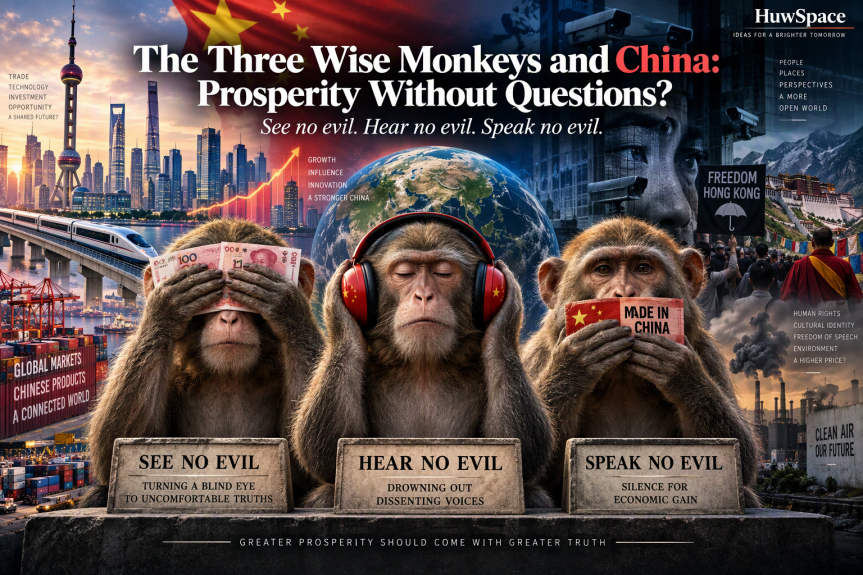
Yet alongside this achievement sits a difficult question: has much of the world adopted the attitude of the Three Wise Monkeys when dealing with China?
The ancient image is familiar. One monkey covers its eyes, another its ears, and a third its mouth.
See no evil.
Hear no evil.
Speak no evil.
In the context of China, the symbolism is striking.
See No Evil
The first monkey closes its eyes.
Around the world, governments, businesses and consumers have enthusiastically embraced Chinese-made goods, Chinese investment and access to Chinese markets. The benefits are obvious. Products are often cheaper. Supply chains are efficient. Growth opportunities can be enormous.
But closing our eyes to uncomfortable realities carries risks.
Questions continue to be raised internationally regarding restrictions on political freedoms, surveillance technologies, treatment of minority groups, pressures on cultural identities, and environmental consequences associated with rapid industrialisation.
For many investors and consumers, however, these issues remain secondary to economic opportunity. The world’s appetite for affordable goods can sometimes create a willingness not to look too closely at how those goods are produced or the political conditions in which production occurs.
Hear No Evil
The second monkey covers its ears.
Critics often argue that dissenting voices about China struggle to be heard. Journalists, academics, activists, campaigners and international organisations may raise concerns about freedom of expression, human rights, Hong Kong, Tibet or other sensitive topics.
Yet those warnings frequently compete with a louder narrative centred on growth, trade and investment.
Many multinational corporations are cautious about criticising Beijing for fear of losing access to one of the world’s largest markets. Politicians may hesitate to challenge China too forcefully if doing so threatens jobs or economic relationships.
The result can be a tendency to hear economic success more clearly than political criticism.
Speak No Evil
The third monkey covers its mouth.
Perhaps the most interesting monkey is the last one.
Across the world there can be reluctance to openly criticise China. Businesses fear losing contracts. Universities fear losing funding. Governments fear diplomatic or economic retaliation. Consumers simply want affordable products.
Silence becomes a practical choice.
Yet history suggests that silence rarely removes problems. It merely postpones difficult conversations until they become impossible to avoid.
A mature relationship between nations should allow admiration and criticism to coexist. It should be possible to recognise China’s extraordinary achievements while also discussing legitimate concerns about freedom, accountability and environmental sustainability.
Looking in the Mirror
The Three Wise Monkeys metaphor ultimately tells us as much about ourselves as it does about China.
The real question is not whether China sees, hears or speaks evil.
The real question is whether the rest of the world does.
When a low-cost product arrives at our door the next day, when pension funds benefit from Chinese growth, when businesses profit from access to Chinese markets, it becomes easier to overlook the uncomfortable questions.
Economic success can be dazzling. Like the monkeys, we may sometimes choose not to see, not to hear and not to speak.
The challenge for the twenty-first century is to engage with China honestly, neither demonising nor romanticising the country. China is too important to be viewed through simplistic slogans. Its achievements deserve recognition. Its shortcomings deserve scrutiny.
If the world learns anything from the Three Wise Monkeys, it is that prosperity should never come at the expense of curiosity, truth and open discussion.
A stronger global future depends not on seeing less, hearing less and saying less, but on having the courage to do the opposite.