
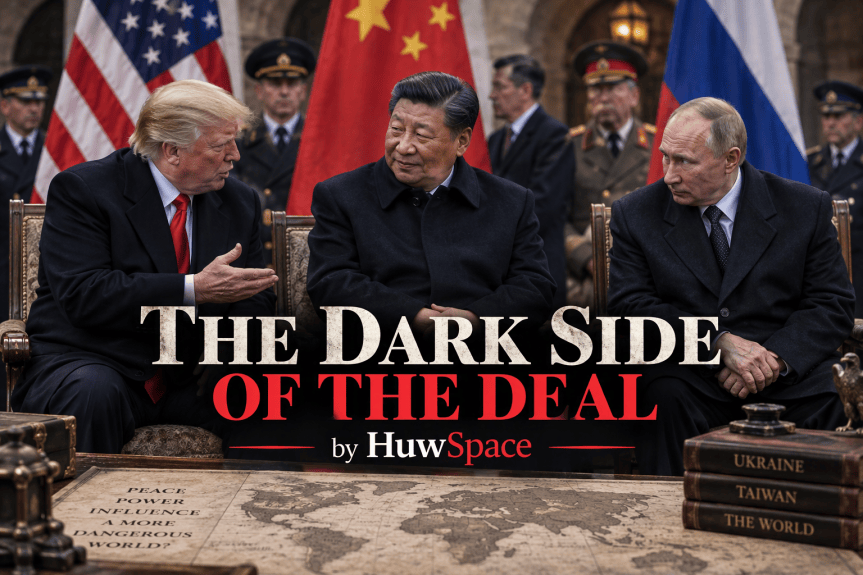
From Yalta to the Present Day
History is often shaped not only by wars and revolutions but by private conversations between powerful leaders. In February 1945, Winston Churchill, Franklin D. Roosevelt, and Joseph Stalin met at Yalta to discuss the post-war world. Their decisions helped shape Europe for decades, but they also left millions of people living behind borders and political systems they had little say in choosing.
To many in Eastern Europe, Yalta became synonymous with a troubling reality: the fate of entire nations being negotiated by a handful of powerful men around a table.
Today, some commentators draw parallels between Yalta and the prospect of major negotiations involving Donald Trump, Vladimir Putin and Xi Jinping. The comparison is not perfect. The world of 2026 is vastly different from that of 1945. Yet the debate raises an important question:
What happens when the world’s most powerful leaders believe they can strike grand bargains over the heads of everyone else?
The Temptation of Great-Power Politics
Throughout history, powerful states have often divided the world into spheres of influence. Empires did it. Colonial powers did it. The great powers of the nineteenth century did it repeatedly.
The attraction is obvious. If powerful countries recognise each other’s interests, they may reduce the likelihood of direct conflict between themselves.
The cost, however, is frequently borne by smaller nations.
The concern expressed by many analysts is not that Trump, Putin and Xi would literally redraw maps in the way leaders once attempted. Rather, the worry is that a return to sphere-of-influence thinking could weaken the principle that sovereign nations should determine their own futures.
When major powers negotiate primarily with one another, smaller countries can become objects of policy rather than participants in it.
Ukraine: The Fear of Being Traded Away
Nowhere is this concern clearer than in Ukraine.
Since Russia’s full-scale invasion in 2022, Ukrainians have repeatedly argued that any settlement must ultimately be decided by Ukraine itself, not imposed by outside powers.
Critics of great-power bargaining fear a situation in which larger states prioritise stability and expediency over justice and self-determination. History shows that peace agreements reached without the consent of those most affected often contain the seeds of future conflict.
The lesson of the twentieth century is that durable peace rarely survives if people believe their future has been negotiated without their voice.
Taiwan and the Indo-Pacific
A similar concern exists in Asia.
Taiwan, South Korea, Japan and many Southeast Asian nations closely watch the relationship between Washington, Beijing and Moscow.
For these countries, the issue is not simply military power. It is trust.
If security commitments become bargaining chips in wider geopolitical negotiations, allies may begin to doubt the reliability of international partnerships. Such uncertainty can encourage arms races, regional tensions and strategic instability.
The consequences extend far beyond any single summit or diplomatic meeting.
The Authoritarian Advantage
There is another concern that deserves attention.
Putin and Xi govern systems in which power is highly centralised. Political opposition is heavily constrained, and criticism of leadership carries significant risks.
Democratic societies are not perfect. They can be slow, messy and frustrating. Yet they contain mechanisms for criticism, correction and accountability.
The risk arises when democratic leaders begin to adopt an increasingly transactional view of international politics, treating complex human societies primarily as pieces on a geopolitical chessboard.
History demonstrates that when human rights, democratic legitimacy and individual liberty are subordinated to power politics, ordinary people are often the first to suffer.
Lessons from the Twentieth Century
The Yalta leaders faced extraordinary circumstances. They were attempting to conclude the deadliest war in human history.
Yet the aftermath revealed an uncomfortable truth.
To some, Yalta represented pragmatic statecraft. To others, it symbolised the abandonment of entire nations to decades of authoritarian rule.
Both interpretations contain elements of truth.
The lesson is not that diplomacy is wrong. Diplomacy is essential.
The lesson is that diplomacy should not take place at the expense of democratic consent, national sovereignty and human freedom.
When decisions affecting millions are made by a small group of leaders behind closed doors, the danger is not merely strategic error. The danger is that human beings become secondary considerations.
Why a Modern Yalta May Not Be Possible
There are important reasons why the world today differs from 1945.
Ukraine is not post-war Poland. Taiwan is not post-war Czechoslovakia. Nations across Europe and Asia possess strong identities, functioning governments and significant military capabilities.
Modern communications also make secret geopolitical bargains far harder to sustain.
In today’s interconnected world, populations are better informed, more politically engaged and less willing to accept decisions imposed from above.
This does not eliminate the risk of great-power deals, but it does limit the ability of any three leaders to determine the future alone.
The Real Danger
The true danger is not that Trump, Putin and Xi recreate Yalta exactly.
The real danger is the mindset that often accompanies concentrated power: the belief that history is made by a few strong leaders while everyone else simply lives with the consequences.
History suggests otherwise.
The greatest advances in freedom, democracy and human rights have rarely come from secret bargains between powerful men. They have come from ordinary people demanding a voice in their own future.
The world does not need a new Yalta.
It needs institutions, democracies and international agreements that place the interests of humanity above the ambitions of individuals.
Because whenever power becomes concentrated in too few hands, the question is never simply what leaders gain from the deal.
The question is who pays the price.


