Texas judge rules all registered voters can vote by mail if they fear catching coronavirus
By Kelly Mena, CNN
Updated 0011 GMT (0811 HKT) April 18, 2020Democrat Jamie Wilson displays a sticker after voting in the Super Tuesday primary at John H. Reagan Elementary School in the Oak Cliff section of Dallas, Tuesday, March 3, 2020. (AP Photo/LM Otero)
Washington, DC (CNN)A Texas judge on Friday ruled that all registered voters in the state should be allowed to request and use mail-in ballots due to the coronavirus pandemic.District Judge Tim Sulak, in a ruling filed Friday in Travis County, issued a temporary injunction that eases the definition of “disability” in Texas’ vote-by-mail provision, making it apply to all registered voters who fear for their health in casting ballots in person for the state’s upcoming elections.Texas’ election code defines “disability” as “a sickness or physical condition that prevents the voter from appearing at the polling place on election day without a likelihood of needing personal assistance or of injuring the voter’s health.” Voters who meet this definition and wish to vote by mail must submit applications.Sulak acknowledged during a court hearing on Wednesday that he expects an appeal from the state attorney’s office, which has issued guidance that fear of Covid-19 does not qualify as a disability.”Moreover the evidence shows that voters and these Plaintiffs … are reasonable that voting in person while the virus that causes Covid-19 is still in general circulation presents a likelihood of injuring their health, and any voters without established immunity meet the plain language definition of disability thereby entitling them to a mailed ballot,” the order read.In late March, Gov. Greg Abbott postponed dozens of election runoffs statewide for party nominations to congressional and local offices, set for May 26, until July 14. The new date was made to coincide with a competitive special election for a Texas state Senate seat. In issuing the delay, Abbott didn’t weigh in on whether to expand mail-in voting access.In a separate ruling on Friday, Sulak also aligned the dates for early voting for the special election and the runoff to July 6-10.The Texas Democratic Party, the original plaintiff in the case, rushed to declare victory after leaving court on Wednesday, in anticipation of the court ruling in their favor. The group argued that Covid-19 posed a significant health threat to voters if they were forced to cast ballots in person.”We cannot allow this public health crisis to be the death of our democracy when it is taking so many of our loved ones,” Texas Democratic Party Chair Gilberto Hinojosa said in a press release.”Our state is better off when more Texans participate in our democracy. Voting by mail is safe, secure, and accessible. It allows more voters to participate in our democracy, and it’s a commonsense way to run an election, especially during a public health crisis,” Hinojosa added.”We just won a preliminary injunction in Texas. All voters get to vote by mail in the primary. No individualized excuses necessary. The coronavirus is a universal excuse. GREAT WORK,” David Cole, national legal director for the ACLU, said Wednesday in a Twitter post.In response, Texas Attorney General Ken Paxton, in a statement late Wednesday, expressed disappointment, saying in part that the district court had ignored the plain text of the state election code in order to allow healthy voters to take advantage of special protections made available to Texans with illnesses or disabilities.”This unlawful expansion of mail-in voting will only serve to undermine the security and integrity of our elections and to facilitate fraud. … My office will continue to defend Texas’s election laws to ensure that our elections are fair and our democratic process is lawfully maintained,” Paxton, a Republican, said in the statement.The Texas state attorney’s office, in response to the court ruling, filed a notice of appeal late Friday.
Democracy is not descent it is decent. Long road to freedom when we speak our mind on election days we have the right to vote for who we want and the right to not tell others who we voted for or why.
It is disappointing to see the human collective act in china against the people of Hong Kong. If you are a good people why do bad things.
If you are not part of the solution you might be part of the problem.
I’m not saying that the electric can not get into each and everyone one of us I am only awake at 03:39 because I am having dream/nightmare that the devil is after me.
Hong Kong: High-profile democracy activists arrested
The government has not explained the high-profile arrests but they come days after Beijing’s most senior official in the city called for a new security law to deal with dissent.
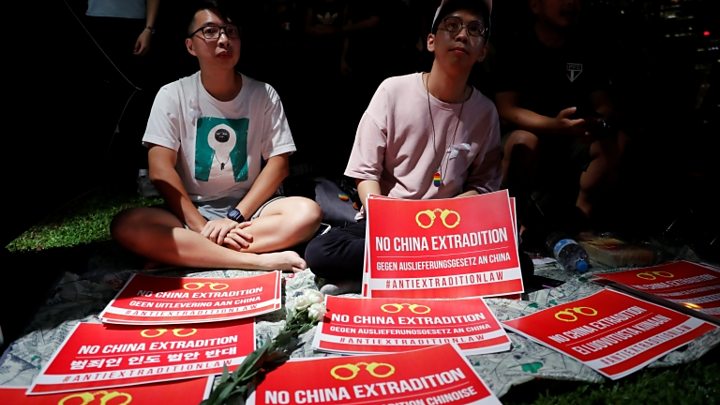
Before the coronavirus outbreak, Hong Kong had witnessed almost weekly demonstrations against a proposal to allow extraditions to the Chinese mainland.
While that was later abandoned, the protests morphed into demands for greater democracy and less control from Beijing, and anger against the government remains.
Who was arrested?
Media tycoon Jimmy Lai runs the Apple Daily newspaper, which is frequently critical of the Hong Kong and Chinese leadership.
Mr Lai, who was estimated by Forbes in 2009 to be worth $660m (£512m), was also arrested in February this year on charges of illegal assembly and intimidation.
Democratic Party founder and barrister Martin Lee, 81, was another prominent figure to be detained.
The 81-year-old – who is known as the father of Hong Kong democracy – said he was “very much relieved” by his arrest, according to AFP news agency.
“For so many years, so many months, so many good youngsters were arrested and charged, while I was not arrested. I feel sorry about it,” he added.
Media caption The BBC’s Helier Cheung on why people are taking to the streets in Hong Kong
Live From Her Kitchen, Pelosi Works to Counter Trump’s Coronavirus Show
The speaker and Senator Chuck Schumer of New York, the minority leader, have begun a media blitz to present an alternative message to the president’s lengthy daily briefings.
Speaker Nancy Pelosi has sat for 25 television interviews over the past three weeks.Credit…Erin Schaff/The New York Times
WASHINGTON — Speaker Nancy Pelosi doesn’t bother watching President Trump’s lengthy daily televised briefings on the coronavirus pandemic. “I don’t watch his shows,” she said in an interview Wednesday. “I don’t have time to watch him contradict himself from one day to the next.”
Still Ms. Pelosi, who is now deprived of the official trappings of the Capitol with Congress in an extended virus-instigated recess, is trying to counter the president’s White House sessions with her own media blitz from her kitchen in San Francisco.
Over the past three weeks, the speaker has sat for 25 television interviews, up from her typical one or two a month. On Monday, she told the “Late Late Show” host James Corden that Mr. Trump was “in denial” and called his push to swiftly reopen the country “really scary.” On Tuesday, she issued a blistering letter calling Mr. Trump an incompetent liar who had caused “unnecessary deaths and economic disaster,” and went on MSNBC to talk about it. On Wednesday, she appeared on CNN, calling Mr. Trump’s move to put his name on government stimulus checks “shameful.”
People in Washington have come to understand that if you want to communicate with Mr. Trump, the best way is to go on television, and Ms. Pelosi, who led the drive to impeach him, is a master at getting under the president’s skin. But Ms. Pelosi — in tandem with her Senate counterpart, Senator Chuck Schumer of New York, who is amping up his own media presence — is doing more than just taking potshots.
Eager to offer an alternate narrative to the one Mr. Trump has been presenting, the two are trying to play on what they regard as Mr. Trump’s biggest political weakness: For all the talking the president is doing, many Americans do not believe what he says.
Polls show that Mr. Trump’s rambling briefings, delivered from the White House briefing room or the Rose Garden just outside, are doing him little good. His job approval ratings, which saw a slight uptick when he first took to the airwaves, are stuck near 46 percent, the same as before the pandemic, according to an average calculated by Real Clear Politics. Surveys show that most Americans think the president waited too late to respond to the novel coronavirus. The nation’s governors are getting far better grades from the public.
Ms. Pelosi and Mr. Schumer, looking toward the November elections amid deep anxiety among Americans about the pandemic, are trying to weaponize those sentiments. Sidelined from the Capitol, they lack Mr. Trump’s powerful megaphone. Ms. Pelosi is conducting interviews in front of a laptop in her well-appointed kitchen, with her high-end appliances in the background. Mr. Schumer has set up his iPad on a pile of books atop his dining room table in Brooklyn.
“It’s supposed to be at eye level,” he explained in an interview Thursday.
Despite their considerably less grand backdrops, the two have managed to play jujitsu with the president, by either baiting Mr. Trump with their own television appearances or commandeering at least some portion of his briefings by raising questions, reiterated by reporters who then push him to respond.
“Even if the public doesn’t hear them directly, Schumer and Pelosi still play a very influential role in shaping the debate in a way that affects what Trump has to answer for when he does his media circus,” said Geoff Garin, a Democratic pollster. “They may not always have the ear of the public, but they have Trump’s ear, and he is hypersensitive to what they have to say.”
As the highest-ranking Democrat in the country and Mr. Trump’s constitutional equal, Ms. Pelosi (and, to a lesser extent, Mr. Schumer) is also stepping into a void left by former Vice President Joseph R. Biden Jr., the Democrats’ presumptive nominee for president, who has been struggling to carve out a place for himself in the coronavirus debate.
Democrats say the pandemic has presented them with a powerful political hand to play.
“This is a perfect storm of messaging,” said Steve Israel, the former congressman from New York who ran the House Democrats’ campaign arm. “The three defining issues in this campaign were Trump’s competence as president, the strength of the economy and health care — and those three issues have now collided spectacularly.”Sign up to receive an email when we publish a new story about the coronavirus outbreak.Sign Up
Ms. Pelosi insists politics is not at work. “This is life and death,” she said.
But the Democrats have succeeded in elevating issues that Mr. Trump would rather not discuss. This month, for instance, Mr. Schumer used an appearance on MSNBC’s “Morning Joe” to urge Mr. Trump to appoint a military official as a “czar” to oversee the production and distribution of medical supplies and equipment. That led to a daylong verbal duel.
First, Mr. Trump blasted “Cryin’ Chuck Schumer” on Twitter. Mr. Schumer followed up with a letter to Mr. Trump reiterating his demand. They spoke by phone, and Mr. Trump threatened to send Mr. Schumer a “nasty letter.” He later did so, accusing the Democratic leader on formal White House stationery of exacerbating New York’s coronavirus outbreak by being distracted by the “ridiculous impeachment hoax.”
Mr. Schumer insisted that he and Ms. Pelosi were having some effect. In the weeks since that exchange, Mr. Trump has occasionally invoked the Defense Production Act, the Korean War-era law allowing him to compel manufacturers to produce vital equipment.
“One of the reasons the majority of people now realize the president is not doing a good job,” Mr. Schumer said, “is we’ve been pointing it out.”
The two have also been using their media appearances to demonstrate how Democrats might govern, even as they highlight the president’s shortcomings. They have been particularly focused on Mr. Trump’s failure to live up to his claim that any American who needed a coronavirus test could get one. On Wednesday, Democrats rolled out their own $30 billion national testing plan — an implicit attack on Mr. Trump that Ms. Pelosi reinforced later in the day when she went on CNN’s “State of the Union.”
“It’s so important to come back to those three big words: testing, testing, testing,” she said, reiterating a phrase that she employs at almost every opportunity.
In the interview with The New York Times, Ms. Pelosi said she was not doing any more press than usual, noting that she frequently spoke to reporters in the Capitol. (She did her regular weekly news conference by telephone on Thursday.) But she has clearly expanded her reach and tried to meet Americans where they are.
That is one reason she went on Mr. Corden’s show. “It is especially important to reach out into the popular culture,” she said.
But excessive media exposure has its downsides, too. When the substance of her interview with Mr. Corden was over, the speaker — who is known for her love of chocolate — engaged in one of the host’s playful episodes of show-and-tell, pulling open her freezer to reveal a drawer full of neatly stacked containers of $12-a-pint artisan ice cream, including her favorite chocolate.
The clip quickly went viral, prompting Ms. Pelosi’s conservative critics to blast her as tone deaf and the Trump campaign to brand her an “ice queen.” Her Republican counterpart, Representative Kevin McCarthy of California, also chimed in, complaining to the Fox News host Bill Hemmer that the speaker was “more interested in showcasing her gourmet ice cream than securing the funding” necessary to keep small businesses afloat.
With Mr. Trump making one outlandish statement after another — he claimed last week that he had “total” authority in the pandemic, prompting a rebellion among governors, and on Wednesday he threatened to force Congress to adjourn — Ms. Pelosi said she was primarily interested in forcing the president to reckon with the truth.
“If he tells more falsehoods, if he conveys more falsehoods again and again, they almost become factoids — not quite a fact,” she said. “He is eclipsing the truth, and you cannot let somebody who is not telling the truth say it so often.”
She said she wrote the “Dear Colleague” letter she released Tuesday evening after reflecting about it over the Easter holiday. In it, she used the word “truth” 18 times to launch a string of broadsides against the president, including: “The truth is, a weak person, a poor leader, takes no responsibility. A weak person blames others.”
Mr. Trump obviously got the message.
“Crazy ‘Nancy Pelosi, you are a weak person. You are a poor leader,’” he wrote on Twitter on Thursday morning, quoting his friend Sean Hannity of Fox News. The president went on in his own voice: “She is totally incompetent & controlled by the Radical Left, a weak and pathetic puppet. Come back to Washington and do your job!”
A judge has revoked a key permit for the controversial Keystone XL tar sands pipeline, in a victory to tribes and environmentalists. Photograph: Nati Harnik/AP
The controversial Keystone XL tar sands pipeline has been dealt a major setback, after a judge revoked a key permit issued by the US Army Corps of Engineers without properly assessing the impact on endangered species.
In a legal challenge brought by a coalition of environmental groups, a federal judge in Montana ordered the Army Corps to suspend all filling and dredging activities until it conducts formal consultations compliant with the Endangered Species Act.
The ruling revokes the water-crossing permit needed to complete construction of the pipeline, and is expected to cause major delays to the divisive project.
Tue 19 Mar 2019 17.00 GMTLast modified on Wed 5 Jun 2019 09.13 BST
Shares628
Floral tributes to those who were gunned down in the Christchurch massacre outside the city’s Botanical Garden. Photograph: Marty Melville/AFP/Getty Images
Following the Christchurch shooting, in which 50 people were killed, New Zealand’s government has announced it will be reforming the country’s gun laws.
People must have a licence to own guns, and the licence requires background checks. While dealers must keep a record of the guns they sell, most guns are not required to be tracked in a central register to monitor changes in ownership due to private sales.
New Zealand law also permits ownership of semi-automatic rifles, such as the AR 15-style gun, used previously in US mass shootings. These rifles are able to be bought under a category A licence, but the licence only covers magazines that hold seven cartridges. While it has been confirmed that the Christchurch shooter legally obtained at least four guns, included two semi-automatic rifles, the shooter also reportedly used larger magazines capable of holding more ammunition.
In a press conference on Monday, New Zealand’s prime minister, Jacinda Ardern, made specific reference to Australia’s implementation of stricter gun laws following the Port Arthur massacre in Tasmania in 1996, in which 35 people were killed and 23 were wounded.
So, what happened with Australia’s laws, and how has gun control worked in other countries?
The Australian situation
Following the Port Arthur incident, Australia implemented the National Firearms Agreement (NFA).
Prohibited firearms that were handed in under the Australian government’s buy-back scheme after the Port Arthur massacre. Photograph: David Gray/Reuters
New, uniform state gun laws banned rapid-fire guns from civilian ownership except under certain, restricted licences, and established a government buyback of semi-automatic and pump-action rifles and shotguns.
Another requirement was that all guns must be individually registered, with all gun sales tracked to record changes in ownership. Previously, registration varied by state and gun type. The laws reduced guns in Australia by about one-fifth, with more than 700,000 guns removed and destroyed.
There have been a number of studies published on the impact of the NFA on firearm-related deaths in Australia. According to a 2011 summary of the research by the Harvard Injury Control Research Centre, a number of studies suggested beneficial effects from the law changes, with a reduction in mass shootings, and a reduction in the rate of firearm-related deaths (both homicides and suicides) overall.
Researchers from the University of Sydney and Macquarie University in 2006, 2016 and 2018 looked at the number of mass killings before and after the NFA, and also whether the law changes affected the number of firearm-related deaths. They found that there was a drop in the rate of firearm deaths – particularly with suicides – but were cautious about attributing this to the NFA with the methods they used.
While two studies found either no reduction in firearm deaths before and after the NFA, or a reduction only in firearm-related suicides, but not overall suicides, the methods for both of these studies were subsequently criticised by other researchers.
The authors concluded “the simultaneous implementation of laws targeting multiple elements of firearms regulations reduced firearm-related deaths in certain countries”, and “some specific restrictions on purchase, access, and use of firearms are associated with reductions in firearm deaths”.
More recently, further studies on gun control in the US have been released that show stricter laws by US state, and states nearby, are associated with reduced suicide and homicide rates.
● You can read more about New Zealand’s history with gun control here. Many thanks to German Lopez for this article at Vox, which is where I first saw several of the papers I’ve mentioned.
• Crisis support services can be reached 24 hours a day. In New Zealand, the crisis support service Lifeline can be reached on 0800 543 354. In Australia, Lifeline is 13 11 14. In the UK and Irish Republic, contact Samaritans on 116 123. In the US, the National Suicide Prevention Lifeline is 1-800-273-8255. Other international helplines can be found at www.befrienders.org.
The European Commission has set out a plan to move towards a ‘right to repair’ for electronics devices, such as mobile phones, tablets and laptops.
More generally it wants to restrict single-use products, tackle “premature obsolescence” and ban the destruction of unsold durable goods — in order to make sustainable products the norm.
The proposals are part of a circular economy action plan that’s intended to deliver on a Commission pledge to transition the bloc to carbon neutrality by 2050.
By extending the lifespan of products, via measures which target design and production to encourage repair, reuse and recycling, the policy push aims to reduce resource use and shrink the environmental impact of buying and selling stuff.
The Commission also wants to arm EU consumers with reliable information about reparability and durability — to empower them to make greener product choices.
“Today, our economy is still mostly linear, with only 12% of secondary materials and resources being brought back into the economy,” said EVP Frans Timmermans in a statement. “Many products break down too easily, cannot be reused, repaired or recycled, or are made for single use only. There is a huge potential to be exploited both for businesses and consumers. With today’s plan we launch action to transform the way products are made and empower consumers to make sustainable choices for their own benefit and that of the environment.”
The Commission said electronics and ICT will be a priority area for implementing a right to repair, via planned expansion of the Ecodesign Directive — which currently sets energy efficiency standards for devices such as washing machines.
Its action plan proposes setting up a ‘Circular Electronics Initiative’ to promote longer product lifetimes through reusability and reparability as well as “upgradeability” of components and software to avoid premature obsolescence.
The Commission is also planning new regulatory measures on chargers for mobile phones and similar devices. While an EU-wide take back scheme to return or sell back old mobile phones, tablets and chargers is being considered.
Back in January the EU Parliament voted overwhelmingly for tougher action to reduce e-waste, calling for the Commission to come up with beefed up rules by this summer.
The Commission proposals also include a new regulatory framework for batteries and vehicles — including measures to improve the collection and recycling rates of batteries and ensure the recovery of valuable materials. Plus there’s a proposal to revise the rules on end-of-life vehicles to improve recycling efficiency and waste oil treatment.
It’s also planning measures to set targets to shrink the amount of packaging being produced, with the aim of making all packaging reusable or recyclable in an economically viable way by 2030.
Mandatory requirements on recycled content for plastics used in areas such as packaging, construction materials and vehicles is another proposal.
Other priority areas for promoting circularity and reducing high consumption rates include construction, textiles and food.
The Commission expects the circular economy to have net positive benefits in terms of GDP growth and jobs’ creation across the bloc — suggesting measures to boost sustainability will increase the EU’s GDP by an additional 0.5% by 2030 and create around 700,000 new jobs.
The backing of MEPs in the European Parliament and EU Member States will be necessary if the Commission proposals are to make it into pan-EU law.
Should they do so, Dutch social enterprise Fairphone shows a glimpse of what’s coming down the repairable pipe in future…
My newly designed logo it cost a prity penny too!!
I am really surprised by how expensive the digital economy is to cyber surf within, to say that you can sometimes earn money and see it disappear into thin air!!
I have only just seen this I can not say I am surprised by the toxic nature of the right and if this has resulted in a blott on the landscape we will never know now. I hope people don’t mind but my local councilor in Exeter is a Green party Councillor and she has stood up to this challenging Coronavirus pandemic prior to others speaking out. I am so please I had faith in Jeremy Corbyn to at the last election to vote for him probably the best leader we never had. Universal suffrage is indeed a long road to freedom and we continue with that walk today. I am sorry to those that now feel anger, fear and like they have been betrayed. Try channeling those emotion to contact your elected representative and to speak your truth to them whether through post, email, Twitter or Facebook, to remind them we are still hear, watching and waiting and we are not going anywhere. Thank you JC for your service to this United Kingdom. Until we meet again at the ballot box to do battle once again my brothers and sisters.



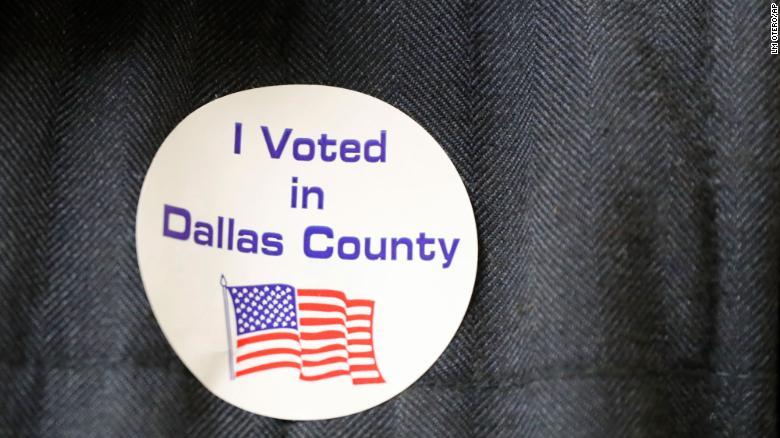 Democrat Jamie Wilson displays a sticker after voting in the Super Tuesday primary at John H. Reagan Elementary School in the Oak Cliff section of Dallas, Tuesday, March 3, 2020. (AP Photo/LM Otero)










You must be logged in to post a comment.