
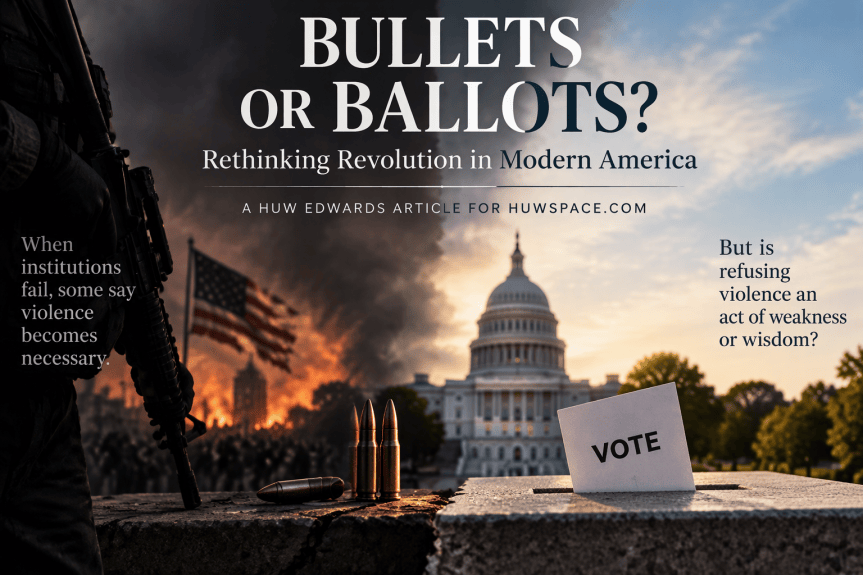
By Huw Edwards for Huwspace.com
The revolutionary argument is as old as politics itself. When institutions cease to serve the people, when governments become unresponsive, and when citizens lose faith that change can occur through democratic means, some begin to argue that violence becomes not merely justified but necessary.
It is a powerful idea. It is also one that deserves far greater scrutiny than it often receives.
Throughout history, revolutionaries have claimed that peaceful reform eventually reaches its limits. If the courts are corrupt, the legislature captured, and the political system incapable of meaningful change, then force becomes the only remaining instrument of political action.
Yet an uncomfortable question remains.
Even if institutions fail, why should anyone assume violence will make matters better?
In modern America, what exactly has failed so completely that civil conflict or revolution is seen by some as a rational answer? And what evidence exists that a bloody struggle would produce freedom rather than simply a different form of oppression?
These are not questions of left or right. They are questions of history, morality and common sense.
The Revolutionary Argument
The intellectual case for revolutionary violence is perhaps most closely associated with Frantz Fanon, whose writings on anti-colonial struggle argued that violence could become necessary when oppressed people were denied any meaningful path towards political self-determination. For Fanon, violence was not merely destructive. It could become a means through which the powerless reclaimed agency, dignity and freedom. [researchgate.net], [digitalcom…ns.usu.edu]
The logic is straightforward:
- Institutions become irredeemably corrupt.
- Peaceful reform becomes impossible.
- Resistance becomes a moral obligation.
- Violence becomes the mechanism through which freedom is achieved.
History contains examples where such arguments carried genuine force. Colonial subjects denied rights, representation and self-government often found themselves confronting systems designed to prevent peaceful change.
Yet accepting that violence may sometimes become understandable is not the same as concluding it is wise.
Hannah Arendt’s Warning
Political philosopher Hannah Arendt offered one of the most important critiques of revolutionary violence.
Arendt argued that violence and power are not the same thing. Violence can destroy institutions, but it cannot by itself create legitimate political authority. Freedom requires trust, participation, civic engagement and durable institutions. Guns alone cannot provide those things. [digitalcom…ns.usu.edu], [researchgate.net]
Her warning was simple but profound.
Revolutions are often successful at tearing down existing structures. They are far less reliable at constructing better ones.
The French Revolution toppled a monarchy only to descend into terror and eventually dictatorship.
The Russian Revolution overthrew Tsarist rule yet produced one of the most authoritarian systems of the twentieth century.
Again and again, history demonstrates that removing an unjust order does not automatically create a just one.
The assumption that freedom naturally follows violence is one of the most dangerous misconceptions in political thought.
America’s Contradiction
Modern America occupies a peculiar place within this debate.
Many political voices appeal to the language of revolution, resistance and even civil conflict. References to 1776 appear regularly in political discourse. The image of the armed citizen standing against tyranny remains deeply embedded in parts of American culture.
But unlike many societies that experienced genuine revolutionary conditions, America still possesses functioning democratic mechanisms.
Citizens vote.
Governments change peacefully.
Political parties compete for power.
Courts continue to rule against governments.
Journalists openly criticise political leaders.
Citizens organise, campaign, protest and publish freely.
None of this means America does not face serious challenges.
Political polarisation has deepened. Trust in institutions has declined. Economic inequality remains severe. Housing costs, healthcare costs and social division continue to affect millions of lives.
These are serious problems.
But serious problems are not the same as complete institutional collapse.
One can argue passionately for reform. It is considerably harder to argue that all peaceful means of reform have been exhausted.
What Exactly Is Failing?
This is perhaps the question most absent from modern revolutionary rhetoric.
What precisely has failed so completely that violence represents a preferable alternative?
If elections still occur, why abandon elections?
If courts still function, why abandon courts?
If free speech exists, why abandon persuasion?
If activism remains legal, why abandon organisation?
Too often, calls for revolution seem rooted less in objective institutional failure and more in political frustration.
An increasing number of people appear willing to regard democratic institutions as legitimate only when those institutions produce outcomes they personally favour.
That is not necessarily opposition to tyranny.
It may simply be disappointment with democracy itself.
Democracy is frustrating by design. It guarantees disagreement, compromise and political defeat as much as it guarantees victory. It promises a process, not a predetermined outcome.
Remember, Remember the Fifth of November
It is fitting that these questions are being asked on Guy Fawkes Night.
Remember, remember, the fifth of November,
Gunpowder, treason and plot.
I see no reason
Why gunpowder treason
Should ever be forgot.
The rhyme recalls the failed Guy Fawkes plot to destroy Parliament in 1605.
Today, some view Guy Fawkes as a symbol of resistance against a broken system. Yet the same question remains as relevant now as it was then: does violence create freedom, or merely more violence?
Had the Gunpowder Plot succeeded, would England have become freer, or would it simply have descended into retaliation, repression and further bloodshed?
That is the challenge modern advocates of revolution must answer. Destroying a political system is far easier than creating a better one. History is filled with movements that successfully overthrew institutions only to replace them with fresh forms of tyranny.
The Fifth of November reminds us not only to remember the plot itself, but to think carefully about what comes after the explosion.
The Historical Record of Political Violence
Supporters of revolutionary violence often emphasise successful struggles for independence and liberation.
Far less attention is given to the countless movements that produced chaos, instability and suffering.
Civil wars are among the most destructive experiences a society can endure.
Even after the fighting ends, the consequences frequently remain for generations.
Communities fracture.
Infrastructure is destroyed.
Political extremism becomes normalised.
Retaliation follows retaliation.
Research into revolutions suggests that violent revolutions can sometimes prove more resistant to counter-revolutionary threats because they create strong security structures capable of defending the new order. [cambridge.org], [cambridge.org]
Yet that observation raises another dilemma.
A state capable of enforcing stability through force is not necessarily a freer state.
Many revolutionary governments become highly effective at suppressing dissent once they achieve power.
The revolution survives.
Liberty does not.
The Liberal Dilemma
Liberals are often criticised for placing too much faith in institutions.
They are accused of excessive patience, endless compromise and a reluctance to confront injustice.
Sometimes those criticisms contain an element of truth.
Yet liberal democracy rests upon a recognition that violence develops its own momentum.
Once violence becomes an accepted political tool, it rarely remains confined to a single purpose.
It changes societies.
It changes movements.
It changes leaders.
Eventually, it changes the people who employ it.
The danger is not merely that violence might fail.
The greater danger may be that it succeeds.
A successful armed movement acquires armed leaders, armed structures and armed habits. Political disagreements that were once settled through debate increasingly become questions of force.
History suggests those habits often outlive the revolution itself.
Wisdom or Weakness?
Some will always argue that refusing violence is an act of weakness.
That real change requires force.
That power never concedes anything voluntarily.
Perhaps there are moments in history where such arguments carry weight.
But there is another perspective.
Perhaps refusing violence reflects an understanding of human nature itself.
Perhaps wisdom lies in recognising that the destruction of institutions is easier than their construction.
Perhaps wisdom lies in understanding that violence often unleashes forces far beyond the control of those who initiate it.
And perhaps wisdom lies in preserving democratic processes precisely because they provide a way of resolving disagreement without killing one another.
Conclusion
On this Fifth of November, as bonfires burn and fireworks illuminate the night sky, it is worth remembering that political violence has always carried an allure far greater than its actual record of success.
The revolutionary argument deserves to be taken seriously. History contains moments when oppression became so severe that resistance appeared unavoidable.
But modern America is not colonial Algeria. It is not Tsarist Russia. It is not a military dictatorship that has extinguished every avenue for peaceful reform.
Before anyone speaks casually about revolution, two questions deserve answers.
What exactly has failed?
And why should anyone believe that bullets will produce a better future than ballots?
The burden of proof lies with those advocating force, not with those exercising restraint.
History suggests that removing what we hate is often much easier than building what we hope for. The wisdom of democracy may not be that it prevents conflict, but that it offers a way of navigating conflict without setting society on fire.
References
- Talkin’ Bout a Revolution: A Comparative Analysis Between Hannah Arendt and Frantz Fanon, Utah State University. [digitalcom…ns.usu.edu]
- What is Violence? On Hannah Arendt’s Critique of Frantz Fanon. [researchgate.net]
- The Grey Zones of Violence in Political Resistance, Theoria (2020). [jstor.org]
- Democracy, Violence, and the Legacy of the American Revolution, History News Network. [historynew…etwork.org]
- Revolutionary Violence and Counterrevolution, American Political Science Review (2023). [cambridge.org], [cambridge.org]
As America wrestles with growing political polarisation and increasingly revolutionary rhetoric, the central question is not whether institutions are imperfect, but whether violence has ever proved a reliable route to freedom. On Guy Fawkes Night, Huw Edwards examines the historical case for revolution and the stronger case for restraint.


