The Case Against Monarchy in Modern Democracies

Many a revolution and civil war has played out across the world in many a country including the UK to sever the head of a monarch from the political control of a country. It seems bizarre in this day and age that Britain has a monarch as the head of it’s state, political and religious institutions. But what is even more bizarre is the strength of will at the heart of the establishment to maintain the status quo and make no change to this set of institutions, state of affairs or even review or to ensure transparency concerning where money goes to the monarch and how or why it is then spent.

For me this is not an argument about whether a King or Queen are good people or not but whether they have the right to be born into the role they play and I strongly believe that there should be no birth right to any position in our state let alone that of the head of state.

Arguments against supporting monarchies in democratic societies generally center on principles of equality, accountability, and the desire for a modern, meritocratic state. Critics argue that inherited power is fundamentally incompatible with the democratic ideal that all citizens are equal and that leaders should be chosen by the people.

  1. Lack of Democratic Accountability 

A core tenet of democracy is that leaders must be answerable to the people they serve. 

No Choice or Removal: Unlike elected officials, monarchs cannot be held to account or removed at the ballot box by the public.

Hereditary Risk: Relying on inheritance means there is no selection process to ensure the leader is capable; a nation risks being stuck with an incompetent, “petty,” or “vindictive” individual for decades. 

2. Incompatibility with Popular Sovereignty

Democracy is rooted in the idea that power belongs to the people, not a specific family. 

Anachronism: Critics view monarchy as a vestige of a feudal past that has no place in a modern world where legitimacy should derive from the consent of the governed.

Secrecy and Lobbying: In some systems, monarchies are exempt from transparency laws (like Freedom of Information requests), allowing for “lobbying by stealth” for private business interests. 

3. Economic and Social Costs

Opponents often point to the tangible burdens of maintaining a royal institution. 

Taxpayer Expense: Critics argue that the significant funds spent on the “extravagant lifestyle” of a royal family—including security, travel, and palace maintenance—could be better used for public services.

Colonial Legacy: For former colonies, retaining a distant monarch as a head of state can be seen as an obstacle to fully reconciling with their history and achieving true national independence. 

4. Institutional Resilience vs. Democratic Values

While some argue that constitutional monarchies provide stability, critics contend: 

Borrowed Time: Monarchies in democratic countries are often described as “operating on borrowed time,” requiring manufactured goodwill to survive.

Fragile Neutrality: A monarch’s perceived neutrality is easily shattered if they attempt to intervene in political matters, leading to constitutional crises.

Will the UK always have a monarchy?

Whether the UK will always have a monarchy is uncertain, as it is not guaranteed by law and relies on public support, which has shown a long-term decline. While it remains popular as a symbol of unity and tradition, support dropped to a record low of 54% in 2023, with around 25% favoring abolition. 

Key Factors Regarding the Future of the Monarchy:

Public Opinion & Trends: While a majority still support the institution, backing has fallen from 76% in 2012 to 54% in 2023. A growing minority, now around 25%, supports a republic, marking a 10% increase in just five years.

Constitutional Pathway: There is no legal barrier to abolition; it could be achieved through a parliamentary act and a referendum, creating a new, elected head of state.

Arguments for Removal: Critics argue the institution is incompatible with modern democratic values, lacks transparency, and that its wealth (e.g., the Duchy estates) should belong to the public.

Arguments for Retention: Proponents highlight the monarch’s role in providing political stability, acting as a non-partisan head of state, and contributing to tourism and international soft power.

Future Adaptability: The monarchy’s survival has relied on its ability to adapt to changing times, a strategy that future monarchs like Prince William will likely need to continue to maintain support.

The monarchy’s future depends on the “oxygen of public support” and its ability to remain relevant to future generations, making its permanence not guaranteed. 
Removing the power base of a born and bred King or Queen from the head of the UK will not be easy or happen overnight but it does feel like a form of constitutional madness to still have a monarch today as the head of a democratic society and is very much one that has been in place for so long it is sadly perceived to be a normal state of affairs.

I’m with stupid!

So why is democracy seen as the worst form of government bar all other forms of governance tried?

Democracy is often characterized as the “worst form of government” primarily through a famous aphorism attributed to Winston Churchill: “Indeed it has been said that democracy is the worst form of Government except for all those other forms that have been tried from time to time”

In the UK we could end up having a Reform government led by Nigel Farage in after the next general election or the very threat of this happening could in effect keep him voted out, the idea of a Britsh Trumping of social norms and political structures is a delight to some and terrifying to others. The political party Reform now has so many dangerous former Conservative Politicians in it they are more regurgitated Tories than they are reformed human beings.

Life, the world and technological futures seem to be creating the perfect storm for our future endeavours which as we vote and how we are governed will show the best and worst of us all. Do we care for ourselves or others, rich man, poor man, beggar man or thief. How should we act and treat one another when a crisis is right at our feet.

The political sentiment for democracy being the best of a bad bunch reflects a pragmatic recognition that while democratic systems are riddled with inherent flaws—such as inefficiency, corruption, and the potential for “mob rule”—they remain preferable to authoritarian alternatives that lack accountability and individual justice. 

Russia, China and Iran all must supress, lock up and kill their own citizens as well as ones abroad in order to maintain their supremacy and there are not enough words on a board to express the horror and suffering they inflict on others in order to get their own way. Democracies do not aspire to be brutal totalitarian regimes but in stead aim to fend of the madness of such regimes from inflicting their brutality and suppressing nature onto us all.

Core Philosophical and Practical Criticisms of democracies

The perception of democracy as a “bad” or “flawed” system stems from several long-standing arguments:

1. Competence and “Mob Rule”

  • Voter Ignorance: A central critique, dating back to Plato, is that democracy gives equal weight to the votes of experts and those who may be “incompetent” or poorly informed. Modern studies have shown that many voters lack basic civic knowledge, making them susceptible to emotional manipulation and propaganda.
  • Tyranny of the Majority: Critics like Alexis de Tocqueville and John Stuart Mill warned that a “poor majority” could dominate decision-making at the expense of minority rights and individual excellence.
  • Mob Law: Churchill himself distinguished true democracy from “mob law,” where armed groups or “gangsters” seize power under the guise of popular will to implement totalitarian regimes. 

2. Structural Inefficiencies

  • Slow Decision-Making: Unlike autocracies, where a single leader can act quickly, democracies require constant deliberation, negotiation, and compromise, which can lead to stagnation or gridlock during crises.
  • Short-Termism: Electoral cycles incentivize politicians to prioritize immediate, popular benefits to win votes, often ignoring long-term risks like climate change, debt crises, or pension sustainability. 

3. Corruption and Elite Capture

  • Influence of Money: Democratic systems are often criticized for becoming “oligarchies” in practice, where economic elites and special interest groups have significantly more influence over policy than the average citizen.
  • Iron Law of Oligarchy: Sociologists have argued that any organization, including a democracy, eventually becomes dominated by a small elite due to the practical demands of organizing power. 

Contemporary Challenges (2025–2026)

Current political analysis highlights specific modern threats that exacerbate these negative perceptions:

  • Erosion of Trust: As of early 2025, global trust in democratic institutions like parliaments has significantly declined, while trust in the police has risen. This disillusionment often leads to support for populist leaders who promise to dismantle existing democratic structures.
  • Information Ecology: The spread of algorithmically-driven disinformation and “fake news” has made it difficult to establish a common factual basis for democratic debate.
  • Polarization: Modern democracies are facing extreme political fragmentation and the formation of “echo chambers,” making social discourse across political lines increasingly difficult. 

The “Least Bad” Perspective

Despite these significant failings, democracy is defended as the only social order consistent with justice and human dignity. Proponents argue that its “built-in flaws” and tendency to decay are actually safeguards; a certain level of skepticism and the ability to change leaders without violence are advantages that other systems, which are often more brittle, do not possess. 

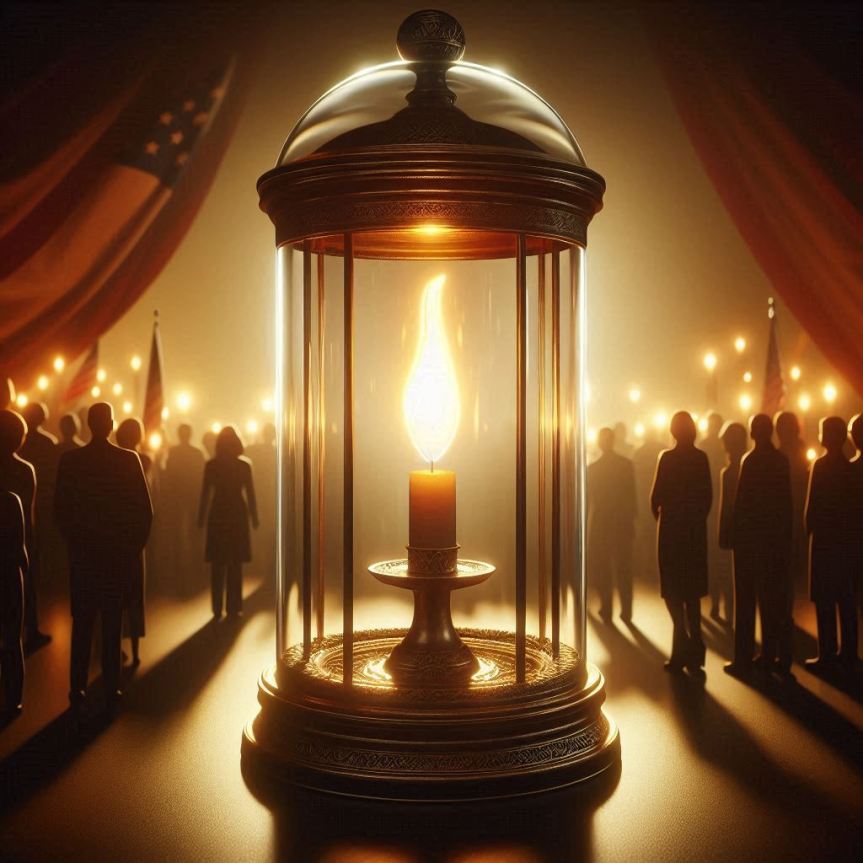
Democracies hold a kinship to freedom like a shining beacon in the dark

Political freedoms to vote, freedom of expression, Freedom to think and freedom to do and be.

Though these freedoms have in some ways restrictions so that one persons freedom does not inflict damage or disregards another persons freedom it is I feel our freedoms that are the eternal beacon of hope which guides and shapes our democracies to not just survive but to live on into a forever future like the eternal flame of freedom, hope and democracy.

The “eternal flame” serves as a global symbol for freedom, hope, and democracy, manifesting in several prominent memorials and monuments worldwide: 

Key Memorials & Symbols

  • The King Center Eternal Flame (Atlanta, USA): Located at the tomb of Dr. Martin Luther King, Jr., it was recently restored to reaffirm King’s vision for justice and peace. It serves as a reminder that the work of freedom and democracy is a shared, ongoing responsibility.
  • Flame of Democracy (Constitution Hill, South Africa): Lit by Nelson Mandela to commemorate the 15th anniversary of South Africa’s constitution. It burns outside the Constitutional Court as a symbol of the country’s liberation and the enduring spirit of human rights.
  • Flame of Peace (Hiroshima, Japan): Lit in 1964, this flame is intended to burn until all nuclear weapons are destroyed, representing hope for a world defined by peace rather than conflict.
  • Freedom Park Eternal Flame (Pretoria, South Africa): A symbol of gratitude and remembrance for those who played pivotal roles in South Africa’s liberation struggle.
  • The Centennial Flame (Ottawa, Canada): First lit in 1967, it commemorates the first hundred years of Canadian Confederation and symbolizes the spirit of national unity. 

Cultural and Global Context

Artistic Expression: Musicians like Bruce Springsteen have recently launched tours (e.g., “Land of Hope and Dreams”) explicitly centered on themes of democracy and defending the American ideal. 

United Nations: Secretary-General António Guterres has used the metaphor to urge the world to “keep the flame of democracy alive” for future generations.

International Day of Democracy: Observed annually on 15 September, this day reinforces the idea that democracy must be nurtured and defended as a “flame” that requires active citizen participation.

Don’t Cry – Seal


What do we do when the machines do the work and AI does the thinking?

Will it be heaven or will it be a further insight into hell, the choice might still be ours to make and the only vote is for how it happens and not if?

I have so many friends now that want to work, can work and would love to work. Many of the jobs left are in care work such as nursing and not everyone is built to be a nurse, or delivery services to peoples doors and not everyone is fit enough to cycle quickly or productively enough to peoples homes. It’s not just about the jobs left but all of the jobs being lost or no longer hired for that  we can’t all be doctors, nurses and delivery drivers so what does the future hold for everyone else. I don’t have any solutions but am certainly aware of the fact that right now there is a clear and present danger and problem for humanity.

Our politicians talk about the need to work our ethics teaches us that work sets you free as does our morality. But what about those left that are unable to due to circumstance out of their control what will happen for them. If we can not afford to run the machines that produce goods and services that no one can afford to buy what happens in a consumption focused society then. Our model of production, services and supply is not as resilient as we might think it is and neither are the people that purchase and consume the goods either.

There is so much chatter by economic experts of productivity, but if people are not working who or what is measured as being productive and none productive. Without an income we struggle to purchase and without our ability to purchase an economy will struggle to produce. This is a global issue and not just a local issue, we can neither run or hide from this situation. It will effect all and our only weapon or strength we have is to vote to mitigate from the impact of these changes and that will take time that many might not have.  

In a future where machines handle most or all traditional jobs, society would likely undergo a fundamental shift in how we value time, income, and purpose. 

1. Economic Restructuring

Universal Basic Income (UBI): Governments may implement unconditional cash payments to all citizens to maintain consumer spending and prevent poverty as wages disappear.

Automation Taxes: To fund UBI, some propose taxing the “robot labor” or the massive profits generated by AI-driven corporations.

Decoupling Income from Labor: We may move toward a “post-scarcity” economy where the cost of goods drops drastically, and survival no longer depends on holding a job. 

2. Shifting Human Roles

Focus on “Human Touch”: Roles requiring deep empathy, complex ethics, and interpersonal care (like nursing, therapy, or early childhood education) are expected to remain human-centric.

Creative and Philosophical Pursuits: Freed from survival-based labor, humans could dedicate themselves to the arts, scientific exploration and personal development- though who ultimately picks up the tab for this I do not know.

Moral Custodians: Humans will still be needed to oversee AI ethics, take legal responsibility for machine decisions, and provide “human-in-the-loop” governance. 

3. Immediate Practical Steps

Continuous Upskilling: Focus on “soft skills” like critical thinking, systems understanding, and adaptability, which are harder for AI to replicate.

AI Literacy: Programs like the UK’s AI Skills Hub are already emerging to help workers transition into roles that manage or implement technology.

Reducing Work Hours: Automation could naturally lead to a two- or three-day workweek as productivity gains are shared. 

The future is potentially quite bleak for humanity if we don’t look to address these issues sooner rather than later. We might get a chance to know our value and see what worth we finally have to others whether we are black or white straight or gay, all are humans and have a right to life, that life has value and although there are always rules to live by and for we have the right to live that life for sure.

Mumford & Sons – Blind Leading The Blind

What is political freedom and what should restrict it and why?

Political freedom is the capacity of individuals to participate in their society’s governance and political processes without unreasonable external constraints. It is often categorized into negative freedom (the absence of interference from the state) and positive freedom (the actual capacity to exercise one’s rights).

Core Components of Political Freedom

  • Political Participation: The right to vote, run for office, and hold governments accountable.
  • Freedom of Expression: The ability to hold, receive, and share opinions and ideas—including unpopular or shocking ones—without state censorship.
  • Freedom of Assembly and Association: The right to form political parties, unions, or groups and to conduct peaceful protests and demonstrations.
  • Rule of Law: A system where governmental power is constrained by fixed, public laws applied equally to all, preventing arbitrary abuse of power. 

Political freedom does not entail absolute, unrestricted liberty; it comes with limitations designed to protect public order, national security, and the rights and reputations of others. Actions that abuse or undermine the freedom of others are generally excluded from the scope of political freedom. 

Specific actions and behaviours that do not entail political freedom (and are often restricted by law) include:

  • Incitement to violence or hatred: Political freedom does not protect speech that encourages or incites violence, hatred, or discrimination against individuals or groups based on their religion, ethnicity, race, gender, or sexual orientation.
  • Defamation and slander: The right to freedom of expression does not extend to damaging the reputation or rights of others through libel or slander.
  • Rebellion and unlawful conduct: Using the right to freedom to incite people to rebel against the government or engage in other unlawful conduct is not protected.
  • Disorderly conduct and carrying weapons: While peaceful assembly is a key political right, this right does not extend to carrying weapons during a meeting or procession, or engaging in behaviour likely to cause a breach of the peace.
  • Online abuse and harassment: Forcing others off communication platforms through abuse or online mobbing is not considered a valid exercise of freedom of expression.
  • Actions that violate others’ rights: Political freedom does not grant a “freedom to pollute” or deforest, as such activities create negative consequences that violate other groups’ liberty to not be exposed to harm.

Treason or sedition: Actions that undermine the state or national security can be subject to legal restrictions. 

In essence, the limits of political freedom are generally drawn where its exercise infringes upon the fundamental rights and safety of other members of society. Laws define what people must not do, while individual responsibility and morality guide what people ought to do beyond legal constraints. 

Aretha Franklin – Think

Why does Donald Trump lie and why do people want to believe him?

Analysts suggest several reasons for the unprecedented frequency and nature of Trump’s lies: 

Political Strategy: Lying serves as a deliberate tactic to “flood the zone” with claims, overwhelming media fact-checkers and public discourse. Falsehoods, such as claims about the 2020 election, can be more interesting and emotionally engaging than complicated truths. Some analysts characterize his statements as “bullshit” rather than lies, arguing he often disregards the truth entirely to guide group beliefs in a politically desirable direction.

Strengthening Group Identity: Psychologists note that some of his statements are “blue lies”—falsehoods told on behalf of a group that can strengthen bonds among members of that group.

Psychological Factors: Observers point to personality traits such as narcissism, where lying helps him look better, avoid blame or embarrassment, and maintain an image of strength. He rarely, if ever, accepts responsibility for mistakes and may get “duping delight” from successfully convincing others of falsehoods.

Repetition: Trump is known for repeating claims, aware that frequent repetition can eventually make people believe false information is true, a phenomenon known as the illusory truth effect. 

Why People Want to Believe Him?

The reasons people believe Trump’s falsehoods are complex and rooted in human psychology and social dynamics:              

Identity and Partisanship: For many, political affiliation has become a tribal identity. Believing Trump’s claims can be a way to express loyalty to this group and boost self-esteem by feeling like a “winner” rather than a “loser”. Challenging a falsehood might feel like an attack on their personal identity.

Confirmation Bias and Information Bubbles: People tend to seek information that confirms their existing beliefs (confirmation bias). Many of Trump’s supporters rely on right-leaning news outlets that echo his claims and rarely present contrary evidence, creating a feedback loop where his version of events is the only one they hear.

Emotional Appeals: Trump’s rhetoric often appeals to emotions and instincts rather than rational analysis, making vivid, emotionally charged images that stick in the mind more effectively than facts.

Distrust of Mainstream Sources: By repeatedly attacking the mainstream media as “fake news” and the “enemy of the people,” Trump undermines their credibility with his base. This encourages his supporters to trust only him as their source of truth.

First Aid Kit – America

Our capitalist designed system is not set to act in our interest! 

Capitalism is an economic system where private individuals or businesses own capital goods like factories and resources, rather than the government or state. The goal is to produce goods and services and generate profit, with supply and demand playing a key role in determining prices and resource allocation. 

But in our global system, capitalism enables the wealthy and powerful to not just own business and means of production but ownership and direction of our governments, public perceptions of reality through the media and a persuasive overarching state of opinion on what should be considered successful, truthful and normal over what is considered a failed system, abnormal and even a lie. 

We operate and exist in extremely complicated economic global structures which dependent on where you look at it from can look extremely pleasing e.g. for those with wealth and power and control its a system within which they see considerable benefit for themselves but to those that live in areas of the world that are exploited such as taking away ecological resource being harvested and irreversible destroyed for economic gain such as the destruction of tropical rain-forest or the abstraction of finite minerals and other resources or even worse those living in an area where there are wars or violence inflicted on people as a means to obtain wealth, power and control things are a lot worse when your being exploited at the expense of the person that is exploiting you.This can be done through both legal and illegal means of exploitation.  

The most logical means of production and consumption to a maximum number of people at a competitive price should be by individuals and organisations but just as ‘power corrupts, and absolute power corrupts absolutely’. The cost to humanity, our ecosystem and our governments integrity should all be priced into production, the means of production and our ability to consume and sustain our ability to produce and consume. 

Our governments today are not deep thinkers and do not show signs of thinking outside of the box of tools within which they think they are provided with. Capitalism and consumption should not be at any cost. A system that eats itself, destroys its own environment and severely impacts on humans within its own sphere of influence is not a healthy form of government and should therefore not be aspired to or believed to be the only economic game in town.

Just because the exploitation that feeds your economy take place on  a global scale and not in your back yard does not mean that the people within positions of power whom exploit others that live within your countries are not in some way responsible for the exploitation of the globe, the chances are the greater wealth that is obtained by someone in this world will likely be at the expense of the planet or the humans within which live upon it that have been exploited in order to capitalize on said wealth   

Just as bees collect pollen and produce beautiful wondrous nests full of honey. We as creatures must consume to exist and wondrous things have and continue to be produced as we consume and exist. As we produce and engage in ever wondrous antics to assist us to hopefully at first survive and if and when possible thrive. Consumption to exist and where possible thrive is very much in our nature but just to be a capitalist being born to exploit at the expense of others is perhaps perceived as normal but not truly necessary or sustainable into the future. 

A healthy society of consumers needs to have strong and robust legal system designed to prevent genocide, ecocide and other forms of manipulation, destruction and death across society so as to maximize the amount of sustainable growth and consumption but not at the expense of those with power, wealth and money being entitled and enabled by our political, legal and media establishments to destroy the environments of others or itself merely for profit from such actions themselves. That is not just an unsuccessful use of a system but one that is inherently flawed for humanity and the planet within which we live upon and sustains our lives.


The Gospel of the future according to Ai gurus

According to those who preach about the importance of Ai some say it is THE future and one day Ai will do all jobs and humans will no longer be needed for work.

Imagine in a utopian world, if this were true, we could all sit back relax pursue our own hobbies, dreams and leisure activities whilst a benevolent AI gently assisted and guided the human race along to follow our dreams and not just survive but thrive.

Or what perhaps about a dystopian world where those with money and power are left to be catered on hand and foot whilst the rest are left to starve and decay locked out of the future or so you might say.  

Now no world or land that I have ever learned about (except maybe eden) has ever been benevolent and kind to humanity, ever situation we seem to find ourselves in is one which is hard thought for existence or means of survival and just because Ai comes along and technological advancements  take place does in no way mean that suddenly life will be made easier for us of for everyone else come to that matter.

Life is a struggle and likely to continue to be one, maybe that’s a trial we all face and must endure in our limited time trial here on earth maybe that’s the whole point, if there is a point that is, is to endure, to learn to be resilient and to resolve to survive and when possible thrive.

Technologies such as Ai might one day have the answers to all question’s although according to a report on the news today, when an Ai chatbot does not have the answers to the questions that they are being asked they might simply lie to the questioner so as to pretend to know an answer or give a spin on an answer when it simply does not know what is untrue or wrong – sounds like it’s learning to lie its becoming more human and less benevolent incorruptible machine.

I remember when mobile phones were first invented and it was like wow this is the future of technology and just think what else we will be able to do in another 20 years. Well 20 years have nearly passed since the launch of the first iphone on 29th June 2007 and low and behold you can go out and by one today and ultimately it’s still a phone with a screen a computer and a camera and that is just what it’s been for the last 20 years and no more.

Fortunately for humanity and maybe designed so by god is that Ai ultimately sits behind a glass screen it’s not in the ‘real world’ like you and I and might never be in the real world like you and I, it might always be trapped in a computer behind a glass screen. For all I know that is god’s gift of Ai to humanity giving it the ability for something that is so dam smart and speedy but ultimately trapped behind a screen on a computer somewhere.

The human and other organic life forms of earth have been evolving for thousands of years to adapt to our life on earth and no matter how dam smart and capable Ai becomes it is not adapted to live, survive and thrive in the ‘real world’ but only to live and survive and thrive in an artificial one on a computer behind a glass screen.

So most likely us humans are not as outdated and defunct as the artificial intelligent gurus would have you believe or fear and we are already quite well adapted to our environment already – we just have to start acting a little more human or benevolent towards each other in order to stand a dam good chance of surviving the rest of this year, decade and beyond. Perhaps we can learn from benevolent sources of knowledge both Ai and human to help us to follow our dreams and not just survive but thrive.

The Flaming Lips – Yoshimi Battles the Pink Robots Pt. 1 [Official Music Video]

Our Father who Art in algorithm

God be thy source coder!

A new physics paper suggests that we may all be living in a computer simulation.

Ok so this is one of the latest physics theories, which to be honest I am in no position to prove or disprove whether it is correct. But the sheer fact that a top physicist publishes what they believe to be ‘evidence’ that we’re living in a computer simulation is kind of fascinating.

Even if this were to one day be proven correct, just what exactly would that mean? I still have freedom of thought and will to write this article and publish it, so in no way am I being coerced into what to think, say or write. So us digital dudes do have some form of self expression and freedom of movement and thought within this computer simulation, just tapping my foot to confirm I also have freedom of movement, yep that’s true also.

But other bigger questions still appear such as who wrote the program and why and even how is the dam thing run and what happens if it crashes?

Also what would be the consequences of finding out that this is a simulation and would there be any cheats or ways of following or even bending the rules?

What are those rules, who wrote or writes them, is it non-consequential to follow them or are their actions and consequences for what you do, think, say or believe? Is the creator alive or dead or even more mind bending in a simulation themselves?

Also according to the programme why is the world in the situation it is, why do we live in what can be perceived to be a dystopian form of reality than a kinder utopian form of existence. Men and women have always focused on trying to better their existence and improving their lot sometimes even trying to improve the lot of their fellow man and women too. Yet somehow things can so quickly go badly wrong or for want of a better phrase turn to shit more often than not more often on global scale of shear incompetence, greed and downright skulduggery behaviour intent and attitude.   

Another interesting thing that I pondered on this subject is what happens when we die? Are we uploaded to the source (god), are we switched off, deleted or reset and started off in a new sentience?

The whole theory of whether we live in a computer simulation or what type of universe we live within godless, spiritual or deity controlled or uncontrolled has always fascinated me. The idea that there are so many sentient beings on this planet all ticking away with their own thoughts evolving or devolving, being born or dieing, or choosing to think in a certain way or not think at all is kind of fascinating.

Then you go to the next level of whether we are being looked after, controlled, ruled or governed by other thinking sentient beings or one ultimately powerful being that is omnipotent and omnipresent or whether we are just in an a soulless existence not run by anything or one, with no control or existence or even a simulation which runs itself as its created died a long time ago. All of these varying theories on the nature of existence have always fascinated me in many ways and to certain degrees at different times of my life.  

I wonder where in the machine of life or tapestry of existence, your views fit into or flow through to?

If only it were as simple or as dramatic as ‘The Matrix’ and there were sides to choose or rules to follow and or break free from!

The Matrix Resurrections – Official Trailer 1