
Live, Work, Die Repeat

The UK economy consists of workers, unemployed and those that profit from the status quo.  

The UK economy in 2026 is characterized by a high-inequality structure where the richest 1% own roughly 21% of wealth, while over 14 million people live in poverty. A weakening labor market has seen unemployment rise to 5.2% with over 9 million economically inactive, often due to long-term sickness, while corporate profits have contributed significantly to cost-of-living pressures.

Those that Work (75.0% employment rate): As of Oct-Dec 2025, approximately 34.24 million people are in work, though the labor market has loosened, with payrolled employees falling in early 2026.

Those that Don’t (20.8% inactivity rate): Economic inactivity remains high, driven primarily by long-term sickness, and an aging population, with youth unemployment (18-24) hitting high levels in early 2026.

Those that Profited: Wealth concentration is high; the richest 56 billionaires hold more wealth than 27 million other people combined. This group’s wealth has grown significantly faster than earnings, benefiting from capital growth, while many households face stagnant incomes and high costs. 

The UK economy in 2026 is defined by a widening gap between earned income and accumulated wealth, with persistent “economic inactivity” and high levels of wealth concentration among a small minority. 

1. Those Who Work (The Employed)

The workforce remains the primary driver of the economy, though it faces significant pressure from “fiscal drag” and rising costs. 

Employment Rate: As of late 2025/early 2026, the UK employment rate stands at approximately 75.0%.

Tax Burden: Many workers are paying more in direct taxes due to frozen income tax thresholds (Personal Allowance remains at £12,570), a phenomenon known as “fiscal drag” that brings more people into higher tax brackets as nominal wages rise.

Income Inequality: The top 1% of income taxpayers account for 12.9% of all pre-tax income, while the bottom 10% account for just 0.3%. 

2. Those Who Don’t (The Unemployed and Inactive)

This group includes both those looking for work and a historically large number of people who are “economically inactive.” 

Unemployment: The unemployment rate has risen to 5.2% (approx. 1.88 million people), with youth unemployment (ages 16–24) being particularly high at 16%–17%.

Economic Inactivity: Roughly 20.8% of the working-age population (over 9 million people) is economically inactive.

Health Drivers: A major driver of this inactivity since 2020 has been long-term health conditions, which remain at historically high levels. 

3. Those Who Have Profited (The Wealthy)

Wealth in the UK is increasingly decoupled from active work, favoring those with existing assets like property and pensions. 

Wealth Concentration: The top 10% of households own more than one-third of the national wealth, with an average of roughly £2.3 million per person. The bottom 10% have almost no net wealth.

Asset Divide: Total household wealth is over 15 times higher for those who own their homes outright compared to those who rent.

Difficulty of Advancement: In 2008, it took 10 years of typical earnings to move from the middle to the top of the wealth distribution; by 2018, this had increased to 16 years, making it harder for working families to “climb” through labor alone.

Corporate Profiteering: Some analysis suggests a “profiteering crisis,” where corporate profits have outpaced wage growth, further concentrating gains among shareholders and asset owners. 

Survive, vote and demand change for the better for you and all.

Those of us blessed to live in democracies should vote for and advocate for positive political and economic change. With the rise of the green party as a potential political and economic force for good in the UK this can only be positive for all. Old invested interests will fight hard for the states quo to continue but what even if there reaches a threshold when even the statues quo of profiting at the expense of everything else also ultimately becomes unsustainable then change must and will come. We should vote and advocate for what shape that change must and will be in the form of.

With rising pressures on human employment stability and continued worsening growths in gaps in wealth between those that exploit others and those that are exploited, political change needs to take place to readdress a balance between the humans that have a right to live and exist over those that wish to dominate for their own self interests at the expense of others.

The Case Against Monarchy in Modern Democracies

Many a revolution and civil war has played out across the world in many a country including the UK to sever the head of a monarch from the political control of a country. It seems bizarre in this day and age that Britain has a monarch as the head of it’s state, political and religious institutions. But what is even more bizarre is the strength of will at the heart of the establishment to maintain the status quo and make no change to this set of institutions, state of affairs or even review or to ensure transparency concerning where money goes to the monarch and how or why it is then spent.

For me this is not an argument about whether a King or Queen are good people or not but whether they have the right to be born into the role they play and I strongly believe that there should be no birth right to any position in our state let alone that of the head of state.

Arguments against supporting monarchies in democratic societies generally center on principles of equality, accountability, and the desire for a modern, meritocratic state. Critics argue that inherited power is fundamentally incompatible with the democratic ideal that all citizens are equal and that leaders should be chosen by the people.

  1. Lack of Democratic Accountability 

A core tenet of democracy is that leaders must be answerable to the people they serve. 

No Choice or Removal: Unlike elected officials, monarchs cannot be held to account or removed at the ballot box by the public.

Hereditary Risk: Relying on inheritance means there is no selection process to ensure the leader is capable; a nation risks being stuck with an incompetent, “petty,” or “vindictive” individual for decades. 

2. Incompatibility with Popular Sovereignty

Democracy is rooted in the idea that power belongs to the people, not a specific family. 

Anachronism: Critics view monarchy as a vestige of a feudal past that has no place in a modern world where legitimacy should derive from the consent of the governed.

Secrecy and Lobbying: In some systems, monarchies are exempt from transparency laws (like Freedom of Information requests), allowing for “lobbying by stealth” for private business interests. 

3. Economic and Social Costs

Opponents often point to the tangible burdens of maintaining a royal institution. 

Taxpayer Expense: Critics argue that the significant funds spent on the “extravagant lifestyle” of a royal family—including security, travel, and palace maintenance—could be better used for public services.

Colonial Legacy: For former colonies, retaining a distant monarch as a head of state can be seen as an obstacle to fully reconciling with their history and achieving true national independence. 

4. Institutional Resilience vs. Democratic Values

While some argue that constitutional monarchies provide stability, critics contend: 

Borrowed Time: Monarchies in democratic countries are often described as “operating on borrowed time,” requiring manufactured goodwill to survive.

Fragile Neutrality: A monarch’s perceived neutrality is easily shattered if they attempt to intervene in political matters, leading to constitutional crises.

Will the UK always have a monarchy?

Whether the UK will always have a monarchy is uncertain, as it is not guaranteed by law and relies on public support, which has shown a long-term decline. While it remains popular as a symbol of unity and tradition, support dropped to a record low of 54% in 2023, with around 25% favoring abolition. 

Key Factors Regarding the Future of the Monarchy:

Public Opinion & Trends: While a majority still support the institution, backing has fallen from 76% in 2012 to 54% in 2023. A growing minority, now around 25%, supports a republic, marking a 10% increase in just five years.

Constitutional Pathway: There is no legal barrier to abolition; it could be achieved through a parliamentary act and a referendum, creating a new, elected head of state.

Arguments for Removal: Critics argue the institution is incompatible with modern democratic values, lacks transparency, and that its wealth (e.g., the Duchy estates) should belong to the public.

Arguments for Retention: Proponents highlight the monarch’s role in providing political stability, acting as a non-partisan head of state, and contributing to tourism and international soft power.

Future Adaptability: The monarchy’s survival has relied on its ability to adapt to changing times, a strategy that future monarchs like Prince William will likely need to continue to maintain support.

The monarchy’s future depends on the “oxygen of public support” and its ability to remain relevant to future generations, making its permanence not guaranteed. 

Removing the power base of a born and bred King or Queen from the head of the UK will not be easy or happen overnight but it does feel like a form of constitutional madness to still have a monarch today as the head of a democratic society and is very much one that has been in place for so long it is sadly perceived to be a normal state of affairs.

😍Weird is Wonderful 😍

I’ve never really wished to be normal, I often get confused by and fearful of those that express how normal they are and then start to say how different from their norm others that they hate are. The UK is really starting to have to consider the possibility that we could have a right wing Farage Reform government in place after the next general election cycle.

Those that vote for him like those that vote for Trump feel ignored by what is described as the establishment and will be offered electoral treats to endorse him and his policies so that they turn around and go, what the hell, why shouldn’t I vote for Farage and his right wing party. He has already boasted that no taxes will go to health care services or in other words will be making tax cuts at the expense of not having a National Health Service.

That will seriously impact on my health with life long medical condition such as diabetes and also a mental health condition that requires daily lifelong medication, I know I will be uninsurable or a waste of money to any health insurance scheme. A good health service is there to treat the ill not profit from them. We are learning the hard way in this country that the privatisation of utilities such as water and transport links on the rail result in poor services with ever increasing profits for share holders as things get worse. I would love to invest in shares of a ethical company that sees’ providing clean transport links and clean water to customers as a force for profitable good but sadly that’s just not the way it works in the UK.

My present political perspective is to try and vote for someone that will not make things shitter than what they already are which for a blue-sky thinker, dreamer kind of person is very disappointing.

Sit Down By The Fire – The Veils

What is breaking Britain?            

Politics is often points of view, opinion and perception. If you are lucky it does not actually direct affect you or where you live, you can normally continue to go about your life, work and/or retirement without it actually interfering with anything other than your opinion of politicians and your own opinions and principles.

But unfortunately Britain is very much different now and not in a good way. There has been 3 Conservative Prime Ministers since the last general election in 2019. All have done well, for themselves, all believe they did well for themselves and all would not change a thing for themselves. But as for the rest of us there is very little to show for the time that they governed us. It’s hard to sum up just  how they have damaged this country while profiting from that act at the same time.

A small example on the local front around where I live is the potholes on the vast majority of roads around Devon and also along national county lanes across the whole of the UK. The holes in the road, damage cars, increase risks of accidents and are so common are now normal on rural roads here now. The difference in well run effective Ireland and cheap don’t fix it can’t fix it Britain is shameful. Councils across the whole country have had their finances squeezed across the country and cut back. So much so that it’s now normal to have a poor council that can’t pay for what it tries to deliver and councils going bankrupt because they can no longer balance the budgets set before them and by them.

What were once state supplied utilities and activities such as water suppliers and postal delivery services are now private companies. Many of the water companies have racked up debt in order to pump money to their share holders pockets at the expense of refusing to clean up our water supplies or rivers and coastal areas. There is an area called Brixton in Devon that is even suffering from an outbreak of cryptosporidium virus which is still an ongoing outbreak while they announce the increase dividends to their share holders.

If you can’t do the little things its then a question of by just how much are they screwing up the big things.

So an election has now been called for the 4th July 2024 and I hope the Conservative are heavily defeated this time in the UK, before they suck any more of the blood and marrow out of Britain!

Cassetteboy – Tory-Zero (Rishi’s Version)

WW2 bomb detonated in Exeter

A 400m cordon was set up before the bomb – which was 1,000kg heavy, around 2.5m in length, and would have fallen from a Nazi bomber in 1942 – was detonated at about 6.10pm on Saturday 27th February. I could hear the explosion from my house which sounded like a firework going off when they detonated it. Social media in Exeter went a bit crazy as well with reports of what was happening from peoples homes at the time of the detonation.

One friend commented on his FaceBook site about the bomb going off, only to have people that did not know what was happening jump on him, saying that there were no bombs in Exeter and they certanly were not being detonated that night (little did they know).

The news that the bomb had been discovered at first broke on Friday 25th February it was found on a buidling site probably for new student accomodation as that is what most buildings sites are for in Exeter or so the locals would have you believe, this site was just by the university. My boss was one the people that had to go on site throughout the weekend and other staff were also called upon to assist during the weekend.

The video below is an edit of a classic 1960’s film scene called the Italian Job with Michel Cain and the actual expolsion in Exeter edited together.

It was a bloody big explosion on site with many properties being damaged close by. Though fortunaly no one was injured and properties are being checked for damage and people being provided ongoing support.

More than 2,600 households and University of Exeter halls of residence were evacuated after the device was found on Glenthorne Road on Friday.

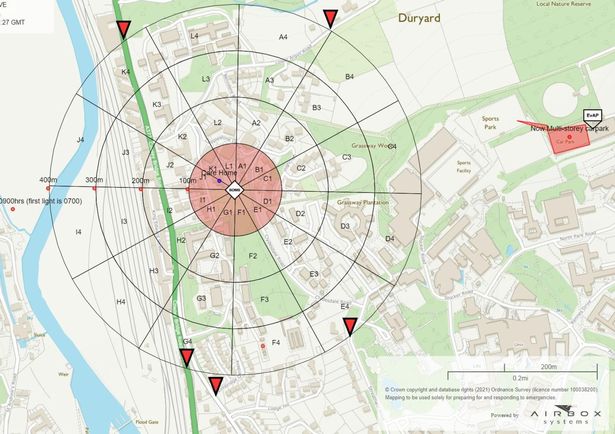
Police declared a major incident and put up an initial 100m (330ft) cordon, extended to 400m (1,310ft).

Bomb disposal experts used 400 tonnes of sand to create an enclosing “box” before it was made safe at 18:12 GMT.

About 1,400 students were evacuated from 12 halls of residence after the explosive was found by builders on private land next to the Streatham campus at about 09:20 GMT on Friday.

The bomb evacuation zone in Exeter Pictured above

Police said bomb disposal crews “worked through the night to establish a walled mitigation structure” and they had been expecting “a big bang” to be heard “quite a distance across Exeter” during the operation to make it safe.

Any residents who have been directly affected who are in need of support should phone the helpline on 01392 265000. The line is open form 9am to 5pm.