
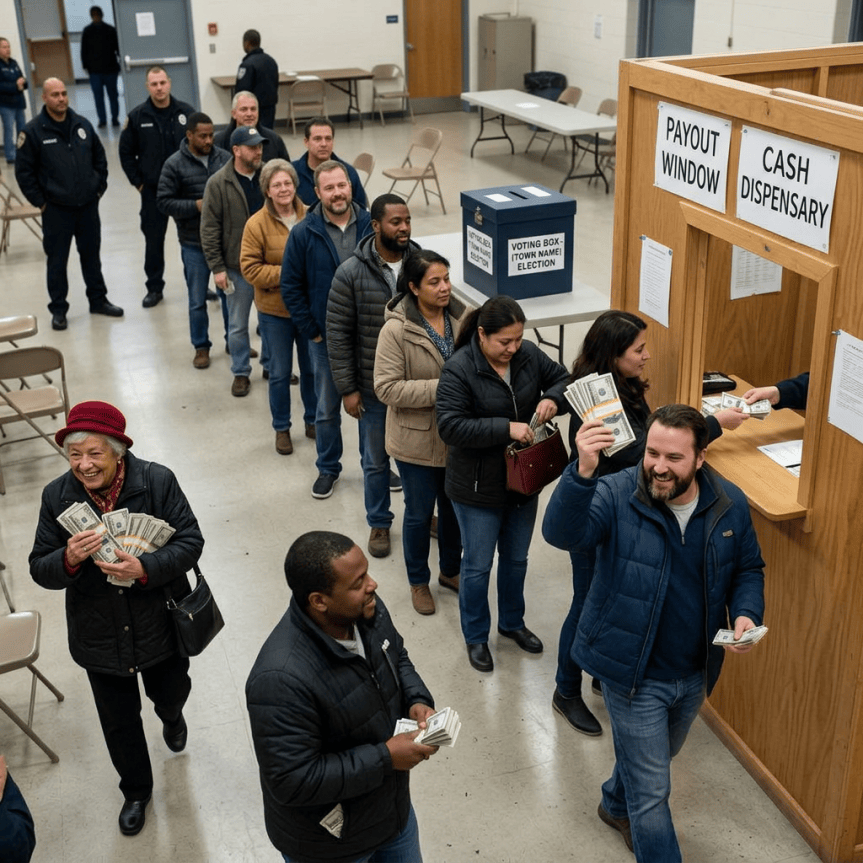
Part of me can’t even believe I am posing this question of whether politicans can buy our votes – is democracy that cheap and easy?
Direct vote buying—exchanging physical cash, goods, or direct personal favors for a vote—is strictly illegal in almost all democratic countries. However, politicians frequently navigate a fine legal line by offering sweeping policy promises, tax cuts, or financial incentives targeted at broad groups of voters. While a politician cannot legally hand you a hundred-dollar bill at a polling station, they can legally promise to pass legislation that puts money in your pocket if they win.
he concept of “buying votes” lives in a complex space between outright criminal bribery and standard campaign strategy.
⚖️ The Legal Line: Direct vs. Indirect
To understand how politicians legally “buy” influence, it helps to look at the difference between criminal bribery and policy-based incentives.
| Type of Incentive | What It Looks Like | Is It Legal? |
|---|---|---|
| Direct Cash Bribery | Handing an individual cash, groceries, or alcohol in exchange for a ballot. | No. Under laws like U.S. Federal Code (18 U.S.C. § 597), it is a federal crime to make an expenditure to any person to vote or withhold their vote. |
| Targeted Policy Promises | Promising student loan forgiveness, specific tax credits, or localized infrastructure funding. | Yes. Courts generally view policy proposals as protected political speech, even if they explicitly offer financial gains to specific groups of voters. |
| Mass Payout Vows | Promising a broad national stimulus or a “dividend” payout contingent on an election outcome. | Grey Area. While heavily criticized as political bribes, they are rarely prosecuted because they require congressional approval and are framed as economic policies. |
🔍 Current Controversies and Historical Context
The debate over where campaign promises end and voter bribery begins is a massive topic right now:
- The “Trump Dividend” (September 2026): At a Republican Midterm Convention in Dallas, President Donald Trump promised a $5,000 cash payment to every American adult if Republicans retain control of Congress. While critics and consumer advocacy groups blasted it as an open attempt to bribe voters, legal experts note it mimics historical tax-cut promises and would require a trillion-dollar congressional authorization to ever happen, keeping it outside traditional criminal prosecution.
Past Precedents: In 2021, former President Joe Biden faced similar criticism from opponents when he tied the passage of $2,000 Covid stimulus checks directly to the outcome of the Georgia Senate runoff elections.
Historical Roots: In early American history, vote-buying was much more explicit. During his 1758 run for the Virginia colonial legislature, George Washington famously supplied voters with 144 gallons of wine, beer, and cider to secure a landslide victory.
🌍 Global Perspectives
In many developing democracies, direct vote-buying remains heavily entrenched despite being illegal:
- Indonesia: Known locally as politik uang (“money politics”), candidates often use a tactic called serangan fajar (“dawn attack”)—handing out small envelopes of cash a day or two before the election.
- India: Political parties frequently distribute cash or gifts to fence-sitters. Interestingly, political scientists find that while it levels the playing field for candidates, it rarely guarantees a win because voters often take the cash but still vote for whoever they want in the privacy of the voting booth.
Should the trump dividened be illegal?
Whether the “Trump Dividend” should be illegal is a matter of intense legal and ethical debate, dividing legal scholars, politicians, and voters alike.
Under current law, the proposal is almost certainly legal under the First Amendment, as the U.S. Supreme Court heavily protects campaign promises as political speech. However, critics argue that conditional cash payouts erode democratic norms and resemble large-scale political bribery.
The arguments on both sides of the issue outline the core conflict between free speech and ethical campaigning:
Arguments That It Should Be Illegal (The Anti-Dividend View)
Critics, including many Democrats and nonpartisan watchdogs, argue that the proposal violates the spirit, if not the letter, of anti-bribery laws.
- It Looks Like Explicit Vote-Buying: Legal experts like former federal prosecutor Michael McAuliffe note that conditioning a massive personal financial reward directly on an election outcome crosses an ethical line. Opponents argue it incentivises people to vote out of direct self-interest rather than civic principle.
- Misuse of Taxpayer Funds: California Governor Gavin Newsom criticized the idea as an attempt to “buy your vote with $5,000 in taxpayer-funded blood money”. Critics argue that public funds should serve the public good, not a specific party’s electoral strategy.
- Fiscal and Economic Danger: Watchdog groups like the Committee for a Responsible Federal Budget warn the plan would cost roughly $1.2 trillion, severely worsening national debt and fueling inflation. Opponents believe dangling a financially damaging policy to win an election should be restricted.
Arguments That It Should Remain Legal (The Pro-Dividend View)
Supporters and constitutional experts maintain that penalizing this type of speech would severely infringe on American democratic principles. [1, 2]
- Protected Political Speech: The definitive legal precedent is the 1982 Supreme Court case Brown v. Hartlage. The Court ruled that candidates have a First Amendment right to tell voters how they intend to financially benefit them. Restricting these promises could criminalize ordinary policy proposals, like tax cuts or student loan forgiveness.
- It Is Not a Direct Bribe: Legal scholars point out that the dividend does not check how an individual voted—every adult citizen would receive it regardless of their party affiliation or whether they voted for a Republican, Democrat, or didn’t vote at all.
- A Standard Economic Strategy: Vice President JD Vance and other administration officials argue the dividend is a legitimate way to distribute national wealth created by the administration’s tariffs and economic investments back to shareholders—the American people. [1, 2]
The Ultimate Reality: The Congressional Check
Even if the promise is legal to make on the campaign trail, President Trump cannot unilaterally hand out the money. The U.S. Constitution gives Congress the sole power of the purse. House Speaker Mike Johnson confirmed that the plan would require congressional approval. Whether it should be illegal to promise such a pay-out remains a philosophical question, but the legislative process serves as the ultimate barrier to it actually happening.
The gift that keeps on giving
There are also strong arguments for universal income so is a universal basic income the same thing as votes being bought and could this be the start of something more profound and bigger leading to the adoption and provision of a universal income?
A Universal Basic Income (UBI) is fundamentally different from a policy like the Trump Dividend in its frequency, purpose, and structure, even though both involve the government sending direct cash payments to citizens.
Political scientists and economists view a Trump Dividend as a one-off, conditional political payoff, whereas UBI is a permanent, unconditional economic safety net.
The core differences illustrate how they diverge in practice:
📊 Direct Comparison: Trump Dividend vs. Universal Basic Income
| Feature | The Trump Dividend | Universal Basic Income (UBI) |
|---|---|---|
| Frequency | One-time pay-out. A single cash injection (e.g., $5,000). | Regular and ongoing. Distributed at fixed intervals, usually monthly, forever. |
| Primary Goal | Economic reward or political incentive. Framed as sharing national growth or wealth from tariffs. | Eradicating poverty. Designed to cover basic survival needs (food, shelter) as a baseline floor. |
| Political Condition | Highly conditional. Explicitly tied to a specific political party winning a legislative majority. | Completely non-partisan. Established by permanent law; does not change based on who wins an election. |
| Target Population | Means-tested. Explicitly excludes high-income earners. | Truly universal. Paid to every single citizen regardless of their wealth or employment status. |
| Funding Source | Variable federal revenue. Allegedly funded by temporary mechanisms like tariffs or agency savings. | Systemic tax restructuring. Funded via permanent income, carbon, or value-added taxes (VAT). |
💡 Why the Distinction Matters
Prominent advocates of cash transfers, like former presidential candidate Andrew Yang, have noted that temporary checks do not provide the long-term psychological and economic security of a UBI.
When a payout is a one-time event, citizens tend to treat it as a windfall bonus (like a tax refund or a stimulus check). Because a UBI is guaranteed every single month, it allows people to make long-term life choices, such as going back to school, leaving an abusive relationship, or starting a business or having a roof over their head, food and clothing.
The Waterboys – This Land Is Your Land

 Welcome to Huwspace