
By Huw Edwards
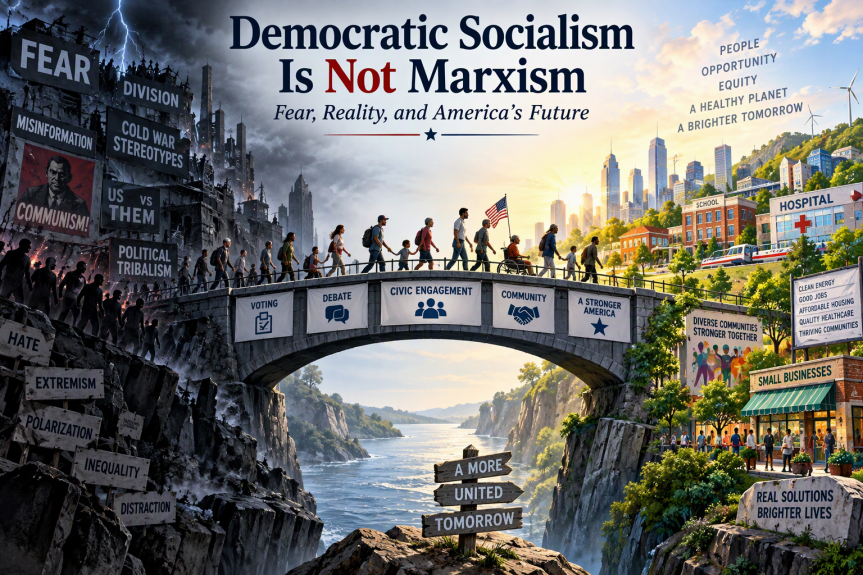
The words we fear are often the words we least understand. Few political labels in America generate more misunderstanding, suspicion, and anxiety than “democratic socialism”. Yet before dismissing it as Marxism, anti-American, anti-Christian, or even a sign of the end times, it is worth asking a simple question: what actually is democratic socialism?
America’s Political Ghost Story
For generations, many Americans have been taught to view socialism as a threat to freedom, faith, and prosperity. The term became synonymous with Soviet authoritarianism, Cold War rivalries, and communist dictatorships. Yet history has a habit of simplifying complex ideas into convenient political slogans.
The result is that millions of Americans hear the word socialism and imagine the former Soviet Union, while many modern democratic socialists are talking about something entirely different: affordable healthcare, stronger worker protections, fair taxation, and opportunities for ordinary citizens to thrive.
The first challenge, therefore, is separating democratic socialism from Marxism.
Democratic Socialism and Marxism Are Not the Same Thing
One of the most persistent myths in American politics is that democratic socialism is simply Marxism with a different label.
It is not.
While both ideologies share concerns about inequality and economic power, their methods, goals, and political structures are fundamentally different. The source document highlights several key distinctions. Democratic socialism embraces multi-party democracy, constitutional rights, free elections, free speech, and gradual reform through democratic processes. Marxism traditionally advocates revolutionary transformation and has historically been associated with one-party systems and state ownership of the economy.
In practical terms, democratic socialists want to change society through ballots.
Marxists traditionally wanted to change society through revolution.
That difference matters.
A philosophy that seeks reform through democratic institutions is fundamentally different from one that seeks to replace those institutions altogether.
What Modern American Democratic Socialists Actually Support
Much of the public debate would look very different if Americans focused on the policies rather than the labels.
Modern democratic socialists in the United States typically advocate for:
- Universal healthcare.
- Affordable or tuition-free higher education.
- Stronger labour rights and trade unions.
- Paid family leave.
- Higher minimum wages.
- Investment in clean energy and environmental protection.
Americans may support or oppose these ideas for a variety of legitimate reasons, but none of these proposals involve abolishing democracy, confiscating all private property, or outlawing private business.
They are policy debates taking place within America’s constitutional framework.
That is not Marxism.
That is democracy.
The Cold War Legacy Still Shapes American Thinking
The fear of socialism did not emerge naturally.
It was shaped by real historical events.
The Bolshevik Revolution of 1917, the rise of the Soviet Union, and decades of geopolitical tension encouraged successive generations to treat socialism and communism as interchangeable concepts. During the McCarthy era, socialism came to be viewed not merely as a political ideology but as something inherently anti-American, anti-religious, and even treasonous.
Many Americans inherited these assumptions without ever examining whether they still accurately describe modern democratic socialist movements.
The world has changed, but some political fears remain frozen in time.
Christianity and Democratic Socialism
Perhaps no accusation is more emotionally powerful in parts of America than the claim that socialism is “the work of the devil”.
Such language generates fear, but it rarely generates understanding.
Supporters of democratic socialism often argue that their goals are deeply aligned with moral and religious principles. The source document notes that many Christian traditions emphasise caring for the poor, healing the sick, protecting workers, and supporting the vulnerable.
Reasonable Christians can disagree about the role government should play in achieving those goals.
However, it is difficult to argue that feeding hungry children, treating sick people, reducing poverty, or improving access to education are inherently evil objectives.
The debate should be about methods, costs, effectiveness, and outcomes, not about whether compassion itself is somehow a threat.
Indeed, many of the social programmes Americans already support today, including Social Security and Medicare, were once condemned by critics as dangerous forms of socialism.
History offers a useful reminder that today’s radical idea often becomes tomorrow’s accepted institution.
America Already Uses “Socialist” Ideas
An uncomfortable truth for both supporters and critics is that America has never been a purely free-market society.
The United States already embraces collective solutions in many areas of public life:
- Public schools.
- Libraries.
- Fire departments.
- Police services.
- Public infrastructure.
- Social Security.
- Medicare.
Most Americans view these services as ordinary parts of modern society rather than dangerous steps toward dictatorship.
Democratic socialists simply argue that similar principles could be applied more broadly to healthcare, education, housing, or environmental protection.
Whether Americans agree with that proposal is another question entirely.
But it is a debate about policy design, not the apocalypse.
Could This Be the Beginning of a Better America?
The United States faces significant challenges.
Economic inequality continues to grow. Millions struggle with healthcare costs. Housing has become increasingly unaffordable in many communities. Trust in political institutions has declined, while social division has intensified.
Supporters of democratic socialism argue that stronger public services and social protections could help address these challenges while preserving democracy and maintaining a market economy. They point to countries such as Denmark, Norway, and Finland, where robust social safety nets coexist with prosperity, innovation, and economic freedom.
These countries are not communist.
They are democratic.
They are capitalist.
Yet they also believe that government has a responsibility to ensure a baseline level of dignity, opportunity, and security for all citizens.
Fear or Possibility?
Every generation faces a choice.
It can view political change through the lens of fear, assuming that every new idea represents the collapse of the old order.
Or it can examine those ideas honestly, testing them against evidence, experience, and democratic debate.
Democratic socialism may not be the answer to every challenge facing America.
Its supporters may overestimate its benefits.
Its critics may underestimate them.
But there is little evidence that modern American democratic socialism resembles the Marxist revolutionary movements that many opponents imagine.
Nor is there evidence that expanding healthcare, improving education, supporting workers, or reducing poverty will somehow usher in the end of civilisation.
Perhaps the more important question is this:
What if the real danger is not that America tries to build a fairer society, but that it becomes too afraid to try?
Reflection
America has always been at its best when it has balanced liberty with responsibility and individual freedom with collective purpose. The debate over democratic socialism should not be reduced to Cold War slogans or religious fear. Instead, it should centre on a timeless question:
How do we build a nation where prosperity, justice, and opportunity are available to all rather than reserved for the fortunate few?
Whatever answer Americans ultimately choose, it should emerge from informed discussion, democratic participation, and a shared commitment to the common good, not from fear of labels.
Donald Trump built much of his political appeal by identifying grievances, frustrations and divisions that many Americans felt had been ignored. The challenge is that highlighting problems is easier than solving them. Social democratic principles, at their best, attempt to move beyond anger and towards practical solutions: healthcare that prevents illness becoming bankruptcy, education that expands opportunity, infrastructure that creates jobs, and democratic institutions that bring people together rather than drive them apart.
Fear can win elections. Solutions build societies. The real test of any political movement is not how effectively it identifies enemies, but how successfully it improves people’s lives. If politics becomes a permanent search for someone to blame, division deepens. If politics becomes a collective effort to solve shared problems, communities become stronger, more resilient and more hopeful.
History suggests that societies thrive not when they are united by fear of one another, but when they are united by a shared belief that tomorrow can be better than today.


