For a generation of supporters, Donald Trump is a political revolutionary. They see a strong leader who rejects convention, challenges elites, and is willing to fight for America when others will not.
History, however, may reach a far harsher conclusion.
Future historians may not remember Donald Trump as America’s saviour. They may remember him as one of the most destructive political figures ever entrusted with the power of the American presidency.
Not because of a single scandal. Not because of a single policy failure. Not because opponents disliked him.
But because so much of his political project appears to have been driven by personal grievance, ego, attention, and confrontation rather than by any coherent vision for the future.
When historians assess leaders, they ask a simple question: did this person leave their country and the world in a better condition than they found it?
That question should terrify Trump supporters.
The Cult of Personality
America’s founders deliberately created institutions stronger than any individual.
Trump’s politics reversed that principle.
Loyalty increasingly became centred not upon democratic institutions, constitutional traditions, or conservative principles, but upon one man himself. Disagreement was treated as betrayal. Criticism became evidence of conspiracy. Facts increasingly mattered less than personal allegiance.
This is the language of personality cults, not healthy democracies.
A nation that begins to place faith in individuals above institutions is travelling a dangerous road. History offers countless examples of where that road eventually leads.
An Economy Built on Political Theatre
Trump regularly presents himself as a master businessman with a brilliant long-term vision.
Yet genuine economic strategy requires stability, predictability, investment, and planning.
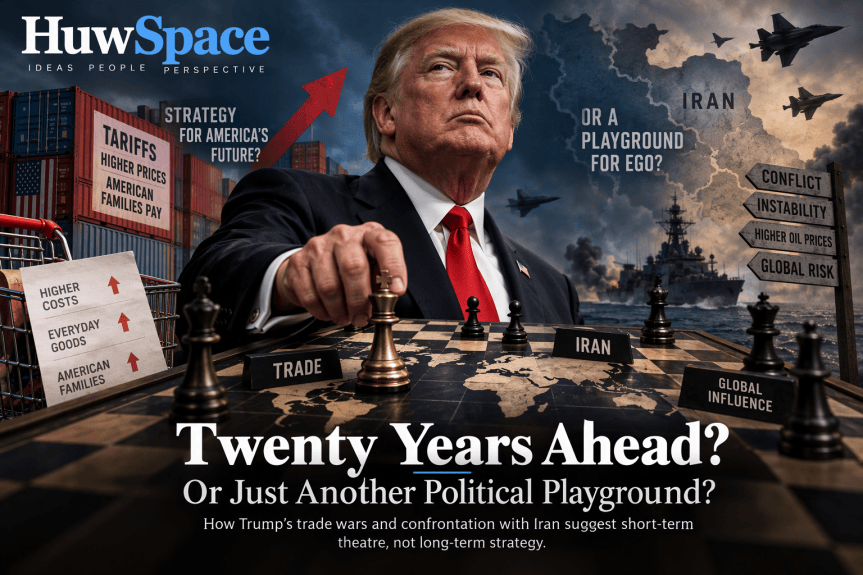
Trade wars and tariffs may generate applause at political rallies, but economists have repeatedly found that much of the cost falls on American consumers and businesses themselves. Research from the Peterson Institute for International Economics, the Congressional Budget Office, and others found tariffs contribute to higher costs, inflationary pressure, and economic disruption. [piie.com], [cbo.gov], [taxfoundation.org]
The problem is not simply that tariffs can be costly.
The problem is that they are often sold as victories even when the financial burden falls on the very people promised protection.
A great leader tells people difficult truths.
A demagogue tells people convenient lies.
America’s Reputation Diminished
For decades, American influence rested on more than military power.
It rested on trust.
Allies trusted American commitments. Investors trusted American stability. Democracies trusted American leadership.
Trump repeatedly treated allies as adversaries and international cooperation as weakness.
Supporters celebrated this disruption. They called it strength.
But strength without trust becomes isolation.
The world’s most powerful nation cannot lead purely through threats, insults, and displays of force. Sooner or later, other nations start looking for alternatives.
That process may take years.
Its consequences may take decades.
The Iran Question
Perhaps nowhere is the danger of ego-driven politics clearer than in the handling of international conflict.
Military escalation with Iran carries risks far beyond headlines and political speeches. Experts and analysts have repeatedly warned about consequences for regional stability, energy markets, global trade routes, and international security. [congress.gov], [congress.gov], [csis.org]
The real measure of leadership is not how eager a leader is to project strength.
It is whether that leader can avoid unnecessary crises in the first place.
History remembers leaders who prevented wars at least as much as those who fought them.
The tragedy is that Trump’s political style often seems incapable of distinguishing between strategic strength and theatrical aggression.
Climate Change and the Failure of Responsibility
There is perhaps no greater example of short-term thinking than the refusal to engage seriously with climate change.
Future generations will not care who won today’s argument on social media. They will not care who dominated the news cycle. They will not care how many political opponents were insulted.
They will care about whether leaders acted when confronted with mounting environmental risks.
A president thinking twenty years ahead invests in the future.
A president thinking only about the next election invests in the next headline.
The distinction matters.
The consequences will last centuries.
The Politics of Anger
Trump did not create division in America.
But he profited from it.
He understood that outrage is addictive. Fear is powerful. Anger motivates voters.
Again and again, political disagreements became battles. Opponents became enemies. Journalists became villains. Institutions became targets.
The result was a political culture increasingly built on resentment.
A healthy democracy requires trust, compromise, and a shared commitment to reality.
Trump’s political model often appeared to reward the exact opposite.
The Real Legacy
The greatest damage of the Trump era may not be economic.
It may not be diplomatic.
It may not even be geopolitical.
The greatest damage may be cultural.
Millions of people were encouraged to believe that expertise is inherently suspect, that institutions are fundamentally corrupt, that compromise is weakness, and that leadership is measured by dominance rather than wisdom.
Those ideas do not disappear when a presidency ends.
They remain.
They shape societies.
They influence generations.
Conclusion
Was Donald Trump the worst president in American history?
History alone can answer that question.
But there is a powerful case that he represents one of the most dangerous forms of modern political leadership: a leader who transformed politics into spectacle, elevated personal loyalty above democratic norms, encouraged division for political gain, treated international affairs as opportunities for performance, and left America more polarised than when he found it.
Supporters see courage.
Critics see recklessness.
Supporters see strength.
Critics see ego.
Supporters see a man fighting for America.
Critics see a man who spent years fighting almost everyone else, including many of the values that once made America respected throughout the world.
The most damning verdict may ultimately be this:
Donald Trump promised to make America great again.
Yet future historians may conclude that he made America smaller, angrier, less trusted, more divided, and less prepared for the challenges that define the twenty-first century.
References
- Who Pays for Tariffs? Insights from Recent Research, Peterson Institute for International Economics. [piie.com]
- How the United States is Eating Trump’s Tariffs, Reuters. [reuters.com]
- Budgetary and Economic Effects of Increases in Tariffs Implemented Between January and May 2025, Congressional Budget Office. [cbo.gov]
- Trump Tariffs Tracker: Rates, Revenue and Impact, Tax Foundation. [taxfoundation.org]
- The Arab Gulf States, the Iran Conflict, and U.S. Relations: In Brief, Congressional Research Service. [congress.gov]
- U.S. Conflict with Iran, Congressional Research Service. [congress.gov]
- Latest Analysis: War with Iran, CSIS. [csis.org]


