Why Britain’s Cocaine Habit Depends on Someone Else’s Fear & Suffering
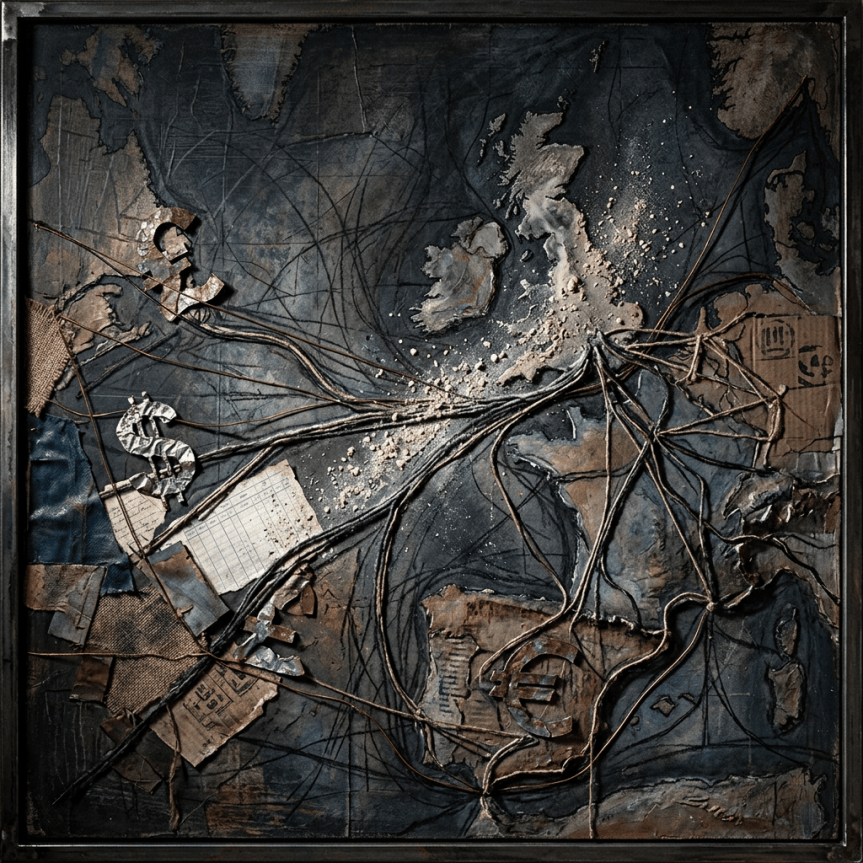
If you knew your sneaky little habbit cost lives and was not a victimless crime would it make you stop to think? In Mexico alone, drug-related and criminal cartel violence has consistently driven over 30,000 to 35,000+ homicides per year in recent years, according to the Council on Foreign Relations Global Conflict Tracker.
The Great Luxury of Distance
One of the greatest privileges of living in the United Kingdom is that most of us rarely have to think about lawlessness.
We worry about crime, complain about policing, and debate government policy. Yet for the vast majority of people, the state remains firmly in control. We expect courts to function, police to respond, and elected officials to govern. These assumptions feel so normal that we rarely stop to appreciate them.
In other parts of the world, they are luxuries.
Across regions of Latin America, entire communities live under the shadow of criminal organisations whose power rivals or exceeds that of the state. Armed groups control territory, dictate local rules, and determine who prospers, who suffers, and sometimes who lives. Communities are displaced, leaders are intimidated, and ordinary families find themselves trapped within systems they never chose.
The uncomfortable truth is that many Britons help fund these systems without ever thinking about them.
A Crime Hidden by Geography
The modern world is remarkably effective at separating cause from consequence.
Most people buying cocaine in Britain will never visit a coca-growing region. They will never meet a displaced farming family. They will never see a river polluted by chemical waste from processing laboratories. They will never hear the stories of communities caught between rival criminal groups.
Instead, the drug arrives neatly packaged at a house party, a festival, or a weekend gathering.
The suffering remains thousands of miles away.
This distance creates a powerful illusion. It allows consumers to view cocaine as a personal choice rather than a transaction connected to a much larger system.
When consequences become invisible, responsibility often becomes invisible too.
Living With Fear as Routine
For many people in Britain, fear is an occasional visitor.
For millions living in cartel-influenced regions, fear can become part of the daily landscape.
It influences decisions that most of us never consider:
- Is it safe to travel today?
- Can I report a crime?
- Will local authorities help me?
- Can community leaders speak openly?
- Will my children be drawn into criminal networks?
The violence associated with drug trafficking is not confined to dramatic headlines. It manifests through intimidation, extortion, corruption, and the constant threat of retaliation against those who challenge criminal interests. Human rights advocates, environmental campaigners, journalists, and local politicians can become targets simply for opposing organised crime.
These are not extraordinary events.
In many communities, they are ordinary realities.
The Myth of the Victimless Drug
Perhaps the most persistent myth surrounding cocaine is that it harms only the user.
This belief survives because the victims remain unseen.
The violence occurs elsewhere.
The environmental damage occurs elsewhere.
The corruption occurs elsewhere.
The intimidation occurs elsewhere.
Yet all of these consequences remain linked by the same economic chain.
The money generated by demand in wealthier countries creates incentives for territorial wars, criminal expansion, and the corruption of local institutions. The profits involved are so immense that they can distort entire regions, weakening law enforcement, undermining democratic institutions, and replacing the rule of law with the rule of fear.
The user may never pull a trigger.
But their money still enters the system.
The Comfort of Not Knowing
Most users are not monsters.
Many are ordinary people who would be horrified by the realities experienced by those living within cartel-controlled territories.
That is precisely why ignorance matters.
If people genuinely witnessed the consequences of the trade, many would struggle to reconcile those realities with the casual language often used around cocaine consumption.
The phrase “cheeky weekend treat” sounds very different when viewed alongside forced displacement, child exploitation, environmental destruction, and political intimidation. The gap between the language and the reality becomes impossible to ignore.
Yet that gap persists because one side of the story remains largely invisible.
Looking Beyond Our Shore
Britain is fortunate.
We are not immune from crime, corruption, or organised criminal activity, but most of us still live within a society where democratic institutions, legal protections, and public accountability remain strong.
That security creates an opportunity.
It allows us to ask difficult questions about how our choices affect people beyond our borders.
The discussion about drugs is often framed around personal freedom, health risks, or criminal justice. All of those issues matter.
But there is another question that receives far less attention:
What responsibility do we have towards people whose lives are shaped by the violence that helps sustain our consumption?
The answer may be uncomfortable.
Yet meaningful compassion begins when we recognise that suffering does not become less important simply because it happens somewhere else.
Final Reflection
Perhaps the greatest privilege enjoyed by many people in Britain is not freedom from violence itself.
It is the ability to ignore where that violence comes from.
For those living under the influence of powerful criminal organisations, lawlessness is not a documentary, a headline, or a political talking point.
It is life.
And the more we understand that reality, the harder it becomes to pretend that what happens thousands of miles away has nothing to do with us.


You must be logged in to post a comment.