
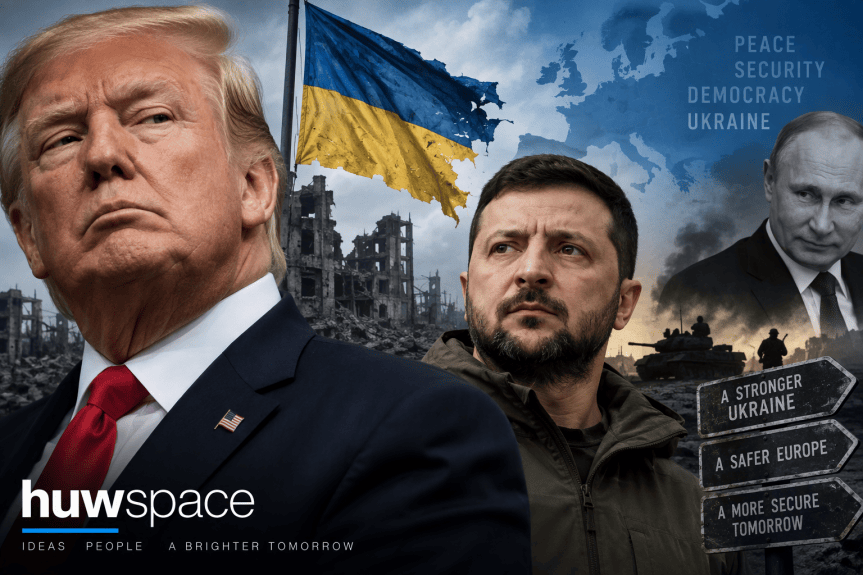
For years, Donald Trump has cultivated the image of strength. His political brand is built on toughness, deal-making, and projecting power. Yet when measured against the greatest security crisis in Europe since the Second World War, that image increasingly collides with reality.
Ukraine’s struggle is not a border dispute, a commercial disagreement, or a property negotiation. It is a war of national survival. Millions of Ukrainians have been forced from their homes, hundreds of thousands have been caught up in the consequences of a brutal conflict, and an independent democratic nation has fought to preserve its sovereignty against an invading authoritarian state.
Faced with this challenge, Trump has repeatedly presented himself as the man who could end the war through personal diplomacy and deal-making. The problem is that successful diplomacy requires leverage, credibility and a realistic understanding of the interests of both sides. Increasingly, Trump’s approach appears to have delivered none of these.
The Wrong Reading of the Conflict
One of the most significant weaknesses in Trump’s approach has been his apparent tendency to view the war through a transactional lens.
Business negotiations can often be settled through compromise because both parties ultimately seek economic gain. Wars driven by nationalism, historical grievance and imperial ambition are different. Russia’s objectives in Ukraine have never appeared limited to a simple commercial bargain. The Kremlin has repeatedly questioned Ukraine’s legitimacy as an independent state and sought to impose its will through military force.
By treating the conflict as though it were primarily a deal waiting to be struck, Trump has consistently underestimated the ideological and strategic factors driving Russian policy. The result is a peace strategy that seems detached from the realities on the battlefield and the political realities in Moscow.
Pressure Applied in the Wrong Direction
Perhaps the most striking feature of Trump’s Ukraine policy has been the imbalance in his public pressure.
Again and again, criticism has been directed towards Kyiv and President Volodymyr Zelenskyy while Russia has often faced far less rhetorical pressure. Instead of clearly identifying the aggressor and demanding meaningful concessions from Moscow, Trump’s statements have frequently suggested that Ukraine should surrender territory or accept outcomes largely favourable to Russia.
This is not the behaviour of a strong negotiator.
Successful negotiators create pressure on the side that needs persuading. Yet much of Trump’s approach has appeared to focus on persuading Ukraine to accept losses rather than persuading Russia to abandon its objectives.
The inevitable consequence is that Moscow has little incentive to compromise. Why make concessions if the person claiming to broker peace appears more willing to pressure your opponent than yourself?
The Problem With Peace on Russian Terms
Peace is not automatically a virtue if it rewards aggression.
History demonstrates that unstable settlements often emerge when the aggressor keeps the benefits of conquest without paying a meaningful price. Such arrangements may temporarily pause a conflict but can create the conditions for future wars.
Any settlement that permanently legitimises territory seized by force sends a dangerous message far beyond Ukraine. It tells authoritarian leaders that military aggression can succeed if they are prepared to absorb enough costs and wait for democratic societies to lose patience.
A peace imposed largely on Russian terms would not merely affect Ukraine. It would reshape security calculations across Europe and beyond.
The Erosion of American Leverage
Trump once claimed that his personal relationship with world leaders gave him unusual negotiating power. Yet leverage depends on credible threats and credible commitments.
If military support becomes uncertain, sanctions become negotiable, and Ukraine is repeatedly pressed to compromise first, then American influence inevitably declines.
Negotiations succeed when all parties believe there are consequences for refusing reasonable proposals. Instead, Trump’s approach has often created the impression that Washington is increasingly eager for an agreement regardless of the terms.
That perception weakens America’s negotiating position rather than strengthening it.
Europe Has Learned a Hard Lesson
The war has also exposed a deeper problem for Europe.
For decades, many European nations relied heavily on the assumption that American leadership would remain consistent during moments of crisis. Trump’s approach has forced many governments to confront a more uncomfortable reality: Europe must increasingly take responsibility for its own security.
Ironically, the President who promised to restore American strength may ultimately be remembered as the leader who encouraged allies to place less confidence in American reliability.
The Strong Man With No Cards Left
Trump’s greatest political asset has always been the perception that he is the dominant figure in any negotiation. The man who wrote books about winning deals promised he alone could solve problems others could not.
But power is not measured by slogans.
Power is measured by results.
Years into the Ukraine conflict, Russia continues its aggression. Ukraine continues its resistance. No lasting settlement has emerged. The promised breakthrough has failed to materialise.
The uncomfortable reality for Trump is that each unsuccessful prediction, each failed diplomatic initiative and each concession-free engagement with Moscow has steadily reduced his leverage.
The self-described master dealmaker now faces a situation in which the cards he once claimed to hold are disappearing one by one.
Conclusion
The tragedy of Trump’s Ukraine policy is not simply that it has failed to end the war. It is that it has too often misunderstood the nature of the conflict itself.
Ukraine is not fighting for a better commercial agreement. It is fighting for the right to exist as a sovereign nation.
A strategy built on pressuring the victim while seeking accommodation with the aggressor was always likely to struggle. Rather than demonstrating strength, it has increasingly projected uncertainty, inconsistency and diminishing influence.
For all the rhetoric about toughness, the defining image may not be that of a strong man forcing peace. It may be of a leader who repeatedly sought a deal with Vladimir Putin but never found a way to make Putin genuinely compromise.
And in that failure lies the real measure of weakness.


