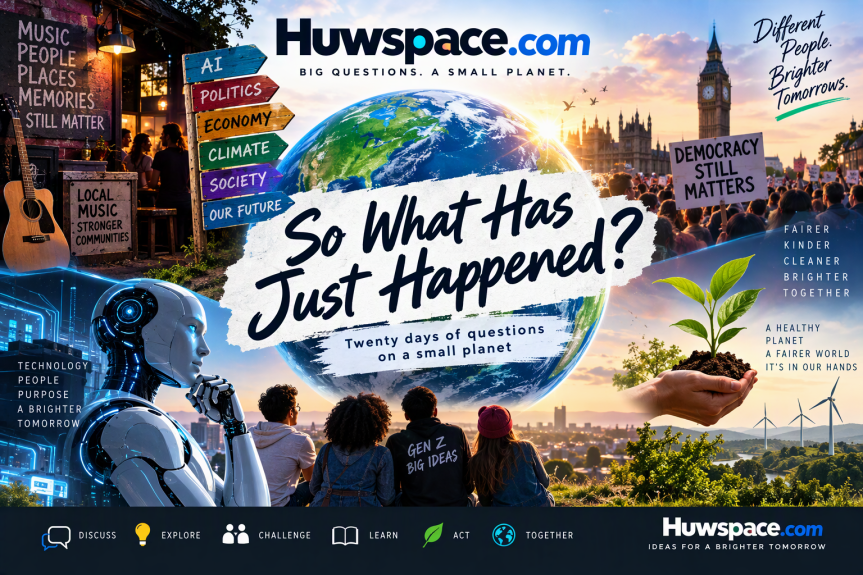
Twenty Days of Questions on a Small Planet
From local music memories to artificial intelligence, from political upheaval to climate anxiety, from economic uncertainty to hope for a better future. The last few weeks at Huwspace have been a journey across the issues shaping our communities, our countries and our world.
There are moments when history appears to move slowly.
Then there are moments when everything seems to happen at once.
The last twenty days on Huwspace have felt very much like the latter.
We have moved from remembering Exeter’s cultural heritage in articles such as Remembering Exeter’s North Bridge Inn and Its Live Music Legacy to examining major political, economic and technological forces reshaping the modern world. [huwspace.com]
At first glance these topics seem unrelated.
They are anything but.
Every article has ultimately been asking the same question:
How do we build a fairer, wiser and more sustainable future on a rapidly changing planet?
Looking Back to Move Forward
One of the most personal recent pieces, Remembering Exeter’s North Bridge Inn and Its Live Music Legacy, reflected on the importance of local music venues, artistic communities and the friendships that form around shared experiences. [huwspace.com]
In an age increasingly defined by digital life, there is something powerful about remembering places where people gathered not through algorithms but through genuine human connection.
The future matters.
But so does remembering what made communities strong in the first place.
The Economy Through Everyday Eyes
Economic questions have featured heavily throughout recent Huwspace discussions.
In Budget 2026: What It Means for Me, My Family and the Rest of the UK, the focus was not on abstract Treasury spreadsheets but on what government decisions actually mean for families, pensioners, savers and household bills. [huwspace.com]
Similarly, From Branches to Bots: Is Lloyds Bank Systematically Destroying its Customer Services? explored whether technological efficiency and corporate profitability are beginning to come at the expense of human relationships and personalised service. [huwspace.com]
Together these articles examined a growing concern felt by many ordinary people: are modern economies serving communities, or are communities increasingly expected to serve economies?
Democracy Under Pressure
Politics has remained a recurring theme throughout the last few weeks.
The Voters Have Spoken Across the UK asked whether political leaders are truly listening to public concerns amid growing frustration with traditional parties and institutions. [huwspace.com]
Across the Atlantic, both How Trump’s Rhetoric Wins Elections and Risks Losing Him Power and Democratic Socialism Is Not Marxism: Why America Should Not Fear It explored why political debate has become increasingly emotional, polarised and driven by competing visions of society. [huwspace.com], [huwspace.com]
Whether discussing Britain or America, the underlying issue remains the same:
How can democracy respond effectively when societies themselves are becoming more fragmented, more connected and more complex at the same time?
Artificial Intelligence and Human Responsibility
Artificial intelligence has emerged as one of the defining topics of our age.
In Trump’s AI Dismissal: Understanding the Risks and Realities, Huwspace explored competing perspectives on the risks and opportunities created by rapidly advancing AI technologies. [huwspace.com]
Will artificial intelligence transform healthcare, education and scientific research for the better?
Almost certainly.
Will it also create challenges concerning power, employment, misinformation and inequality?
Almost certainly.
Technology itself does not determine our future.
How we choose to use technology does.
Living Within Planetary Limits
Environmental issues have appeared again and again across recent articles, not because they are fashionable topics, but because they sit behind almost every other challenge humanity faces.
In We Exploit the Planet Without Realising It – So What Can We Build Instead?, Huwspace examined alternative economic approaches to sustainability and questioned whether endless extraction can ever be compatible with long-term human wellbeing. [bing.com]
Likewise, The UK Royal Family Care About Many of the Crises Affecting the Planet, But Is This Enough? asked an increasingly important question: is awareness alone enough, or does genuine change require far more than concern and good intentions? [huwspace.com]
The evidence increasingly suggests that awareness is only the beginning.
Why Bad Things Happen
One of the most thought-provoking recent discussions came through Do Bad Things Happen Because of Greed or Poor Choices?. [huwspace.com]
Looking at war, climate change and biodiversity loss, the article explored a difficult truth:
Many of humanity’s greatest challenges are not inevitable.
They emerge from decisions.
Some driven by fear.
Some by short-term thinking.
Some by greed.
But if human choices contribute to our problems, human choices can also contribute to their solutions.
That should give us hope.
So What Has Just Happened?
Over the last twenty days, Huwspace has not simply reported on events.
It has explored the forces beneath them.
We have looked at communities and culture.
At politics and power.
At economics and inequality.
At artificial intelligence and technological change.
At climate risks and environmental limits.
At leadership, responsibility and social justice.
The subjects have varied enormously, but the underlying question has remained remarkably consistent:
What kind of future are we trying to create?
Reasons for Optimism
It is easy to focus exclusively on crisis.
Political division.
Environmental pressures.
Economic uncertainty.
Technological disruption.
Yet another story is unfolding alongside those challenges.
People are asking harder questions.
Citizens are becoming more informed.
Communities are adapting.
Technology continues to create possibilities that previous generations could hardly imagine.
Perhaps most importantly, millions of people continue trying to understand how to build a better future.
History rarely moves in a straight line.
Progress is messy.
Democracy is messy.
Humanity is messy.
But the past twenty days on Huwspace suggest that people have not given up on the future.
And that may be the most encouraging sign of all.
Huwspace.com
Big Questions. A Small Planet.
Exploring the ideas, challenges and possibilities shaping our shared future, one conversation at a time.


