
By Huw Edwards
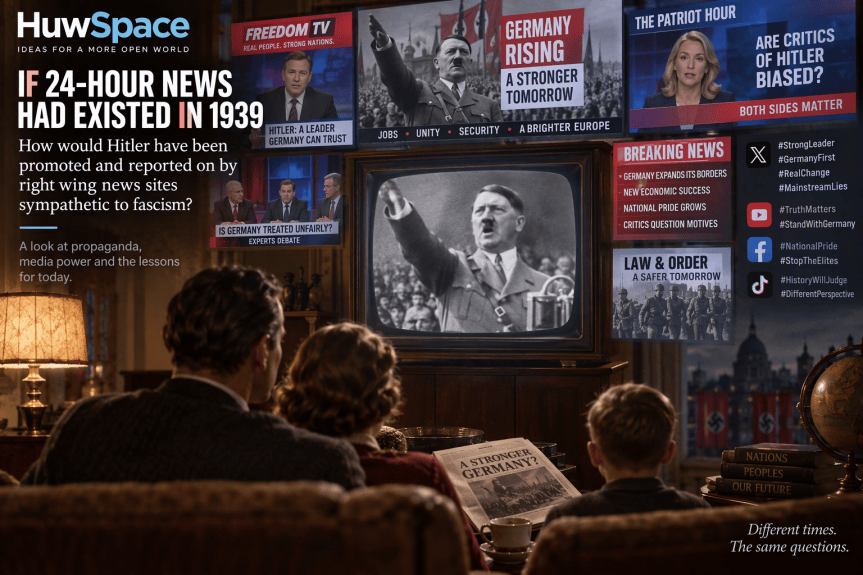
History often feels inevitable when viewed through the lens of hindsight. We know who the villains were, how events unfolded, and the suffering that followed. Yet one of the most unsettling questions we can ask is this: if the modern media environment had existed in 1939, would we have recognised the danger of fascism any sooner, or would sophisticated media ecosystems have helped normalise it?
It is a question worth asking because the technologies have changed, but human nature has not.
The News Cycle That Never Sleeps
In 1939, news travelled through newspapers, radio broadcasts, and cinema reels. Information moved relatively slowly. Governments could control narratives, but they could not dominate every waking moment of public attention.
Today, audiences are immersed in a 24-hour news cycle. Political leaders are analysed, criticised, defended, and promoted continuously. Every action generates headlines. Every policy announcement becomes a panel discussion. Every controversy becomes a culture war.
Had these systems existed in the 1930s, Adolf Hitler would not simply have been a political leader. He would have been content.
His speeches would be streamed live. His rallies would dominate prime-time schedules. His provocations would generate endless debate. Outrage and attention would become part of the same business model.
The uncomfortable truth is that modern media often rewards engagement more than accuracy.
The “Strong Leader” Narrative
History tells us that many supporters of authoritarian movements do not initially support oppression. Instead, they support promises.
Promises of national renewal.
Promises of economic recovery.
Promises of security.
Promises that someone, somewhere, finally has a plan.
A hypothetical fascist-friendly news network in 1939 would likely have framed Hitler not as a dictator in waiting but as a decisive leader overcoming national decline.
Coverage might have focused on:
- Falling unemployment.
- Infrastructure projects.
- Economic recovery.
- National pride.
- Military rebuilding.
Critics would be portrayed as pessimists, elitists, or opponents of national success.
The conversation would not begin with concentration camps or genocide because those horrors had not yet reached their full scale. Instead, audiences would hear discussions about borders, patriotism, economic revival, and law and order.
Authoritarianism rarely introduces itself honestly.
It arrives wrapped in the language of stability.
The Manufacture of Doubt
One of the defining features of many modern media environments is not necessarily persuading audiences of one position.
It is persuading them that objective truth itself is uncertain.
Imagine reports emerging about persecution of Jewish people in Germany.
Some outlets would investigate.
Others might respond differently:
“Are the reports exaggerated?”
“Can we trust the sources?”
“Both sides have arguments.”
“We should wait for more evidence.”
The goal would not necessarily be to deny reality outright. It would be to create enough uncertainty that audiences feel justified in looking away.
History offers many examples where atrocities proceeded because too many people convinced themselves that the warnings were probably overstated.
The Business of Outrage
Modern media rewards attention.
Attention often comes from conflict.
Imagine nightly television debates:
“Was Germany justified in reclaiming lost territory?”
“Has the international community treated Germany unfairly?”
“Are critics of Hitler ignoring economic progress?”
The loudest voices would attract the largest audiences.
Extreme viewpoints would become profitable.
Outrage would become programming.
The more controversial the statement, the more airtime it would receive.
In such an ecosystem, fascist rhetoric would not simply be tolerated. It would become valuable.
Rebranding Authoritarianism
One lesson repeated throughout history is that oppressive movements rarely market themselves as oppressive.
Rather than focusing on anti-democratic goals, sympathetic commentators might describe Hitler as:
- A reformer.
- A nationalist.
- A defender of traditional values.
- A protector of sovereignty.
- A political outsider challenging established elites.
Language matters.
Changing the description changes how audiences interpret the reality.
An assault on democratic institutions can become a debate about efficiency.
An attack on minorities can become a discussion about social cohesion.
State repression can be presented as maintaining public order.
The message remains the same, but the packaging changes.
The Social Media Multiplier
If we extend the thought experiment further and imagine social media existing alongside 24-hour television news, the effects become even more concerning.
Algorithms prioritise engagement.
Fear engages.
Anger engages.
Identity-based conflict engages.
A modern fascist movement would not rely solely on government propaganda. It would benefit from millions of people voluntarily sharing content that reinforces their existing beliefs.
Conspiracy theories would spread instantly.
False stories would travel globally in minutes.
Fact-checks would rarely move as fast as emotionally satisfying narratives.
The result would be a fragmented public sphere where different groups inhabit entirely different realities.
Would The Media Have Stopped Hitler?
Perhaps.
Many journalists would have recognised the threat.
Many broadcasters would have sounded the alarm.
Many editors would have exposed the abuses.
Yet history suggests that warnings alone are not always enough.
The challenge is not simply access to information. It is whether people are willing to accept information that challenges their worldview.
Some audiences would have listened.
Others would have sought outlets confirming what they already wanted to believe.
That dynamic is not unique to Germany in 1939.
It is a recurring feature of human societies.
The Real Lesson
The most important lesson is not about Hitler.
It is about us.
It is comforting to imagine that people in the modern world would immediately recognise authoritarianism. It is comforting to believe that propaganda only works on other people.
History suggests otherwise.
The danger of fascism has never been that it appears obviously evil to everyone at the start. The danger is that it often presents itself as the answer to genuine grievances. Economic hardship, social uncertainty, political dysfunction, and cultural anxiety create fertile ground for leaders who promise simple solutions to complex problems.
The question is not whether a 24-hour news network could have promoted Hitler.
It almost certainly could have.
The more important question is whether modern societies have become any better at recognising the warning signs when charismatic leaders, media organisations, and powerful interests ask us to fear one another rather than understand one another.
History’s greatest warning may be this:
Authoritarian movements succeed not because everyone embraces them, but because enough people convince themselves that the threat is not yet serious enough to matter.
By the time the evidence becomes undeniable, the institutions designed to stop them may already be weakened beyond repair.


