
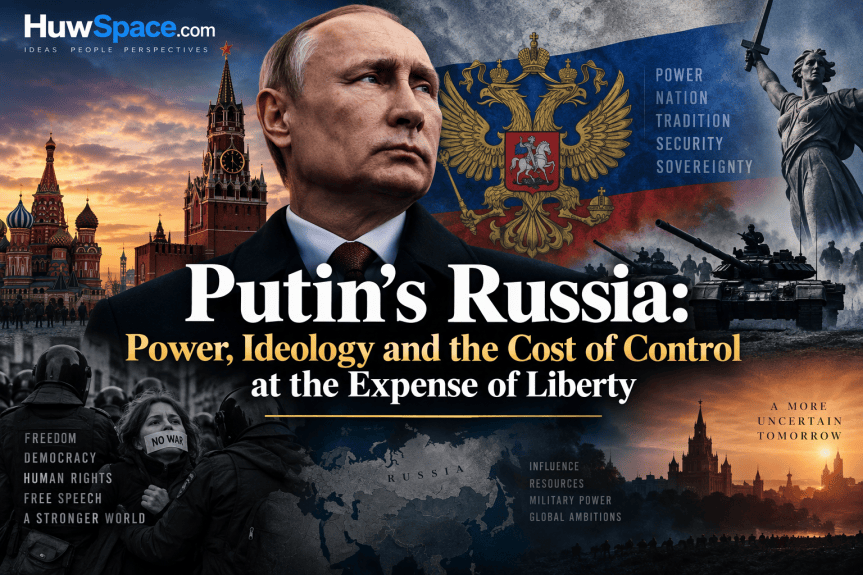
Understanding the Political Philosophy Behind Modern Russia
Every nation develops a political philosophy. Whether liberal democratic, socialist, conservative, religious or nationalist, states are shaped by ideas about power, authority, identity and freedom.
Modern Russia under Vladimir Putin has evolved into a distinctive political system often described as “Putinism”. It is neither a return to Soviet communism nor a revival of Tsarist monarchy. Instead, it is a hybrid ideology combining Russian nationalism, state authority, Orthodox Christianity, security-state thinking and a belief that Russia represents a unique civilisation with a special historical mission.
For supporters, this ideology has restored stability, national pride and international influence following the collapse of the Soviet Union.
For critics, it has achieved these goals at the expense of political freedom, democratic accountability and individual liberty.
The tension between strength and freedom lies at the heart of Putin’s Russia.
The Trauma That Shaped Putin’s Worldview
To understand Putin’s Russia, it is necessary to understand the impact of the Soviet Union’s collapse in 1991.
For many Western observers, the end of the USSR represented freedom and democratic progress. For many Russians, it brought economic hardship, political chaos, corruption and a dramatic loss of international influence.
The Russian economy contracted sharply during the 1990s. Living standards fell for millions. Organised crime flourished. State institutions weakened. Many Russians came to view the decade as one of national humiliation.
Putin emerged promising to reverse this decline.
His message was simple:
- Russia would be stable.
- Russia would be respected.
- Russia would be strong.
- Russia would never again be humiliated.
Much of his popularity has rested on delivering a degree of economic stability and restoring a sense of national confidence after the uncertainty of the post-Soviet years.
Russia as a Civilisation-State
A central theme within Putin’s ideology is the belief that Russia is not merely another nation-state but a distinct civilisation.
The Kremlin increasingly portrays Russia as possessing its own unique culture, values and historical destiny.
This idea draws upon several traditions:
- Russian Orthodox Christianity
- Tsarist imperial thought
- Patriotism and nationalism
- Soviet victory in the Second World War
- The concept of Moscow as the “Third Rome”
According to this worldview, Russia must defend its civilisation from external cultural and political pressures, particularly those originating from the modern liberal West.
Putin has repeatedly argued that Russia should follow its own path rather than simply imitate Western political models.
Russia’s Power Bases
Whatever one’s opinion of Putin, Russia remains one of the most powerful states in the world.
Military Strength
Russia possesses one of the world’s largest armed forces and the largest nuclear arsenal on Earth.
Its military capabilities provide significant geopolitical influence and ensure that Russia remains a major strategic power despite economic challenges and international sanctions.
Energy Power
Russia possesses vast reserves of oil, natural gas and other natural resources.
For decades these resources have enabled Moscow to project influence beyond its borders while generating substantial national revenue.
Geography
Russia’s immense territory stretches across Europe and Asia.
Its geographical scale has historically provided strategic depth against invasion and contributes to its continued geopolitical importance.
Permanent Seat at the United Nations
As one of the five permanent members of the United Nations Security Council, Russia continues to wield substantial diplomatic influence on the global stage.
National Identity and Historical Continuity
Few countries draw as heavily upon historical memory as Russia.
The defeat of Nazi Germany during the Great Patriotic War, centuries of statehood and a narrative of resilience against foreign threats form powerful foundations for national unity.
The Rise of the Security State
Perhaps the most significant characteristic of Putin’s Russia is the central role of the state itself.
Putin’s background in the KGB shaped his understanding of politics.
Within this worldview:
- Stability is prioritised over political competition.
- Security is prioritised over political experimentation.
- National unity is prioritised over ideological diversity.
Many senior figures surrounding Putin come from military, intelligence or security backgrounds, often referred to collectively as the siloviki.
Supporters argue this system has strengthened Russia and protected it from internal disorder.
Critics argue it has created an increasingly authoritarian political environment.
Strength Through Control
The Russian state has become highly effective at consolidating power.
Regional authorities are more closely aligned with Moscow than during the 1990s.
Political opposition faces significant obstacles.
National television networks largely support official government narratives.
The Kremlin has constructed a political system that prioritises loyalty, stability and control.
From the government’s perspective, these measures are necessary to protect Russia from instability, terrorism, extremism and foreign interference.
However, critics argue that the same mechanisms also suppress legitimate democratic competition.
The Cost to Democratic Principles
One of the central criticisms of modern Russia concerns the narrowing of political choice.
Although elections continue to take place, opposition politicians and independent political movements often face substantial barriers.
Critics point to the imprisonment, disqualification or exile of opposition figures as evidence that the Kremlin seeks to prevent genuine political competition.
The most prominent example was opposition leader Alexei Navalny, who became the face of anti-corruption activism and political opposition within Russia. His repeated arrests, exclusion from electoral participation and eventual death in a penal colony intensified international criticism of the Russian political system.
Supporters of the Kremlin have consistently argued that individuals prosecuted by Russian authorities have violated Russian law.
Critics contend that such prosecutions frequently serve political objectives.
The result is an ongoing debate about whether modern Russia remains genuinely democratic or whether elections increasingly function within tightly controlled limits.
Freedom of Speech Under Pressure
Freedom of speech represents another major dividing line between Russia and liberal democracies.
The Russian government argues that controlling misinformation and protecting national security requires regulation of media and online communication.
Critics argue that these powers have been used to restrict independent journalism and suppress dissenting voices.
Independent media outlets have faced closure, legal restrictions or designation as “foreign agents”.
Journalists, activists and opposition campaigners have frequently reported intimidation, prosecution or censorship.
Following the invasion of Ukraine, further restrictions were introduced regarding reporting on military operations.
For supporters, these measures protect national interests during a period of geopolitical conflict.
For critics, they undermine one of the most fundamental liberties within an open society: the right to question those who govern.
Purging Opponents or Defending the State?
Throughout history, governments have often justified restrictions on opponents as necessary for public safety or national survival.
Russia is no exception.
The Kremlin has frequently described opposition groups, independent organisations and foreign-funded institutions as potential threats to security and sovereignty.
Critics argue that the Russian state has engaged in the systematic marginalisation of perceived political enemies through:
- Legal prosecutions
- Electoral exclusions
- Restrictions on civil society organisations
- Media suppression
- Political intimidation
- Exile and imprisonment
Supporters reject the term “purge”, arguing instead that Russia is enforcing laws against corruption, extremism and foreign interference.
Yet the outcome remains clear: political space for meaningful opposition has become increasingly restricted.
Challenging the Liberal Democratic Model
Putin’s Russia presents itself as an alternative to the liberal democratic vision that dominated much of the post-Cold War world.
Where liberal democracies typically emphasise:
- Individual rights
- Freedom of expression
- Political pluralism
- Civil liberties
Putin’s Russia generally emphasises:
- State authority
- National unity
- Traditional values
- Sovereignty
- Security
The Kremlin argues that Western societies have become fragmented by excessive individualism and cultural division.
Critics argue that Russia’s model concentrates power in the hands of a political elite while limiting citizens’ ability to hold leaders accountable.
A Fundamental Question
Ultimately, the debate surrounding Putin’s Russia centres on one of the oldest questions in political philosophy:
Should the power of the state take precedence over the freedom of the individual?
The Russian system under Vladimir Putin has largely answered yes.
Its supporters see a nation restored from weakness, respected on the world stage and protected from instability.
Its critics see a state that has rebuilt power by steadily restricting democratic freedoms, political competition and freedom of speech.
Both interpretations contain elements of truth.
Russia today remains a formidable military, diplomatic and geopolitical power. Yet much of that strength has been built through centralisation of authority and the narrowing of democratic space.
Whether history ultimately judges Putin’s project as the restoration of Russian greatness or as a period of authoritarian consolidation remains uncertain.
What is beyond dispute is that Putin’s Russia represents one of the most significant ideological challenges to liberal democracy in the twenty-first century, forcing the world to confront a difficult question:
How much liberty should any society be willing to sacrifice in pursuit of order, stability and power?
Final Thoughts: The Lesson of Russian History
Russian history offers a recurring lesson about the dangers of political systems that become too disconnected from the people they govern.
The Romanov Empire collapsed in 1917 after Tsar Nicholas II proved unable or unwilling to respond effectively to growing demands for political reform, economic hardship and social change. The Soviet Union, despite its immense military and ideological power, ultimately fell because its rigid political system struggled to adapt to the aspirations and frustrations of its own citizens.
In both cases, strong and seemingly permanent states discovered that power alone could not guarantee legitimacy. Stability imposed from above eventually collided with pressure building from below.
Modern Russia is a very different country from either Tsarist Russia or the Soviet Union. Its institutions, economy and society have evolved considerably. Yet the fundamental challenge facing all governments remains remarkably similar: how to maintain authority while continuing to listen to the people they govern.
Putin’s Russia has undoubtedly restored elements of Russian power, influence and national confidence. However, critics argue that the concentration of authority, restrictions on political opposition and limitations on free expression risk creating the same problem that confronted previous Russian rulers: the gradual isolation of decision-makers from public sentiment.
History does not repeat itself precisely, and no one can predict Russia’s future with certainty. Nevertheless, Russian history suggests that when political systems become too rigid, too centralised or too insulated from criticism, pressures do not disappear. They accumulate.
The fate of the Tsars and the Soviet leadership serves as a reminder that the greatest threat to a powerful state is not always external. Sometimes it emerges from the widening gap between those who govern and those who are governed.
Whether Putin’s Russia can avoid that historic pattern may prove to be one of the defining political questions of the twenty-first century and if he sustains Russia what will be the cost to the world?
Sources and Further Reading
Democratic Rights, Civil Liberties and Media Freedom
- Freedom House: Russia Freedom in the World Report
https://freedomhouse.org/country/russia/freedom-world
- Reporters Without Borders (RSF) – Russia Profile
https://rsf.org/en/country/russia
- Human Rights Watch – Russia
https://www.hrw.org/europe/central-asia/russia
- Amnesty International – Russia
https://www.amnesty.org/en/location/europe-and-central-asia/eastern-europe-and-central-asia/russia
Political Analysis and Governance
- Carnegie Endowment for International Peace – Russia and Eurasia Program
https://carnegieendowment.org/programs/russia-eurasia
- Chatham House – Russia and Eurasia Programme
https://www.chathamhouse.org/regions/russia-and-eurasia
- Stanford Centre on Democracy, Development and the Rule of Law
https://cddrl.fsi.stanford.edu
Understanding Putinism
- UK in a Changing Europe – Understanding Putin
https://ukandeu.ac.uk/understanding-putin
- Encyclopaedia Britannica – Vladimir Putin
https://www.britannica.com/biography/Vladimir-Putin
- Steven Levitsky & Lucan Way – Competitive Authoritarianism
https://www.cambridge.org/core/books/competitive-authoritarianism
- Fiona Hill & Clifford Gaddy – Mr. Putin: Operative in the Kremlin
https://www.brookings.edu/books/mr-putin-operative-in-the-kremlin
International Relations and Geopolitics
- Council on Foreign Relations – Russia
https://www.cfr.org/europe-and-eurasia/russia
- Brookings Institution – Russia Research
https://www.brookings.edu/topic/russia
- United Nations Security Council
https://www.un.org/securitycouncil/


