
By Huw Edwards
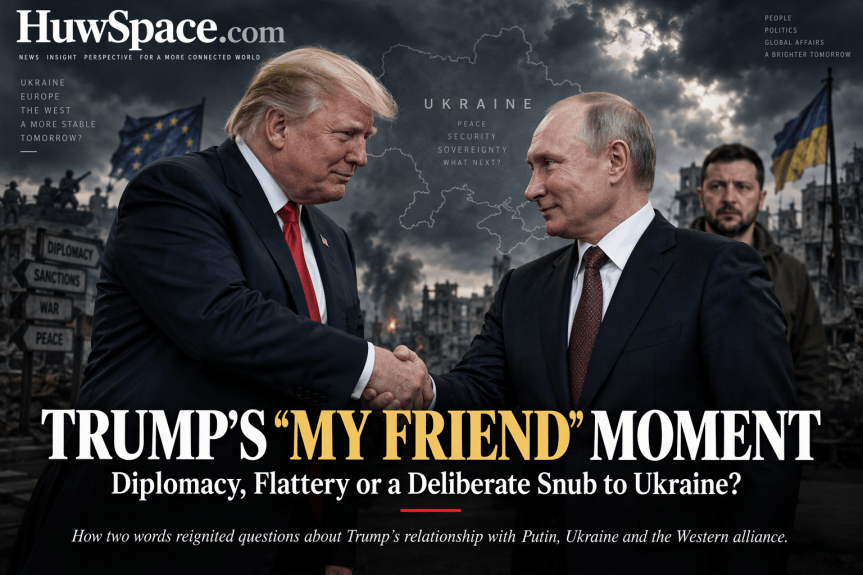
When Donald Trump greeted Vladimir Putin by calling him “my friend” at the APEC summit, the words travelled around the world far faster than any formal diplomatic statement.
On one level, it was classic Trump. The US President has long favoured personal relationships over traditional diplomatic language. He frequently presents international politics as a negotiation between individuals rather than institutions. Friendship, respect and personal chemistry are concepts he often places at the centre of his political style.
Yet in international affairs, words are rarely just words.
At a time when Ukraine continues to face Russian aggression, and when Western governments continue to provide military and financial support to Kyiv, describing Putin as “my friend” carries consequences. Even if intended merely as a gesture of diplomacy, the phrase inevitably sends a message to Ukraine, NATO allies and the wider democratic world.
The Art of Flattery
Trump has always understood the power of flattery.
Throughout his business and political career, he has often praised those whose cooperation he seeks. Supporters argue that this approach is strategic rather than ideological. They claim that leaders are more likely to negotiate when treated with respect rather than hostility.
Viewed through that lens, calling Putin “my friend” could be interpreted as a negotiation tactic.
A negotiator seeking concessions does not normally begin by insulting the person on the other side of the table. By projecting warmth and familiarity, Trump may believe he creates space for discussions that others cannot achieve. His supporters would argue that diplomacy sometimes requires uncomfortable language if it ultimately reduces conflict.
The question is whether such an approach works when dealing with leaders who may interpret friendliness as weakness rather than strength.
A Message Heard in Kyiv
Regardless of Trump’s intentions, Ukrainians are unlikely to hear the remark as a simple diplomatic courtesy.
For many people in Ukraine, Putin is not merely another world leader. He is the architect of a war that has claimed countless lives, displaced millions and devastated entire communities.
When the President of the United States publicly describes Putin as a friend, many Ukrainians will inevitably ask what that says about America’s commitment to their cause.
Political symbolism matters.
A handshake can become a headline. A smile can become a policy signal. A single phrase can create doubts that take months or years to repair.
Even if no policy changes follow, perceptions alone can have significant consequences.
The NATO Question
Ukraine is not the only audience listening.
European allies have spent years attempting to present a united front against Russian aggression. Countries across Europe have invested heavily in supporting Ukraine, strengthening defence spending and maintaining sanctions against Moscow.
Against that backdrop, Trump’s words may be interpreted by some allies as a warning that Washington’s priorities are shifting.
The concern is not simply about Putin.
It is about whether America’s traditional alliance structure remains its primary foreign policy priority.
If allies begin to believe that personal relationships between leaders matter more than long-standing commitments between nations, uncertainty begins to grow. In international politics, uncertainty is often almost as powerful as policy itself.
The Politics of Offence
There is another possibility.
Trump understands media attention better than almost any modern politician. He knows controversial remarks dominate headlines and reshape political conversations.
Calling Putin “my friend” guaranteed global coverage. It ensured the focus would move from official communiqués to Trump’s personal diplomacy style.
It is therefore fair to ask whether the comment was designed not just to flatter Putin but also to provoke critics, unsettle Ukraine’s supporters and once again place himself at the centre of the global conversation.
In modern politics, generating outrage can be politically valuable. Every criticism reinforces support among loyal followers who see establishment anger as proof that their candidate is challenging conventional thinking.
If that was the objective, the remark succeeded.
Within hours, discussions were no longer centred on meeting agendas and diplomatic outcomes. The world was debating Trump’s relationship with Putin.
A Pattern, Not an Isolated Remark
Trump’s description of Vladimir Putin as “my friend” did not emerge in a political vacuum. Critics argue that it forms part of a broader pattern in which he has repeatedly used unusually warm language towards strongman leaders while often reserving his sharpest criticism for democratic allies, international organisations and political opponents.
Supporters see this as pragmatic diplomacy. Trump would likely argue that maintaining personal relationships with rival leaders is essential if conflicts are to be resolved and deals are to be struck.
Critics see something very different.
They point to a recurring tendency to speak favourably about leaders whose records on democracy, civil liberties and political opposition have drawn concern across the Western world. To them, the latest remark is not simply a diplomatic courtesy. It is another example of Trump creating uncertainty about where America’s sympathies lie during one of the most significant European conflicts since the Second World War.
The controversy is amplified because the comments come against the backdrop of Russia’s continuing war against Ukraine. When cities have been bombarded, families displaced and lives shattered, language that appears friendly towards the Kremlin inevitably attracts scrutiny. Trump may view the phrase as relationship-building. Many Ukrainians are likely to view it as a dismissal of their suffering.
Previous Examples That Fuel the Debate
The reaction to Trump’s latest comments is shaped by several previous controversies.
Perhaps the most significant occurred at the Helsinki summit in July 2018. Standing alongside Putin, Trump appeared to give greater weight to Putin’s denial of Russian election interference than to the conclusions of US intelligence agencies. The performance prompted criticism from Republicans and Democrats alike and remains one of the most controversial moments of his first presidency.
Trump has also repeatedly questioned NATO’s effectiveness and criticised member states for failing to meet defence spending commitments. His supporters argue this pressure encouraged higher defence expenditure. Critics argue the rhetoric risked weakening confidence in the alliance at a time when unity was increasingly important.
His relationship with Ukraine has generated further scrutiny. In 2019, Trump became only the third US President to be impeached after allegations related to his dealings with Ukrainian President Volodymyr Zelensky. Although acquitted by the Senate, the episode remains central to debates about Trump’s approach to Ukraine and Eastern Europe.
More recently, Trump’s repeated assertions that he could quickly bring the Ukraine war to an end have attracted scepticism from foreign-policy experts who argue that the conflict’s complexity makes simple solutions unlikely.
Seen individually, each event can be defended or criticised. Taken together, they provide the context through which many observers interpret the phrase “my friend”. What supporters see as a pragmatic willingness to speak to adversaries, critics see as part of a long-running pattern that appears unusually accommodating towards the Kremlin while often creating uncertainty among democratic allies.
Strength or Risk?
Supporters will argue that peace is built through engagement. History contains numerous examples of leaders maintaining cordial relationships with rivals while pursuing national interests.
Critics will counter that there is a difference between communication and admiration.
The risk is that language intended to open doors can instead undermine confidence among allies and embolden adversaries.
The challenge for Trump is that every attempt at personal diplomacy comes with strategic consequences. Praising Putin may improve the atmosphere in a meeting room, but it may simultaneously weaken confidence elsewhere.
Conclusion
Perhaps the most important question is not whether Trump genuinely considers Putin a friend.
The more significant question is why he chose to say it publicly.
Political language is designed for audiences. Putin heard the remark. So did Zelensky. So did every NATO leader, every Ukrainian soldier and every citizen wondering where American foreign policy is heading next.
Whether the phrase was diplomacy, flattery, political theatre or a calculated provocation, one thing is certain: it was not accidental.
For Trump’s admirers, it demonstrated confidence and unconventional diplomacy. For his critics, it was another example of a pattern that increasingly blurs the distinction between strategic engagement and moral ambiguity.
Either way, two simple words succeeded in generating headlines around the globe.
“My friend.”
References
- Reuters reporting from the 2026 APEC summit, published by The Star: Trump described Vladimir Putin as “my friend” and spoke of their long-standing relationship.
- Sky News live coverage of the APEC summit confirming Trump’s description of Putin as “my friend” before bilateral talks.
- U.S. Senate Select Committee on Intelligence, Report on Russian Active Measures Campaigns and Interference in the 2016 U.S. Election (Volume 5). Available at: Senate Intelligence Committee Report
- NATO, Defence Expenditure of NATO Countries. Available at: NATO Defence Expenditure Reports
- U.S. Congress, impeachment proceedings relating to Ukraine and President Trump (2019-20). Available at: Congress.gov
- Reuters and major international reporting on Trump’s claims regarding ending the war in Ukraine.


